

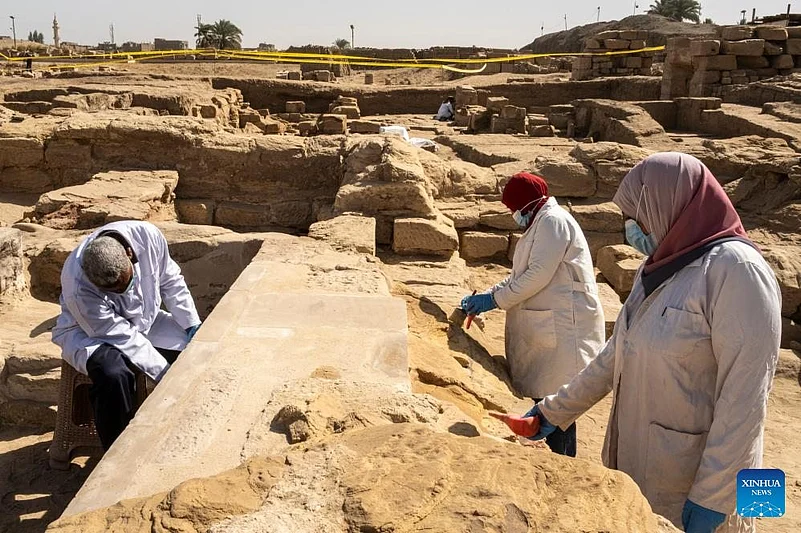
A joint Egyptian–Chinese archaeological team has brought to light a limestone construction thought to belong to the temple of King Apries, who ruled during Egypt’s 26th Dynasty (664–525 BC). The remains were identified at Tel Aziz, to the east of Mit Rahina in Giza, according to a statement issued on Thursday by the Ministry of Tourism and Antiquities.
The excavation is being carried out by a collaboration between Egypt’s Supreme Council of Antiquities, Peking University and the Shandong Institute of Cultural Relics and Archaeology. Work at the site has been ongoing for several seasons, with earlier campaigns revealing additional sections of the temple complex.
What Has Been Found
The principal discoveries include substantial limestone remains attributed to the temple of King Apries — also known as Wahibre — who reigned during Egypt’s 26th Dynasty (664–525 BC).
Excavations also brought to light five headless sphinx statues, along with a series of stone blocks inscribed with hieroglyphic texts dedicated to the god Ptah and bearing the royal cartouches of the king.

Among the smaller finds were pottery sherds, glass vessels and copper coins. Together, these objects shed light on patterns of economic activity and aspects of daily life in Egypt from the Late Period through the Greco-Roman era.
About The Site
Giza is the seat of Al-Jīzah Governorate in Upper Egypt. It stands on the Nile’s western bank, slightly south-west of Cairo, and is physically joined to the capital’s urban spread. Even so, the city has developed a profile of its own, shaped above all by the historic monuments and cultural sites found there.
The Aziz site lies to the east of Mit Rahina in Giza and marks part of what was once ancient Memphis, the earliest capital of Egypt. The area has long been regarded as archaeologically significant, occupying ground central to the former city’s civic and religious life.
Other Discoveries In The Area
Over the past decade, excavations at Tel Aziz and the wider Mit Rahina area have revealed several significant discoveries. In the northern sector, archaeologists uncovered the palace of King Apries and an adjacent military encampment, confirming the site as a key administrative and ceremonial centre of ancient Memphis.
A substantial building complex found in 2018 included a Roman-style bath and a chamber likely used for religious rituals. Five headless sphinxes and limestone blocks inscribed with dedications to Ptah further highlight the site’s religious importance. Smaller finds, including pottery, glass vessels and copper coins, provide a glimpse into daily life from the Late Period through the Greco-Roman era.
Exploring Giza's Wonders
The Giza Plateau: The plateau is home to the three majestic pyramids of Khufu, Khafre, and Menkaure, each built as a tomb for a pharaoh. The sheer scale and precision of these structures are astonishing. In addition, there are six smaller queens’ pyramids, which were built for the pharaohs’ consorts and family members. Walking among these ancient monuments gives a sense of the incredible engineering and religious significance of the Old Kingdom.

The Great Sphinx: This colossal limestone statue, with the body of a lion and the head of a pharaoh (believed to be Khafre), stands as one of the most recognisable symbols of ancient Egypt. Its enigmatic expression and monumental size—over 20 metres high and 73 metres long—make it a must-see. While viewing, consider the Sphinx’s role in Egyptian mythology and its connection to solar worship.
If you don’t mind paying a little extra, you can go inside the Great Pyramid and see the King’s Chamber where Pharaoh Khufu was buried. The passageways are narrow and the ceilings low, which is very different from the huge outside of the pyramid. Being inside gives you an idea of how people built and used these tombs.
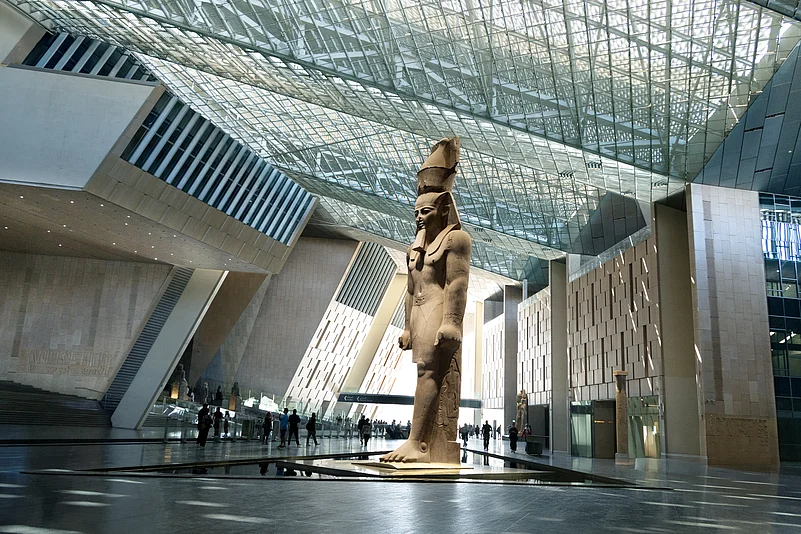
Grand Egyptian Museum (GEM): Just outside Giza, the Grand Egyptian Museum has the largest collection of Egyptian artefacts in the world, including items from Tutankhamun’s tomb. The museum has displays you can interact with, reconstructed temples, and exhibits that show what life was like in ancient Egypt.
Sound and Light Show: In the evening, the pyramids and Sphinx are illuminated in a dramatic light show that tells the story of their construction, the pharaohs, and ancient Egyptian civilisation. Narration in multiple languages provides historical context, making the experience both entertaining and educational.
Valley Temple: The Valley Temple is part of the pyramid complex and was used to prepare pharaohs’ bodies for burial and mummification. Its limestone walls and statues are still in good condition and give an idea of the rituals and beliefs around death in ancient Egypt.
FAQs
What was discovered?
Archaeologists uncovered a limestone structure believed to be part of the temple of King Apries, who ruled during Egypt’s 26th Dynasty (664–525 BC).
Where was the site found?
The remains were located at Tel Aziz, to the east of Mit Rahina in Giza.
Who is carrying out the excavation?
The dig is a joint effort between Egypt’s Supreme Council of Antiquities, Peking University, and the Shandong Institute of Cultural Relics and Archaeology in China.
How long has the excavation been going on?
Excavation work has been ongoing for several seasons, with previous campaigns uncovering additional parts of the temple complex.
Why is this discovery important?
It sheds light on the religious and architectural practices of the 26th Dynasty, helping historians understand more about King Apries and the temples built during his reign.
What does the temple tell us about ancient Egypt?
The temple’s remains give clues about religious rituals, construction methods, and the layout of royal temple complexes in that period.