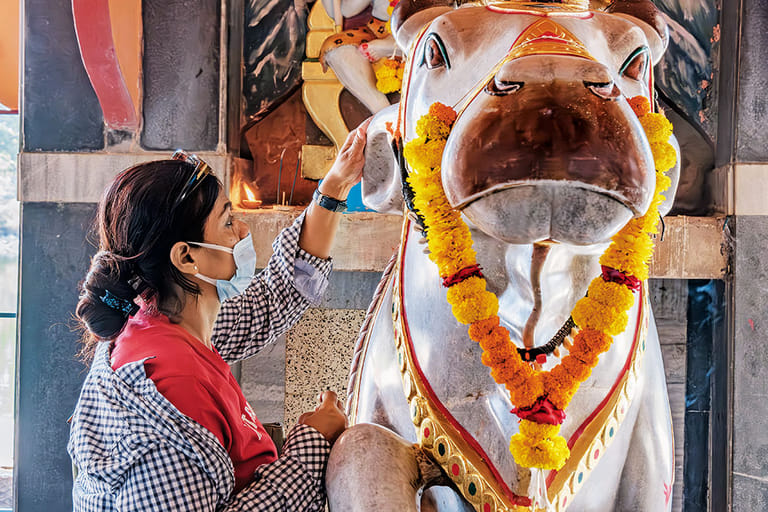
In 2010, I travelled to Bishnupur in West Bengal with my family to visit a particular temple I did not care to remember. I was annoyed about missing celebrating my 15th birthday more than being curious about admiring the terracotta marvel that I now look in awe at. At that age you are more focussed inwards to give much thought to experiences. And today, experiences are all we seek.
For a country like India, where travelling in large numbers for leisure is a fairly recent development, sightseeing made perfect sense in the beginning. There were places to see, and we wanted to see them. You would arrive in a new city, leave your bags at the hotel and set out with a list. You take the obligatory photograph, maybe buy something at the souvenir shop, eat at the restaurant everyone recommended and move on to the next stop. By evening, there would be that satisfying feeling of having done a place.
And that way of travelling still exists. But alongside it, another kind of traveller is emerging, one who may begin with a question rather than a destination. Where can I see a snow leopard? Which city does a particular type of textile come from? And the answers to these are now becoming the baseline for planning trips. A desire to see a snow leopard might lead to Spiti; an interest in Maheshwari silk to the riverside town of Maheshwar in Madhya Pradesh. The destination, in other words, is becoming a consequence of the experience rather than the other way around, and that is shifting Indian travel. Wildlife, safaris and trekking were among the earliest forms of experiential travel. Today, that appetite has expanded to food, craft, music, art, wellness and the everyday life of a place.
The Experience Comes First
Divyakshi Gupta, experiential trip curator and creator of Quirky Wanderer, sees this change through the travellers who join her trips. Her itineraries are built around encounters that might once have been considered side activities. Making momo with a local family in Arunachal Pradesh or picking apples and making jam in Himachal Pradesh can become the memories that outlast the headline attractions.
“Travellers want to say ‘I experienced this destination’ rather than saying ‘I visited this destination’,” Gupta said. It is a small change in language that points to a larger one in behaviour. The experience can determine the destination, broadening what people travel for, and what they’re willing to pay for. Gupta said her groups spend extra on local dham cuisine in Himachal Pradesh, tractor rides and bhangra workshops in Punjab, and meditation with monks. The appeal is not necessarily luxury in the traditional sense. It is the chance to enter a place rather than simply pass through it.


Staying for the feeling
That distinction becomes even clearer when the journey slows down. At Slowness Himalayas, a farmstay in a nondescript village called Basgaon in Uttarakhand, owner and host Ashish Godara has built the property around giving guests time rather than filling it. “Most of our guests don’t want to leave the village,” Godara said.
The experiences offered at Slowness grow naturally from the life of the farm and its surroundings. Natural-dyeing workshops are popular, with guests taking home what they have made.
There is no rigid programme. Much of the staff comes from the village and is given the freedom to shape the guest experience. The property is not listed on booking platforms and has only four rooms. Its intimacy is not an add-on; it is the point.

A wider Appetite
The numbers suggest this is more than a niche interest. Booking.com’s Travel Trends 2026 research found that 88 per cent of Indian travellers want to travel to experience food, while 86 per cent want to experience a new way of daily living. Another 88 per cent want to try new activities and 60 per cent want to immerse themselves in a different culture.
Santosh Kumar, Regional Head, South Asia, Booking.com, described the movement as the “Era of YOU,” with travellers choosing holidays around individual passions rather than standard itineraries.
“Travel has always been experiential, but in 2026 it moves beyond one-size-fits-all itineraries as travellers reject convention to lean into passions that feel truly their own,” he said.
The Social Media Paradox
Social media has played a major role in widening this passion. A quiet village can become crowded after one viral video, while an intimate experience becomes another item on a checklist. Even the search for authenticity can become consumption when every “hidden” place is photographed, geotagged and replicated.
Gupta tries to keep some experiences outside that cycle. Her most memorable moments, she said, are often those that cannot be easily “content-ified”: singing with Arunachali locals, eating home-cooked food in a Punjabi village, listening to stories that will never appear on Google, or sitting quietly in the forest. Sometimes, she asks travellers not to geotag certain places. There is wisdom in that restraint. An experience’s value can lie in its intimacy, which is hard to preserve once overexposed.
Sightseeing is not disappearing. India’s forts, temples, museums, landscapes and monuments remain powerful draws. But they no longer have to carry the whole journey. Travel has always given us memories we didn’t set out to make. Now, Indian travellers are beginning to seek out the memories they want to create.
Looking for more such exciting and meaningful stories? Grab our latest issue on Amazon.