


In recent years, Egypt has quietly unveiled a pilgrimage unlike any other, one rooted not in pharaohs or pyramids, but in an intimate story. Launched by the Ministry of Tourism & Antiquities, the Holy Family Trail traces a network of around 25 sites believed by Coptic Christian tradition to have sheltered Jesus, Mary and Joseph during their flight from Bethlehem. For travellers accustomed to seeing Egypt through the lens of antiquity, this route offers a different kind of encounter: part spiritual journey, part historical excavation, part window into the country’s living religious landscape.
The story begins, as recounted in the Gospel of Matthew, with an angel visiting Joseph in a dream, warning him that King Herod had ordered the killing of male infants in Bethlehem. Under cover of darkness, the young family fled south, crossing Sinai into Egypt. According to Coptic belief, they remained in the country for three and a half years, travelling more than 3,000 kilometres. Along the way, stories accumulated, of wells springing from dry ground, temples trembling, idols collapsing and caves transformed into places of blessing. For centuries, these locations were known mainly to monks and local worshippers. Today, they are restored, signposted and linked together, not only as a tourism initiative but as an act of heritage preservation.
Miracles Along The Nile


Travelling the trail feels like watching a sacred narrative unfold amid the rhythms of modern Egyptian life. In the Nile Delta town of Bubastis, ancient texts claim that pagan temples shook at the arrival of the infant Jesus. A fenced-off well marks the spot where a spring is said to have appeared to offer the family water as they fled hostile locals. Nearby, in Mostorod, once a village beyond Cairo’s fringes, a 12th-century church encloses al-Mahamah, believed to be the place where Mary washed the child. Pilgrims still press handwritten prayers into the stone recesses, tangible proof that these stories remain emotionally charged rather than merely historical.
From the Delta, the trail bends towards Wadi El Natrun, a stark desert valley where tradition holds that Jesus called forth another spring. From the fourth century onwards, thousands of early Christian ascetics settled here, drawn by the promise of solitude and spiritual clarity. Four monasteries are still active today, their walls recently cleaned, frescoes restored and courtyards carefully tended. At Al-Sourian Monastery, medieval depictions of Christ’s life glow softly in reds and ochres, and it is not difficult to imagine the monks who once crossed the desert carrying little more than scripture and resolve.
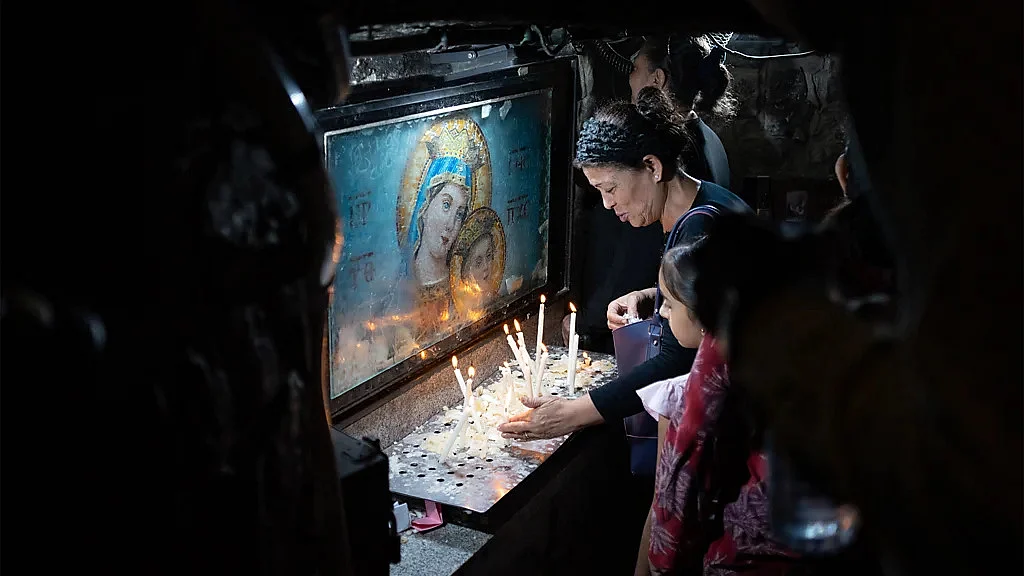
Cairo sits at the heart of this sacred geography. In Matariya, Mary’s Tree, a weathered sycamore, is said to have shaded the Holy Family as they rested. Nearby, a well believed to have quenched their thirst has been restored, while the tree itself is now protected behind railings to prevent pilgrims from breaking off leaves as talismans. In nearby Coptic Cairo, the fourth-century Church of Abu Serga marks one of the family’s longest stays. Its crypt, reached by steep, narrow steps, contains a small cave where they are believed to have lived for three months. The space is spare and atmospheric, equal parts archaeological site and prayer room, filled with murmured hymns, candle smoke and the quiet click of cameras.
The final Cairo stop lies in Maadi, a leafy suburb where tradition holds that the family boarded a papyrus boat bound for Upper Egypt. The stone steps linking the Church of the Virgin Mary to the Nile are now closed, but inside the church rests a water-damaged Bible retrieved from the river in 1976, its pages reportedly open to a verse blessing Egypt. Even the most sceptical visitors tend to pause here, struck by the symbolism if not the miracle.
History Meets Devotion

Further south, the trail enters Upper Egypt, a region long marginalised but now slowly receiving attention. The Church of the Blessed Virgin atop Jabal al-Tayr was once so remote that only the most determined pilgrims reached it. Today, a winding road climbs past ancient quarries and Coptic graves to a complex overlooking the Nile. Beneath the church lies a cave where the family is believed to have rested. The air still carries renovation dust, but the energy is palpable, centuries of devotion concentrated in a single, shadowed space.
The journey continues through ancient Hermopolis, near modern Al-Ashmonein, described in early monastic writings as another place where idols fell in Jesus’ presence. It then reaches Mount Qusqam and Al-Muharraq Monastery, regarded by Copts as a “Second Bethlehem.” Here, tradition holds that the family stayed for six months until an angel appeared to Joseph, announcing Herod’s death and their safe return home. The monastery’s oldest church marks the spot with restrained simplicity; a monk may quietly indicate where a miraculous well once flowed before being sealed to curb its renown.
The final and most widely accepted stop is the Monastery of Saint Mary at Drunka in Asyut. Built into the mountainside and humming with construction, it contains caves where the family is believed to have slept. Pilgrims speak of visions and answered prayers. Whether one takes these accounts literally or metaphorically, the emotional intensity of the place is undeniable.
A Journey That Continues
Still very much a work in progress, the Holy Family Trail is already reshaping how Egyptians view their own past. It highlights a chapter of history that predates Islam, underscoring Egypt’s long role as a crossroads of belief. International visitors remain relatively few, deterred by distance and the trail’s complexity, but those who make the effort encounter a rare fusion of archaeology and devotion.
Ultimately, the trail is less about verifying events than about engaging with a story carried in collective memory for centuries. Sacred narratives live not only in scripture, but in landscapes, ruins, wells and caves, and in the gestures of monks, nuns and pilgrims who continue to tend them. For travellers willing to listen, that quiet continuity may be the most powerful revelation of all.
FAQs
1. What is the Holy Family Trail?
The Holy Family Trail is a route through Egypt connecting around 25 sites believed to have been visited by Jesus, Mary and Joseph during their flight into Egypt.
2. Where does the trail start and end?
It begins in the Nile Delta region and passes through Cairo before continuing south into Upper Egypt, ending near the Monastery of Saint Mary at Drunka in Asyut.
3. Why is the trail significant?
The route highlights Egypt’s Christian heritage, featuring caves, wells, churches and monasteries tied to centuries-old Coptic tradition and biblical lore.
4. Can travellers visit the sites today?
Yes. Many sites have been restored with improved access, signage and basic tourism infrastructure, though some areas remain remote.
5. Who is the trail suitable for?
It appeals to pilgrims, history lovers, cultural travellers and anyone interested in early Christianity, Coptic culture or Egypt beyond the pharaohs.


