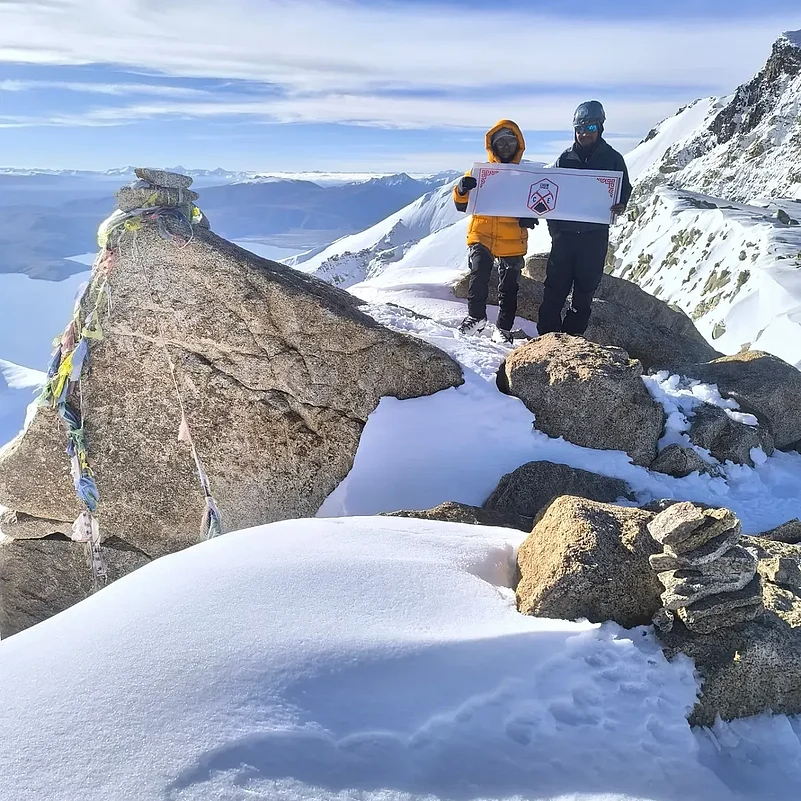
On July 27, at 6 AM, January Tali and Hachu Lombo became the first women from Arunachal Pradesh to summit Mount Kun. At a height of 7,077 m, this is one India’s most technically challenging peaks, marking a milestone not only for the state but also for Indian mountaineering. Their ascent followed an 11-day expedition in Ladakh's Zanskar amidst steep snow slopes, crevassed glaciers and unpredictable weather. Of the nine-member expedition team, excluding Sherpas, only four reached the summit.
Why Mount Kun Commands Respect
Part of the Nun-Kun massif overlooking the Suru Valley in western Ladakh, Mt Kun is the second-highest peak in the massif after Mt Nun (7,135 m). While it is not as famous as Mount Everest, it is widely regarded within the climbing community as one of India's finest technical expeditions.
The climb demands far more than stamina. Climbers must negotiate glaciers riddled with crevasses, steep snow, and ice slopes, and rapidly changing weather, all while functioning above 7,000 metres. Success depends on technical skill, sound judgement, and careful acclimatisation as much as physical endurance.
That makes Tali and Lombo's achievement particularly significant. January Tali, who has previously climbed UT Kangri and the Mentok Kangri peaks, added another major summit to her growing mountaineering résumé, while Hachu Lombo's success places her among the small group of Indian women to have conquered the formidable mountain.

A Peak With A Long Legacy
Long before climbers attempted Mt Kun, the Nun-Kun massif drew the attention of explorers. Among the most influential were American mountaineers Fanny Bullock Workman and William Hunter Workman, whose early twentieth-century expeditions documented the region through surveys, photographs and detailed accounts.
Although Fanny Bullock Workman never climbed Mt Kun, she remains an important figure in its story. At a time when women rarely took part in high-altitude exploration, she established herself as one of the world's pioneering female mountaineers, helping bring the remote Nun-Kun massif into the global imagination.
Mt Kun itself was first climbed in 1913 by an Italian expedition led by Mario Piacenza and Lorenzo Borelli. More than a century later, the mountain continues to attract climbers seeking a challenging climb. In 2015, Telangana police officer G. R. Radhika became the first Indian woman to summit Kun, adding another landmark achievement to the mountain's history.
A New Chapter For Arunachal Pradesh
The ascent by January Tali and Hachu Lombo builds on that legacy while opening an entirely new chapter for Arunachal Pradesh. Their success reflects the growing presence of climbers from India's eastern Himalayas in a sport that has traditionally received limited attention outside a handful of mountaineering institutions.
It also broadens the public understanding of Himalayan climbing. While Everest dominates headlines, peaks like Kun represent a different kind of mountaineering, one defined by technical expertise, careful preparation and resilience rather than records or commercial expeditions. Reaching its summit is as much about decision-making as determination.
Both climbers are expected to receive summit certificates from the Indian Mountaineering Foundation, but their achievement carries a significance beyond official recognition. For young women in Arunachal Pradesh, January Tali and Hachu Lombo have shown that some of India's toughest mountains are no longer distant ambitions but attainable goals. In doing so, they have added their names to the long and evolving story of Mt Kun.
FAQs
1. Who are January Tali and Hachu Lombo?
January Tali and Hachu Lombo are mountaineers from Arunachal Pradesh who became the first women from the state to summit the 7,077-metre Mount Kun in Ladakh on July 27, 2026.
2. Where is Mount Kun located?
Mount Kun is located in the Nun-Kun massif overlooking the Suru Valley in the Zanskar region of western Ladakh. At 7,077 metres, it is the second-highest peak in the massif after Mount Nun.
3. Why is Mount Kun considered a difficult climb?
Mount Kun is regarded as one of India's most technically challenging mountains because climbers must navigate crevassed glaciers, steep snow and ice slopes, high altitude and rapidly changing weather conditions.
4. Who was the first Indian woman to climb Mount Kun?
G. R. Radhika, a police officer from Telangana, became the first Indian woman to summit Mount Kun in 2015.
5. Why is January Tali and Hachu Lombo's achievement significant?
Their ascent marks the first time women from Arunachal Pradesh have climbed Mount Kun, highlighting the growing presence of mountaineers from India's eastern Himalayas and inspiring more women to pursue high-altitude climbing.