

Sponsored Content
Spain has a way of rewarding those who look up. Beyond its celebrated cities and sun-drenched beaches lies a country shaped by dramatic cliffs, volcanic peaks, ancient villages and windswept coastlines that feel designed for contemplation. Here, nature often provides its own amphitheatres—high vantage points where the land opens up to the sea, the sky stretches endlessly overhead, and time seems to slow.
These natural balconies are more than scenic viewpoints. They are places where travellers come to watch sunsets dissolve into twilight, where the Milky Way reveals itself above silent landscapes, and where rare celestial events like eclipses feel almost theatrical. From volcanic summits in the Canary Islands to rugged cliffs in the Basque Country and river-carved gorges in Castile, Spain offers remarkable settings for outdoor moments that stay with you long after the journey ends.
Here are some of the most magical places across the country where the horizon feels infinite—and the sky becomes part of the experience.
Stargazing Above The Clouds
High in the volcanic landscapes of Tenerife, the Chipeque viewpoint offers one of the island’s most spellbinding perspectives. Perched along the forested slopes that lead toward Mount Teide, Spain’s highest peak, it looks out over a dramatic sea of clouds that often gathers below the mountains—an ever-shifting blanket that turns the horizon into something almost surreal.
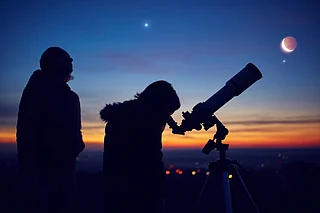
But it is after sunset that this landscape reveals its true allure. The Canary Islands are widely regarded as among the best places in the world for astronomical observation, thanks to their altitude, clean air, and exceptionally low light pollution. On neighbouring La Palma, home to one of the world’s most renowned observatories, the skies are so pristine that the island was the first in the world to be certified as a Starlight Reserve and later recognised as a Starlight Tourist Destination in 2012.
From Tenerife, viewpoints such as Chipeque become natural observatories in their own right. As darkness settles, constellations sharpen into focus and the Milky Way unfurls across the sky with remarkable clarity. On nights marked by meteor showers, the experience feels almost otherworldly—stargazing not just beneath the sky, but seemingly above the clouds themselves.
Where Two Continents Meet
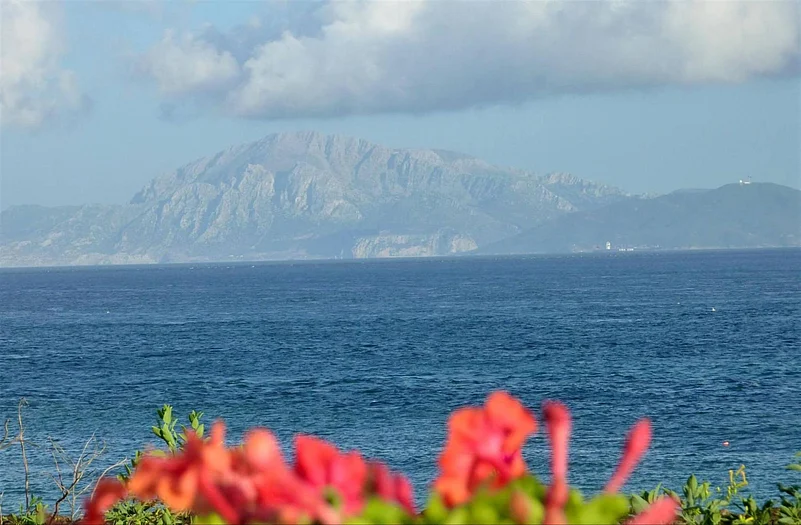

On Spain’s southern edge, the El Estrecho viewpoint looks out across the narrow strait that separates Europe from Africa. From this high vantage point near Tarifa, the meeting of the Mediterranean Sea and the Atlantic Ocean unfolds in a vast sweep of blue. On clear days, the mountains of Morocco rise faintly on the horizon, creating a view that feels both expansive and intimate.
The surrounding landscapes of Cádiz are defined by wind, sea and golden light. As evening approaches, the coastline glows in warm tones, and the wide-open sky becomes a perfect stage for sunset and twilight watching. The region’s proximity to mountain ranges such as the Sierra de Grazalema and Sierra Morena elevates its appeal for stargazers. Both are recognised Starlight Destinations, where protected landscapes, low light pollution, and high-altitude vantage points create ideal conditions for observing the night sky. On clear nights, constellations emerge with remarkable clarity, and during meteor showers, the darkness is so complete that the sky feels vast and almost immersive—less a view, more an experience.
A Lighthouse At The Edge Of The Mediterranean
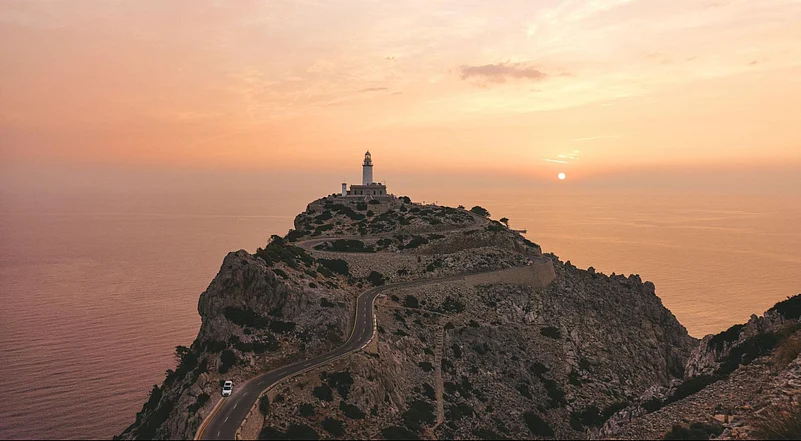
At the far northeastern tip of Majorca, the road to Cap de Formentor twists through cliffs and pine forests before arriving at one of the island’s most celebrated viewpoints. Here, the land narrows into a rugged peninsula that stretches into the Mediterranean, crowned by a solitary lighthouse that has guided ships for generations.
The Formentor viewpoint delivers a striking contrast of jagged rock, deep-blue sea and endless sky. Sunrise and sunset are especially dramatic, when shifting light paints the cliffs in gold and amber. On calm nights, far from the glow of the island’s towns, the sky reveals a quieter spectacle, constellations reflected faintly in the dark Mediterranean waters. For travellers drawn to the intersection of sea, sky and solitude, few places feel as cinematic.
Eagles Above A River Gorge
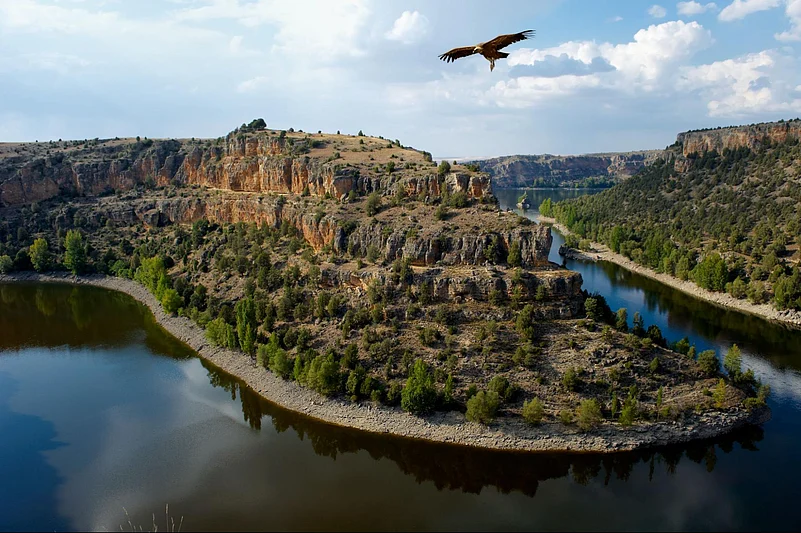
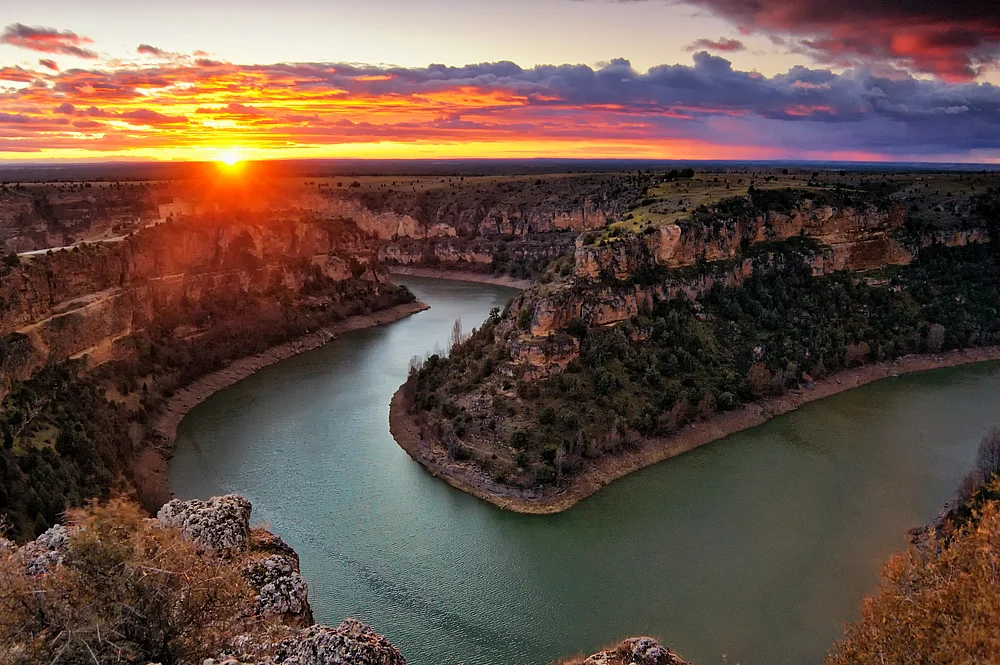
In the heart of Castile and León, just a short drive from Madrid, the Hoces del Río Duratón Natural Park offers a very different kind of natural balcony. Here, the Duratón River has carved a series of sweeping limestone gorges through the landscape, creating cliffs that rise dramatically above the water. Come autumn, the park takes on a quieter, more contemplative beauty, as the surrounding vegetation turns warm shades of gold and rust, making it an especially rewarding time to take in the views.
From the viewpoints along the gorge, visitors often watch griffon vultures gliding effortlessly on thermal currents. The scene feels timeless — a rugged landscape shaped by geology and silence. As daylight fades, the wide skies above the plateau deepen into deep indigo, and the park’s remote setting allows stars to emerge with remarkable clarity. For those seeking quiet places to observe the night sky away from urban lights, the Duratón gorge provides an unexpectedly serene stage.
A Stairway To The Sea
Along the Basque coast, Game of Thrones fans may recognise San Juan de Gaztelugatxe as Dragonstone, a setting as dramatic in real life as it was on screen. Rising from the sea like something from legend, a narrow stone bridge connects the mainland to the tiny rocky islet, crowned by a centuries-old hermitage. To reach it, visitors climb a winding staircase carved into the cliffside—a journey that is as memorable as the destination itself.
From the summit, the Bay of Biscay spreads out in every direction, its waves crashing dramatically against the rugged coastline below. The wind carries the scent of salt and sea spray, while seabirds wheel overhead. At dusk, when the last light fades beyond the horizon, the scene becomes quietly magical. On particularly clear nights, the stars appear above the vast Atlantic sky, completing a setting that feels both wild and contemplative.
Spain’s landscapes don’t fade with nightfall—they take on a different kind of presence. With wide stretches of protected land, low light pollution in rural regions, high-altitude terrain, and a climate that brings a high number of clear nights, the country is among Europe’s most rewarding places for stargazing. In many regions, the night sky is treated as part of the natural heritage, safeguarded through Starlight certifications that recognise destinations where darkness is carefully preserved. Step away from the glow of cities, and the change is striking: constellations sharpen, planets become visible to the naked eye, and the Milky Way arcs across the sky with quiet intensity.
Beyond the well-known spots, there are many lesser-known regions where the experience feels just as immersive. In Extremadura, the skies above Monfragüe National Park, the Sierra de Gata, and the Villuercas-Ibores-Jara Geopark remain remarkably unspoilt. Aragón, particularly Teruel, combines vast, open landscapes with dedicated astronomy facilities such as the Javalambre Observatory. In Andalusia, Sierra Morena is known for its network of stargazing viewpoints and guided experiences. Across Spain, these places offer a reminder that some of the most memorable views are not always in front of you—but overhead, waiting in the stillness of the night.
For more information, visit Spain Tourism's website