A 143-kilometre voyage by sea from Port Blair will be bringing travellers face to face with one of India’s most remote and unusual sights—Barren Island, the nation’s only active volcano. The route cuts straight across the Andaman Sea, with no landfall in between, until the island appears as a sudden rise of dark volcanic rock from an otherwise uninterrupted stretch of blue.
The Journey To Barren Island
Run by the Directorate of Shipping Services (DSS), India’s most exclusive ocean expedition heads deep into the Andaman Sea to Barren Island, home to South Asia’s only active volcano. This uninhabited marvel offers dramatic black-sand landscapes, smoking craters, and some of the world's most pristine scuba diving and marine life.
About 140 kilometres from Port Blair, the uninhabited island rises out of open water as a stark geological outcrop—black rock, hardened lava fields, and a coastline shaped entirely by eruption. The surrounding sea is clear and alive, but the island itself feels raw and unsoftened by time.
You depart Port Blair after dusk and sail east into darkness. For hours there is nothing in sight—no shoreline, no navigation points, just open sea and the steady movement of the vessel cutting through it. The crossing takes most of the night.
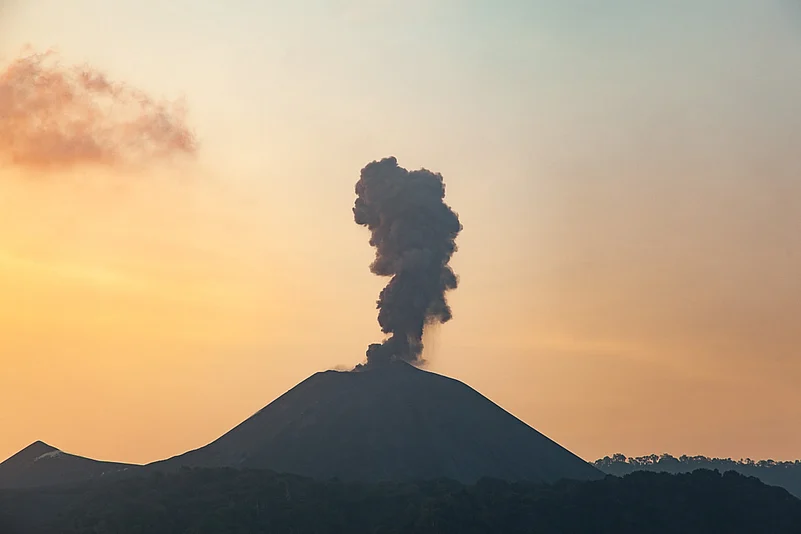
By first light, the island is suddenly there: a dark volcanic cone rising straight from the ocean. As you draw nearer, the details come into focus—fractured ridgelines, layered lava flows spilling down to the water’s edge, and, at times, a faint smoke line lifting from the crater. The vessel maintains a safe distance throughout, tracing a slow arc around the island before setting course back towards Port Blair.
The Expedition At A Glance


The island lies in the Andaman Sea, roughly 135–140 kilometres from Port Blair.
Barren Island’s volcano rises 354 metres above sea level, while its base plunges more than 2,250 metres into the ocean floor.
The first recorded eruption dates back to 1787, and the volcano has remained intermittently active since, with occasional ash emissions and lava activity reported in recent years.
Travel and Access
You cannot land on Barren Island at any point. The terrain is active, protected, and considered unsafe for footfall.
The only way to see it is by charter boat on a day trip from Port Blair or Swaraj Dweep (Havelock Island).
Indian nationals require permits from the Forest Department and local administration, while access for foreign visitors is limited.
The journey is long, with most expeditions taking 12 to 14 hours for a full round trip at sea.
What To Expect
The boats do a slow circuit around the island, giving clear views of the crater, black lava flows, and occasional smoke rising from the summit.
The waters around the island are known among experienced divers for their depth and clarity, with lava tunnels, steep underwater drops, and sightings of manta rays, turtles, and hammerhead sharks.
From the boat, you will also see how little life exists on land—mainly seabirds and a small number of feral goats that have adapted to the harsh volcanic conditions.
The cruise runs overnight, with cabins to sleep in and simple meals served on board as the ship makes its way out from Port Blair. Before departure, passengers are given a short briefing on Barren Island and its volcanic history. On the return or during calmer stretches of the voyage, a semi-submarine viewing section lets you look through glass panels at coral reefs and marine life passing beneath the hull.
Plan to stay some days in Port Blair. For a list of interesting things to do, check here.
FAQs
Is landing on Barren Island allowed?
No. The island is strictly off-limits for landing due to its active volcanic nature and protected status.
How far is Barren Island from Port Blair?
It lies roughly 135–140 kilometres away in the Andaman Sea.
How long does the cruise take?
Most trips take around 12 to 14 hours for a full round journey, depending on sea conditions.
Can you see the volcano up close?
You cannot go ashore, but boats circle at a safe distance, giving clear views of the crater and lava-covered slopes.
What else can you see during the trip?
The surrounding waters are known for coral reefs and marine life, and some vessels also offer glass-bottom or semi-submarine viewing sections.