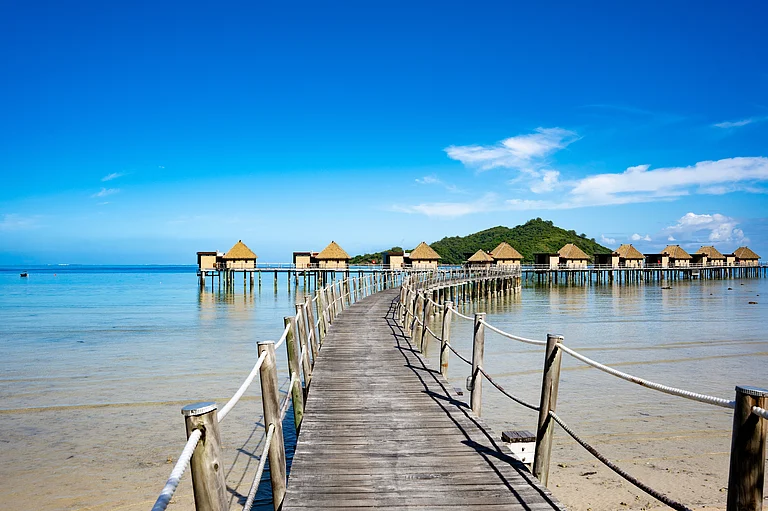


Centuries of voyagers, missionaries and colonial rule have shaped what the Cook Islands now represents. Here, that memory lives as much in its villages and traditions as in its blue lagoons. Spread across 15 islands in the South Pacific between New Zealand and Hawaii, this self-governing nation has emerged as one of the region's most rewarding destinations, offering travellers an experience shaped as much by living Polynesian culture as by postcard-perfect beaches.
For Indian travellers looking to make the journey via Australia or New Zealand, the Cook Islands offer a slower, more intimate alternative to the Pacific's better-known island destinations. Here, rainforest-clad volcanic peaks meet coral atolls, Saturday markets serve as community gathering spaces, and cultural traditions continue to shape everyday life rather than being performed solely for visitors.
Well before European explorers arrived, Polynesian navigators settled these islands, guided by the stars and ocean currents. British colonial rule and New Zealand administration followed, while Christian missionaries had a lasting influence on local society. Today, the Cook Islands are self-governing in free association with New Zealand, where Cook Islands Māori culture continues to flourish through language, music, dance and craftsmanship.
Get Your Passport Stamped on One Foot Island
A passport stamp may seem like an unusual travel highlight, but on One Foot Island, known locally as Tapuaetai, it has become something of a badge of honour. Situated within Aitutaki's spectacular lagoon, this tiny palm-fringed motu is home to one of the world's most remote post offices. Visitors arriving on lagoon cruises can have their passports stamped with the distinctive One Foot Island seal, a souvenir that has become almost as famous as the island itself. But the real attraction lies beyond the novelty. The lagoon's shifting shades of blue, coral gardens and sandbars make Aitutaki one of the Pacific's most beautiful lagoons.
Hike the Cross-Island Track to The Needle
Rarotonga's coastline may be lined with lagoons, but its mountainous interior tells the story of the island's volcanic origins. The Cross-Island Track cuts through dense rainforest before climbing towards Te Rua Manga, better known as The Needle, a dramatic volcanic rock pinnacle rising sharply above the forest canopy. The four-hour trek is one of the Cook Islands' most rewarding hikes, revealing giant ferns, native vegetation and panoramic viewpoints along the way. Good hiking shoes and an early morning start are recommended, particularly in the humid tropical climate.


Snorkel and Kayak Through Muri Lagoon
If there is one image that defines Rarotonga, it is Muri Lagoon. Protected by an outer reef, its clear waters make it ideal for kayaking, paddleboarding and snorkelling. Four small offshore islets, or motu, dot the lagoon, and paddling between them is one of the island's simplest pleasures. Beneath the surface, coral bommies shelter colourful reef fish, while the shallow water allows even novice snorkellers to explore comfortably. Unlike many commercialised beach destinations, Muri still feels intimately connected to island life. Locals fish here, families gather on the shore, and traditional outrigger canoes remain part of the landscape.
Shop Like a Local at Punanga Nui Market
Every Saturday morning, Avarua comes alive with the sounds of ukuleles, drumming and conversation as Punanga Nui Market opens its stalls. More than a shopping destination, it serves as a weekly gathering place where farmers, artisans and home cooks come together to share the best of island life. Visitors can browse handwoven rito hats, black pearl jewellery, carved wooden crafts and colourful pareu fabrics while sampling local favourites such as ika mata, raw fish marinated in coconut cream, and tropical fruit smoothies. Cultural performances often accompany the market, making it one of the easiest places to experience Cook Islands music and dance without attending a formal show.

Discover Pre-Christian Aitutaki at Punarei Cultural Village
To understand the Cook Islands beyond beaches and lagoons, head to Punarei Cultural Village on Aitutaki. The experience focuses on life before Christianity transformed the islands in the nineteenth century, introducing visitors to ancient Māori beliefs, social customs and everyday practices. Guided tours explain oral traditions, legends and the role of chiefs while demonstrating Indigenous cooking techniques, such as preparing food in a traditional umu earth oven. Visitors can also learn about local carving, weaving and village life before European contact. Rather than presenting culture as an art installation, Punarei emphasises stories shared by local guides whose families continue many of these traditions.
Attend a Sunday Service at the Cook Islands Christian Church
Even travellers with no religious affiliation often describe attending a Sunday service at a Cook Islands Christian Church (CICC) as one of their most memorable cultural experiences. Christianity has shaped island society since missionaries arrived in 1821, yet worship here is distinctively Polynesian. Visitors are warmly welcomed, provided they dress modestly and observe local etiquette. After the service, many churches invite guests to share fruit and refreshments with parishioners, creating opportunities for authentic conversation. It is less about witnessing a religious ceremony than experiencing the close-knit community life that continues to define the islands.
Swim at Wigmore's Waterfall
Hidden inland amid tropical forest, Wigmore's Waterfall offers a refreshing contrast to Rarotonga's beaches. Fed by freshwater flowing through the island's volcanic interior, the waterfall cascades into a natural swimming hole surrounded by lush vegetation. Once part of a private estate, the site has become a favourite stop for locals looking to cool off after exploring the island's interior. Visiting after rainfall often brings stronger flows, although conditions can vary seasonally. Combined with a drive or cycle through Rarotonga's interior roads, a visit to Wigmore's Waterfall highlights another side of the Cook Islands, where rainforest, freshwater and volcanic terrain complement the better-known lagoons along the coast.
FAQs
1. What is the best time to visit the Cook Islands?
The best time to visit the Cook Islands is during the dry season, from May to October, when temperatures are pleasant, humidity is lower and conditions are ideal for hiking, snorkelling and lagoon cruises.
2. Which islands should first-time visitors explore in the Cook Islands?
First-time visitors usually combine Rarotonga, the main island known for its beaches, markets and hiking trails, with Aitutaki, famous for its turquoise lagoon, One Foot Island and water-based activities.
3. Do Indian travellers need a visa to visit the Cook Islands?
Indian travellers should check the latest entry requirements before planning their trip. Most visitors reach the Cook Islands via New Zealand or Australia, and transit visa requirements may depend on the route and nationality.
4. What are the top things to do in the Cook Islands?
Some of the best experiences include getting a passport stamp at One Foot Island, hiking the Cross-Island Track to The Needle, snorkelling in Muri Lagoon, visiting Punanga Nui Market, exploring Punarei Cultural Village and attending a Sunday church service.
5. How many days are enough for a Cook Islands trip?
A 7–10 day itinerary allows enough time to explore Rarotonga, spend a few days in Aitutaki, enjoy outdoor activities, experience local culture and relax on the islands' beaches and lagoons.