Light held me for a moment, then released me. One step and the sun thinned, filtered by leaves, broken into shards that flickered across the forest floor. I moved on, measured, balancing across fallen logs to cross shallow streams and dark, yielding patches of marsh.
Waking Up To The Lesser Himalayas At JW Marriott Mussoorie Walnut Grove Resort And Spa
A forest-led escape in Mussoorie where gentle treks, Garhwali flavours, mindful luxury, and sweeping Lesser Himalayan views turn a stay at JW Marriott Walnut Grove into something deeply grounding and wholly unforgettable

Advertisement
This was the Mussoorie Wildlife Sanctuary, and the journey here asked for no conquest of peaks. It blossomed instead as a passage through the woods, a trail that invited patience rather than endurance. Water revealed itself in scattered streams, each one feeding narrow tributaries that stitched the land together. Banj oak, chir pine, deodar, rhododendron and Himalayan maple completed the gathering, an assembly of the mountains’ old residents. I had known another trek once, in Menchhukha, Arunachal Pradesh, where thorns tore at the legs, and the climb demanded resolve. That summit rewarded effort with a wide, arresting view. This forest asked for something else entirely. It offered ease, stillness, and a rhythm that soothed rather than tested.

Inside Mussoorie Wildlife Sanctuary Anwesha Santra
My base for this gentler adventure was the JW Marriott Mussoorie Walnut Grove Resort and Spa. The hotel arranges several such treks for those who are interested. On our second morning at the stay, a short drive carried us away from polished corridors and into waiting wilderness. Balveer, our guide, stepped ahead with the assurance of someone who knew these paths by heart.
Advertisement
Inside The Mussoorie Wildlife Sanctuary
The fire nearby kept us company while my companion and I engaged in a board game inside a tent. Balveer had set it up earlier and now crouched in front, feeding the flames with dry branches. Each stick caught with a soft crack, lighting up his face for a second before settling down. I rolled the dice, half paying attention to the game, half watching the fire do its thing. We ate sandwiches and chocolate doughnuts, the kind that feel indulgent even outdoors. Behind us, a waterfall went on endlessly, water crashing over rock without caring who was listening.
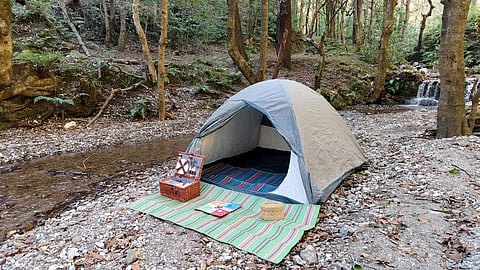
The tent set up inside Mussoorie Wildlife Sanctuary Anwesha Santra
Curiosity won. We stepped out of the tent and walked towards it. The water was clear and brutally cold. I dipped my hands in, laughed, and pulled them back almost instantly, fingers red and stinging, feeling far more awake than I had moments earlier. As I stood there, a blue whistling thrush called out from nearby. This wildlife sanctuary in Mussoorie (also called the Benog Wildlife Sanctuary) houses plenty of avian life, like the Kalij Pheasant, Great Barbet, the Black-headed Jay, and various smaller birds like Himalayan Bulbuls, Indian White-eyes, and babblers.
Advertisement
By the time we turned around, Balveer had switched roles. A pan sat on the fire, Maggi slowly coming together as steam curled into the air. Mountain Maggi is spoken about with reverence, and now I understand why. He stirred, tasted, and then nodded, satisfied. “Wood fire Maggi tastes different. You will know when you eat,” he said, handing us the plates.

Cooking Maggi noodles on a wood fire Anwesha Santra
He was not exaggerating. Sitting there, eating hot Maggi from wooden plates, surrounded by trees and running water, it tasted better than it ever had at home. We ate slowly, talked a little, and let the afternoon stretch on, feeling content in a way that did not need explaining.

A waterfall inside Mussoorie Wildlife Sanctuary Vaani Kumar
My Stay At JW Marriott Mussoorie Walnut Grove Resort And Spa

Inside my stay at JW Marriott Mussoorie Walnut Grove Resort and Spa Anwesha Santra
I sank into a chair in my room, the good kind of tired settling in after the trek. Outside, laughter floated up from the lawns where guests were busy with an afternoon game of tambola, along with the Garhwali tea ritual of Kachdi. At JW Marriott Mussoorie Walnut Grove Resort and Spa, it is a daily ritual at four, loud, cheerful, and impossible to ignore. My companion leaned by the window, framing the view on a phone. Leave the curtains open at night, and morning arrives with the Lesser Himalayas filling the frame. The hotel offers both valley-facing and garden-facing rooms, spread across 115 guest rooms and 10 suites, each designed to keep the mountains close.
Advertisement

View from my room at JW Marriott Mussoorie Walnut Grove Resort and Spa Anwesha Santra
By five, it was time to head to the lounge for tea. The Perch opens out towards the Nag Tibba range, part of the Lesser Himalayas, named after its highest point, Nag Tibba or Serpent’s Peak (standing at an altitude of 3,022 m), believed to be the home of the snake god Nag Devta. In front of me, rose and jasmine tea slowly infused in a pot, releasing gentle aromas with every passing minute. Much of what finds its way into the hotel’s kitchens is grown in the JW Garden, which includes an impressive glass greenhouse. Even our welcome had carried this idea of freshness, with a rosemary and cardamom drink, followed by a pre-meal elixir. Buransh, the local rhododendron drink, makes frequent appearances here, too.

Tea session at The Perch, JW Marriott Mussoorie Walnut Grove Resort and Spa Anwesha Santra
Walking through the garden earlier had felt like flipping through a well-kept botanical journal. Geranium grew alongside button jade and clusters of succulents. There was Himalayan spearmint, dianthus with its edible blooms, lemon mint, citrus basil, a young peach tree, kale, begonia tuberose used for food colouring, snake plant, and plenty more, all thriving in the mountain air.
Advertisement

Glass greenhouse at JW Marriott Mussoorie Walnut Grove Resort and Spa Anwesha Santra
The first night, dinner had been rolled out inside the glasshouse itself. We sat down to a traditional Garhwali Pahadi Thali, featuring chainsoo, local jholi curry, kandali ki sabji, pahari mutton keema, jakhiya rice, and bal mithai to finish. Soft music filled the dimly lit space as we ate, the glass walls reflecting warm light, making the meal feel unhurried and deeply rooted in the region.

Traditional Garhwali thali at JW Marriott Mussoorie Walnut Grove Resort and Spa Vaani Kumar
Experiencing Myriad Cuisines During The Stay
Even in the middle of Uttarakhand’s hills, JW Marriott Mussoorie Walnut Grove Resort and Spa keeps the dining experience varied and wide-ranging. The setting may be alpine, but the kitchens travel far beyond it, offering a pensive mix of cuisines and flavours.
Breakfast unfolds each morning at JW Café. A young local boy sings while you make your start to the day. When I mentioned wanting something light to begin the day, the sous chef made me an avocado toast. It was simple, fresh, and exactly right.
Advertisement
Lunches and dinners were planned across the hotel’s different restaurants, each with its own rhythm and mood. On the day we arrived, Wisteria, the outdoor Mediterranean restaurant, set the tone. The evening had turned cold by then. As we settled in, a mountain cat wandered close, meowing softly, an unexpected visitor that instantly lifted the moment. We shared lamb legs cooked with vegetables and a wood-fired pizza recommended by the chef. In that weather, it all worked beautifully. The salad felt crisp and alive, and a spicy guava mocktail adjusted perfectly to my preference, rounding off the meal.

Lamb legs at Wisteria, JW Marriott Mussoorie Walnut Grove Resort and Spa Anwesha Santra
The following night took us to Trout House Grill and Bar, the hotel’s seafood-focused restaurant, though meats are equally well represented. The menu brings together global influences with local produce. We tried the pahadi trout, seasoned with spices and Himalayan mint, then cooked in a tandoor. Another standout was the chef’s special Kumardhari Meat, sourced from Panjta goats and known for its tender texture and deep, game-rich flavour. For starters, the Mukteshwar Murgh Ki Chaap proved equally memorable.
Advertisement

Pahadi Trout at Trout House Grill and Bar, JW Marriott Mussoorie Walnut Grove Resort and Spa Anwesha Santra
Our final dinner in Mussoorie was at Teppan, the pan Asian restaurant. Asian flavours feel especially comforting in cold weather, and this meal leaned into that idea. We began with avocado tartare paired with crisp nori. What followed was a generous progression of dishes prepared by the chef, each one given its moment. Miso soup, inarizushi filled with sushi rice and pulled crab, quinoa-crusted sole, jasmine rice with Thai curry, and tori gyoza arrived in steady succession. We tasted everything, unhurried and thoroughly satisfied.

Quinoa Sole at Teppan, JW Marriott Mussoorie Walnut Grove Resort and Spa Anwesha Santra
Contributing To Nature
Departure day came sooner than expected. Before leaving Mussoorie, I was invited to take part in a small but meaningful ritual, planting a sapling within the property. It was part of the Good Travel with Marriott Bonvoy initiative. With the nature specialist showing me how to loosen the soil and place it right, I planted a variegated euonymus, pressing the earth down with my hands, aware that something of me would stay behind, growing quietly with time.
Advertisement

Planting a sapling as part of Good Travel with Marriott Bonvoy initiative Vaani Kumar
Beyond moments like these, the hotel curates a range of experiences for guests who wish to step out and explore. Guided treks lead into nearby ranges and forested trails. Visits are arranged to wildlife sanctuaries and familiar landmarks such as Kempty Falls, Landour, and Mall Road.
As I left, Mussoorie felt less like a place I had visited and more like one I had briefly belonged to, leaving behind a footprint that was light, intentional, and rooted in the hills.

The variegated euonymus I planted at JW Marriott Mussoorie Walnut Grove Resort and Spa Anwesha Santra
The Information
How To Reach JW Marriott Mussoorie Walnut Grove Resort and Spa
The hotel is accessible by air, rail, and road. The nearest airport is Jolly Grant Airport in Dehradun, about 65 to 70 kilometres away, with a drive of roughly two hours. Dehradun and Rishikesh railway stations serve as the closest railheads, from where taxis can be hired for the uphill journey to Mussoorie and the resort on Kempty Fall Road. By road, Mussoorie is well connected to Dehradun and nearby cities, with the drive typically taking between 90 minutes and two hours.
Advertisement
Tariffs:
The resort follows a dynamic pricing model, with rates fluctuating based on season, demand, and availability.
During the off-season, the starting tariff is approximately INR 22,500++ per night for base category rooms. In the peak season, starting rates typically go up to around INR 28,000++ per night, though prices may rise further during holidays and long weekends.
Visitors can book from their website or by calling +91 135-2635700.
Things To Do While At JW Marriott Mussoorie Walnut Grove Resort & Spa
Apart from their multi-cuisine restaurants, the hotel houses The Cedar Spa by L’Occitane, which offers wellness therapies, while the temperature-controlled indoor swimming pool, fitness centre, games room, and arcade areas cater to leisure and recreation.
For guests keen on outdoor experiences, the hotel arranges guided nature walks and treks to nearby forest trails, viewpoints, and surrounding ranges. Curated excursions are also available to popular attractions such as Kempty Falls, Landour, Mall Road, Camel’s Back Road, Gun Hill, and nearby wildlife areas.
Advertisement
FAQs
Where is JW Marriott Mussoorie Walnut Grove Resort & Spa located?
The resort is located on Kempty Fall Road, close to Mussoorie Wildlife Sanctuary, and is surrounded by forested slopes of the Lesser Himalayas.What kind of experiences does the resort offer beyond accommodation?
Guests can take guided forest treks, visit nearby wildlife sanctuaries, enjoy curated cultural experiences, participate in sustainability initiatives, and unwind with spa and wellness therapies.Is JW Marriott Mussoorie suitable for nature and slow-travel enthusiasts?
Yes. The resort is ideal for travellers who prefer gentle outdoor experiences, immersive forest walks, mountain views, and unhurried days rooted in nature rather than sightseeing-heavy itineraries.What dining options are available at the resort?
The property offers multiple restaurants serving Garhwali cuisine, Mediterranean dishes, seafood, Pan-Asian food, and comfort classics, with ingredients sourced partly from the on-site JW Garden.What is the best time to stay at JW Marriott Mussoorie Walnut Grove Resort & Spa?
March to June and October to February are ideal, with winter offering crisp air, clear mountain views, and a quieter, more reflective atmosphere.
Published At: