Dehradun, the winter capital of Uttarakhand, sits in the Doon Valley where the Himalayan foothills meet the plains, and that overlap shows up in its birdlife. Within a short drive of the city, forest, riverbank, wetland, and cliff habitats each hold their own set of species, from garden regulars to birds rarely seen outside the mountains. Here are 10 worth watching for.
Going To Dehradun? Here Are The Birds You Should Look For
From wetland finches to Himalayan cliff dwellers, the birds around this Uttarakhand city are reason enough to pack a pair of binoculars

Advertisement
Brown-headed Barbet

Brown-headed Barbet Puneet Pandit (Instagram: @eternaleverlasting)
The Brown-headed Barbet is a common but easy to overlook resident, its streaked brown head and bright green body blending into foliage. It announces itself instead through sound, a repeated tuk-tuk call that carries through orchards, gardens and tree-lined neighbourhoods across Dehradun. Largely fruit eating, it favours fig trees and is often heard well before it is seen.
Red Avadavat

Red Avadavat Puneet Pandit (Instagram: @eternaleverlasting)
Also known as the red munia, the Red Avadavat is a small finch found in the grasslands and wetlands around Dehradun. Breeding males turn a vivid crimson dotted with white spots, a striking contrast to the drabber plumage they carry the rest of the year. The species can be reliably spotted at the Asan Conservation Reserve, a Ramsar-recognised wetland in Dehradun district formed around the Asan Barrage.
Scarlet Minivet
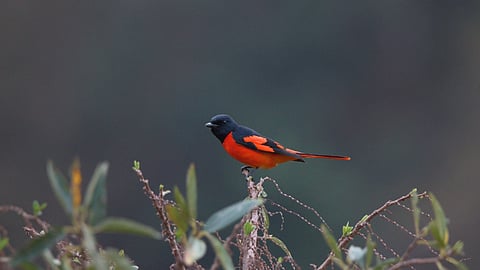
Scarlet Minivet Puneet Pandit (Instagram: @eternaleverlasting)
The Scarlet Minivet is a canopy-dwelling bird best known for its stark sexual dimorphism, males in scarlet and black, females in yellow and grey. Around Dehradun it favours the forested stretches of Rajaji National Park and the hills above Mussoorie, including Benog Wildlife Sanctuary, where it moves through the treetops in small, vocal flocks.
Advertisement
Wallcreeper

Wallcreeper Puneet Pandit (Instagram: @eternaleverlasting)
A high altitude specialist, the Wallcreeper is one of the harder birds to spot in the region, favouring bare rock faces and cliffs where its grey plumage offers near perfect camouflage. Only in flight does it reveal the crimson patches on its wings, moving with a fluttering, almost butterfly-like motion as it forages for insects in rock crevices.
Crested Kingfisher

Crested Kingfisher Puneet Pandit (Instagram: @eternaleverlasting)
Among the largest kingfishers found anywhere, the Crested Kingfisher is a striking black and white bird with a shaggy crest and a barred tail, typically seen perched over the fast-flowing, boulder-strewn rivers that run through the hills near Dehradun. It hunts by diving directly into the water for fish, and its presence is often taken as a sign of a clean, well-oxygenated stream.
Greater Flameback
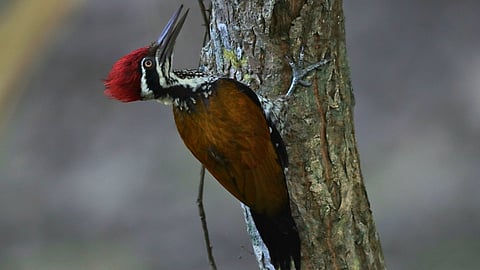
Greater Flameback Puneet Pandit (Instagram: @eternaleverlasting)
A large, golden-backed woodpecker, the Greater Flameback is easy to identify by its crimson crest, present in males and reduced to black and white spotting in females, and by the loud, resonant drumming it produces while excavating dead wood. It favours open and semi-open wooded country, where its calls and hammering carry well beyond the tree it is working on.
Advertisement
Indian Paradise Flycatcher

Indian Paradise Flycatcher Puneet Pandit (Instagram: @eternaleverlasting)
Known chiefly for the male's long, ribbon-like tail streamers, the Indian Paradise Flycatcher is one of the more theatrical birds found in Dehradun's wooded gardens and forest edges. Males occur in both white and rufous colour forms, and their looping, acrobatic flight as they chase insects mid-air makes them one of the easier species to notice even for casual observers.
Together, these species trace the range of habitats packed into a small stretch of Uttarakhand, from wetland to river gorge to Himalayan forest edge. For anyone willing to carry binoculars on an early morning walk, Dehradun turns out to be one of the more generous birding cities in North India.
All photographs courtesy: Puneet Pandit (Instagram: @eternaleverlasting). Puneet Pandit is a Dehradun-based educator, birder, trekker, and nature photographer, whose lens celebrates India’s remarkable avian diversity and the quiet beauty of the wild.
Is Dehradun a good destination for birdwatching?
Yes. Dehradun’s location in the Doon Valley, between the Himalayan foothills and the plains, gives it access to forests, wetlands, rivers and other habitats that support a wide variety of bird species.
Advertisement
Where can I go birdwatching around Dehradun?
The Asan Conservation Reserve, Rajaji National Park, Benog Wildlife Sanctuary and the forested areas around Mussoorie are among the notable birdwatching spots in and around Dehradun
Which birds can I see around Dehradun?
Birdwatchers may spot species including the Brown-headed Barbet, Scarlet Minivet, Indian Paradise Flycatcher, Indian Pitta, Greater Flameback, Mountain Bulbul and Red Avadavat, depending on the habitat and season.
What is the best time for birdwatching in Dehradun?
Early mornings are generally the best time for birdwatching, when birds are most active. The season also affects what you may see, particularly when migratory species are passing through the region.
What should I carry for birdwatching in Dehradun?
Binoculars, comfortable walking shoes, drinking water, sun protection and a bird field guide or identification app are useful. A camera with a suitable lens can also help you record sightings without disturbing the birds.
Advertisement
Published At:
Tags