A short ferry ride across Lake Huron takes travellers to a place where the sound of an engine is replaced by bicycle bells, horse hooves and the occasional call of a bird. Mackinac Island, off Michigan’s northern coast, has been without ordinary motor traffic for more than 125 years. Cars, golf carts and other everyday motorised vehicles are absent from its streets, while horses, bicycles, and pedestrians form the island’s distinctive transport system.
Inside Mackinac Island, The US Destination Where Cars Are Banned
From Fort Mackinac and Arch Rock to cycling trails and horse-drawn carriages, explore what to see and do on Mackinac Island

Advertisement
Spread across just 3.8 sq km, Mackinac Island has around 600 year-round residents and welcomes roughly 1.2 million visitors during the warmer months. The island’s car-free character is more than a novelty. It shapes the pace of a visit, from arriving by ferry and hiring a bicycle to watching horse-drawn carriages make their way through the historic town. With much of the island protected as state parkland, there is also plenty to explore beyond the main streets.
Why Mackinac Island Has No Car

Mackinac Island has prohibited ordinary motor vehicles since 1898 Unsplash
The ban dates to 1898, when the automobile was still a relatively new invention. As motor vehicles began appearing on the island, local carriage operators became concerned about their impact on horses. The village council subsequently prohibited motor vehicles on July 6, 1898, making Mackinac Island one of the earliest places in the US to restrict automobiles.
Today, M-185, the road circling much of the island, remains the only state highway in the US where motor vehicles are prohibited for ordinary use. The approximately 8.2-mile route is now popular with cyclists, walkers and runners. There are exceptions: emergency and utility vehicles operate when necessary, while golf carts are permitted on the island’s golf courses. In winter, some residents also use snowmobiles.
Advertisement
For most visitors, however, getting around means choosing between two wheels, two feet or four-legged horsepower. More than 1,500 bicycles are available to rent, including tandem bikes, and other options for families. Horse-drawn carriages provide another way to see the island, while walking opens up its network of more than 70 miles of trails.
Explore Mackinac Island State Park
Around 80 per cent of Mackinac Island is protected as Mackinac Island State Park, giving the destination considerably more to offer than its picturesque downtown. Forested trails wind through the interior, while limestone formations and views across Lake Huron provide natural landmarks along the way.
One of the island’s best-known sights is Arch Rock, a natural limestone arch measuring around 50 ft across. It can be reached by bicycle, on foot or by horse-drawn carriage. The coastal road also offers access to stretches of shoreline and wooded areas, making cycling around the island an easy way to combine sightseeing with the outdoors.
Advertisement
The island’s historic character is equally compelling. Fort Mackinac, established by British forces in 1780, sits above the harbour and recalls the island’s strategic importance in the Great Lakes. Costumed interpreters, historic buildings, and cannon demonstrations bring its military past into focus, while the Biddle House houses the Mackinac Island Native American Museum, which explores the Indigenous history of the region.
A Destination Steeped In History
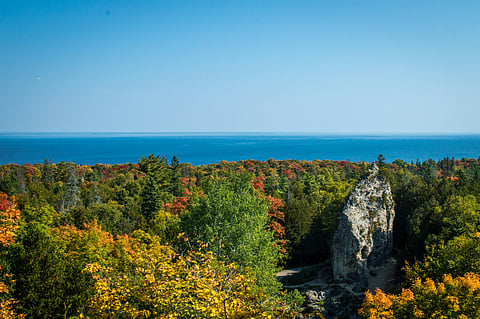
Around 80 per cent of Mackinac Island is protected as state parkland Unsplash
Long before the arrival of European settlers, Mackinac Island was used by Indigenous communities as a fishing and hunting ground. Its name comes from Michilimackinac, an Anishnaabemowin name associated with the shape of the island and traditionally interpreted as the "place of the great turtle."
Its location between Lake Huron and Lake Michigan made it an important meeting point and travel route for Indigenous peoples, with the surrounding waterways serving as natural routes across the Great Lakes. Archaeological evidence, including Indigenous burial sites dating back thousands of years, points to a history that predates the island’s later military and tourism eras by centuries.
Advertisement
By the 19th Century, Mackinac Island had begun attracting affluent summer visitors from cities such as Chicago and Detroit. The Grand Hotel, opened in 1887, remains one of the most recognisable reminders of that period. Its individually decorated rooms, expansive verandah, and Gilded Age architecture have made it a defining part of the island’s identity.
Horses, Fudge, And Summer Traditions

Horse-drawn vehicles handle everything from sightseeing to freight and rubbish collection Unsplash
Horses are central to everyday life on Mackinac Island. They pull sightseeing carriages and taxis, but their role extends well beyond tourism. Deliveries, freight, and rubbish collection are also handled by horse-drawn vehicles, allowing the island to function without the delivery trucks and service vehicles found in most American towns.
The horse population swells during the summer season, when hundreds arrive from the mainland to support the island’s busy tourism industry. As autumn approaches, many of these seasonal horses return to Michigan’s Upper Peninsula, while a smaller number remain through winter for essential services.
Advertisement
The island’s other great summer tradition is its fudge. Mackinac Island is famous across Michigan for its fudge shops, many of which line the historic downtown streets. June brings another seasonal highlight, the 10-day Lilac Festival, when the island’s gardens and streets are filled with blooming lilacs. For a different perspective, head to Fort Holmes, the island’s highest point, or the Grand Hotel’s Cupola Bar for expansive views of the surrounding landscape and night sky.
What Travellers Should Know
How to reach: Take a ferry from Mackinaw City or St Ignace; the journey takes around 20 minutes. Private boats can dock at the island’s marina, while Mackinac Island Airport offers another option.
Getting around: Cars are not permitted for ordinary use. Explore by bicycle, on foot or by horse-drawn carriage, and taxi.
Best time to visit: Summer is the busiest season, while autumn sees cooler weather and the departure of many seasonal horses.
Winter travel: Ferry services can be disrupted when ice affects Lake Huron. Winters are also considerably quieter and colder.
How long to stay: A full day allows time to cycle or walk around the island, visit Fort Mackinac, and explore the historic downtown area.
Advertisement
FAQs
1. Why are cars not allowed on Mackinac Island?
Motor vehicles were banned in 1898 after concerns that automobiles were frightening horses.
2. How do you get around Mackinac Island?
Visitors can explore by bicycle, on foot or by horse-drawn carriage, and taxi.
3. What are the main attractions on Mackinac Island?
Fort Mackinac, Arch Rock, Mackinac Island State Park, and the historic downtown are among the key attractions.
4. How do you reach Mackinac Island?
Ferries connect the island with Mackinaw City and St Ignace, with the crossing taking around 20 minutes.
5. What is Mackinac Island known for?
The island is known for its car-free streets, horse-drawn transport, historic architecture, cycling trails, fudge, and natural landscapes.
Published At: