I glance at my watch. 10:16 a.m.
When The Jungle Looked Back: A First Safari At Pench, Written In Stripes And Silence
From heart-stopping tiger encounters to silent hides and nights beneath the forest canopy, a first-time safari at Pench becomes a lesson in patience, presence and the quiet power of the wild

"A tiger's mind isn't as tangled as a human's... even the simplest person's mind is more complex."Satyajit Ray, 'The Royal Bengal Mystery'
Advertisement
I look up.
Sunlight filters through towering teak, mahua, and jamun trees, fractured and restless, barely piercing the dense canopy that stitches itself into a living roof above my head. The forest presses in from all sides. Seven hundred and fifty-eight sq km of wilderness, and just one narrow, paved strip cutting through it. One way in. One way out.
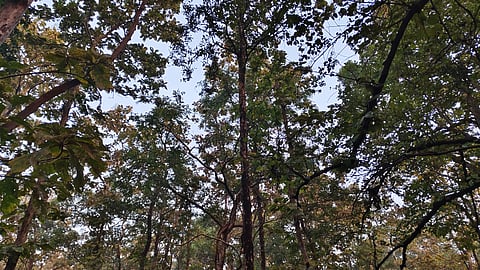
Trees inside Pench National Park Anwesha Santra
It’s early November. The wind has teeth now, sharp and cold against my skin. I pull my camouflage jacket tighter, trying to disappear into the jungle, to become invisible, insignificant, unnoticed. In places like this, attention can be dangerous.
This is my first safari. I sit rigid in the open jeep, scanning every shadow, every twitch of grass. I know the odds. Spotting a tiger is a matter of sheer luck. I had seen one at dawn, a distant flicker of movement, gone before my mind could register its stripes. A glimpse is not a meeting.
Advertisement
Delhi feels like another lifetime. I arrived at Pench National Park just a day before, the journey long enough to dull the senses.
“Don’t be sad,” the woman beside me says. “You saw a tiger. Even from far away. Most people don’t.”
She’s right. I smile, though the forest doesn’t let me relax.
Then—
*a faint growl*
The jeep slows.
The driver lifts a hand. The guide leans forward, head tilted, listening. The jungle holds its breath.
*Another growl.*
Closer. Louder.
My pulse spikes. Is it near? Or just echoing? In a jungle this still, sound lies. Distance becomes a trick.
“It’s approaching us,” the driver whispers. “Stay still. Stay silent.”
My eyes search desperately for yellow and black, for movement in the tall grass that sways but reveals nothing. The vegetation is too thick, too alive. Every second stretches. My chest tightens.
And then, she descends.
From higher ground, she emerges, unhurried, absolute. Muscles ripple beneath her coat as she steps into view. Majestic. Gorgeous. Ferocious.
Advertisement
The Bijamatta female.
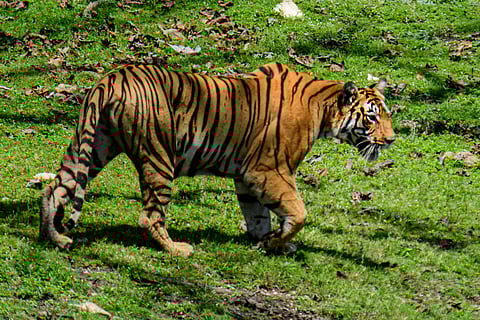
The Bijamatta Female tigress in Pench National Park Shutterstock
She moves a few yards ahead of us. Her nose skims the air, then the earth, every step measured. She walks the path like a runway, the famous catwalk she was born to own. After all, they are big cats.
We watch her in silence. Four safari vehicles have come to a standstill behind ours. No engines rev. No whispers rise. No cameras click too loudly. This is not our moment to interrupt.
We are trespassers here.
She crosses the track in front of us. Slow, steady, absolute. Each paw lands with purpose, as if the ground itself has agreed to hold her weight.
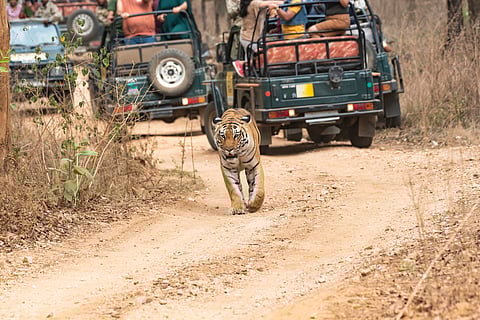
A tiger crosses in front of safari vehicles, Pench National Park, Madhya Pradesh (representational photo) Shutterstock
“She’s looking for her cub,” the driver had told me earlier, his voice low. “A semi-adult. The cub was taken to the infirmary yesterday. It has to be returned within a day or two—before she forgets.”
Bijamatta looks back.
So do we.
For a heartbeat, our eyes meet—or at least it feels that way.
Advertisement
Another tiger steps into view.
Smaller. Lighter. Following her path like a shadow that knows where it belongs.
My breath catches.
“That’s her second cub,” someone murmurs.
The two cats linger, unbothered by time. Then, they retreat—melting back into the dense green as if they were never there at all.
The jungle exhales.
I don’t move. I keep staring into the thicket, my mouth half-open, eyes burning, heart pounding. Overwhelmed. Flooded. Knowing, with a certainty that will stay with me forever, that I have been allowed into a moment most never are.
On my first safari, I wasn’t just lucky.
I was chosen.
Staying Amidst The Wilderness (Literally) At Pench Tree Lodge
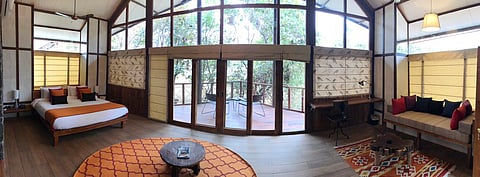
Interiors of a cottage at Pench Tree Lodge Supplied/Pench Tree Lodge
I am back at a desk now. My watch reads fifteen minutes past midnight.
A pool of warm yellow light spills from the table lamp, cocooning me in its glow as I sip pea blue flower tea. My journal lies open. I write, the pen moving instinctively, the way it has since childhood—since the days I devoured the adventures of Professor Trilokeshwar Shonku. The polymath, the polyglot, the fearless explorer, written by Satyajit Ray. Growing up with stories like his, I always believed adventure lived somewhere far away. Tonight, I realise it has quietly caught up with me.
Advertisement
I am staying at the Pench Tree Lodge, owned by Pugdundee Safaris. Forty acres of wilderness cradle the property, tucked near the small tribal hamlet of Sarrahiri. The lodge doesn’t intrude—it blends. Safari-style furniture, local crafts, textures that feel borrowed from the forest itself. The Karamajhiri gate of Pench National Park lies just twenty minutes away. The Jamtara gate is equally close. The Gond village stands nearby, close enough to remind you that life here has always coexisted with the wild.
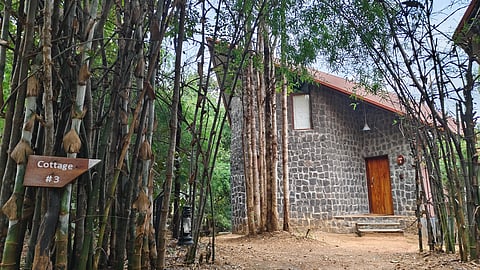
My cottage during my stay at Pench Tree Lodge Anwesha Santra
There are fourteen tree houses and cottages scattered across the land. Mine is a cottage—stone-clad, almost camouflaged, half-hidden by mahua and bamboo trees. From the outside, it looks unassuming. Step in, and the world changes.
I pause my writing and take in the room.
Dim light. Outside, nothing but darkness. Somewhere beyond the glass doors of the balcony, a dragonfly buzzes, its sound oddly loud in the quiet. I’ve dreamt of a stay like this for years. It reminds me of Shankar from "Chander Pahar" (The Mountain of the Moon) by Bibhitibhushan Bandyopadhyay. No African lions prowling outside, no black mamba slipping through the cracks—but the feeling is close enough.
Advertisement
“A tiger walked into the property last year,” the manager had said earlier, almost casually. “A guest saw it from his room.”
The thought follows me as I sip more tea and wander around. I stop at the verandah glass. The outline of chairs sits outside, barely visible. It would be foolish to step out. I turn back in.
There’s a bed downstairs. But why sleep there when a wooden staircase inside the room leads upwards?
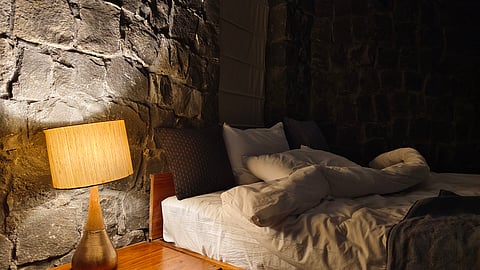
The bed-space upstairs in my cottage at Pench Tree Lodge Anwesha Santra
I climb. The stairs creak softly beneath my feet. Upstairs, a tree-house-like loft waits for me, another bed tucked into the shadows. I light the lamp and sit down. As my eyes adjust, I notice a rope tied to one of the foot stands.
Made like a hunter’s bed. I recognise it instantly.
Dinner still weighs pleasantly in my stomach. The lodge had arranged a farm dinner earlier that evening. We sat beneath a sky crowded with stars and a moon bright enough to cast shadows. Most of the vegetables were grown right there. The meat—goat and peafowl—sourced from nearby villages. The mutton curry was rich, earthy. Fresh food tastes different when you know where it comes from.
Advertisement

Sitaphal and Rose ice creams as dessert at Pench Tree Lodge Anwesha Santra
And then there was the rose ice cream—fragrant, delicate, unmistakably real. We all went back for seconds. And thirds. The night before, dinner by the pool had been just as memorable: garden salad, beans, duba macchi, murgh dori kebab. Candles flickered in shot glasses, the air crisp, the forest breathing around us.
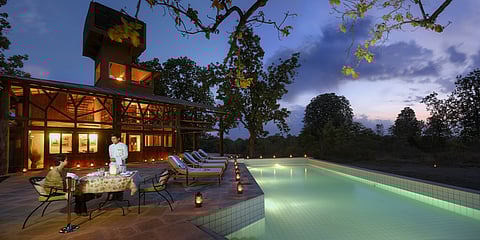
Poolside dinner at Pench Tree Lodge Supplied/Pench Tree Lodge
Now, alone in my room, I inhale deeply. The air smells clean. Alive.
It’s late.
Tomorrow, another safari waits.
I turn off the lamp and lie down, listening to the quiet. Somewhere beyond the darkness, the jungle is awake. Moving. Watching.
Who knows what I’ll spot next?
Going Inside The Indira Priyadarshini Pench National Park For A Second Time
Pench National Park is a wildlife landscape in central India, spread across the states of Madhya Pradesh and Maharashtra. Forming the core of the Pench Tiger Reserve, the park came into existence as a national park in the early 1980s and later became part of Project Tiger. Its rolling hills, seasonal streams, and teak-rich forests are often associated with the wilderness imagery that inspired Rudyard Kipling’s "The Jungle Book", giving Pench a strong literary and ecological identity. The vegetation of Pench is dominated by dry deciduous and mixed forests, where teak trees form the backbone of the landscape. These are interspersed with mahua, saja, haldu, salai, bija, dhaora, and tendu trees, along with thick patches of bamboo. The forest floor supports grasses, shrubs, climbers and a variety of medicinal plants. Seasonal changes transform the forest dramatically, from dense green canopies after the monsoon to open woodland during summer, improving wildlife visibility.
Advertisement
I am back in the safari vehicle, just like the day before.
The metal frame hums beneath me as the jeep rolls forward. I grip my binoculars, scanning instinctively, alert now in a way I wasn’t before. The jungle has taught me quickly. I spot an Indian roller perched on a branch. Its face and throat are pinkish, the head and back brown, the rump blue, the wings and tail marked with striking contrasts of light and dark blue.
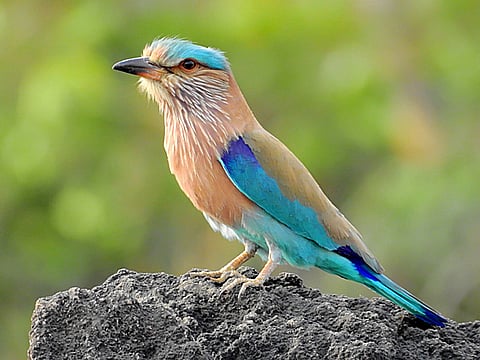
An Indian roller Wikimedia Commons
This forest hosts many more winged inhabitants—peacocks, Eurasian spoonbills, owls, tufted ducks, and ruddy shelducks. Pench is widely regarded as an important bird habitat. Peafowl, hornbills, raptors, owls, rollers, and woodpeckers are frequently observed, while winter draws migratory water birds to rivers and reservoirs.
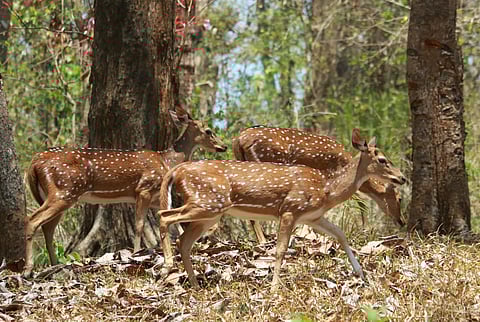
A herd of spotted deer (representational photo) Wikimedia Commons
Wildlife diversity is one of Pench’s strongest assets. Bengal tigers dominate this reserve, sharing space with leopards, dholes, wolves, jackals, and hyenas. Sloth bears, while jungle cats and smaller carnivores keep the balance intact. Herbivores—chital, sambar, gaur, nilgai, barking deer, four-horned antelope, and wild boar—move cautiously through the forest, forming a strong prey base. Reptiles such as monitor lizards and snakes inhabit both the forest floor and water bodies, while insects and amphibians complete the ecosystem.
Advertisement
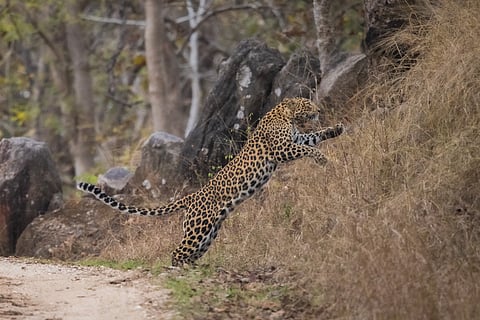
A leopard at Pench National Park Shutterstock
Just a day ago, before I had sighted the tigers, I had spotted three leopards.
A mother and her two cubs.
The mother sat calmly, composed and watchful, while the cubs played within the branches of a tree perched atop a rock. I am still replaying that scene in my mind when the jeep comes to a sudden halt.
“Tiger! Tiger!” the driver hushes urgently.
Where?
I see nothing at first. We had come across fresh pugmarks in the early morning hours, their edges still sharp in the damp forest floor.
And then she appears.
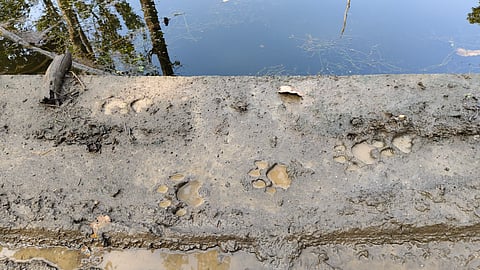
Fresh pug marks on mud, Pench National Park Anwesha Santra
Kalapahad.
Another female tiger of Pench National Park. Named after the area she is frequently sighted in, Kalapahad is a young tigress who covers Fireline, Kalapahad, Saath mod, and 25 no camp. At 3.6 years old, she has often been seen this season with the L-mark male around the Bijamatta Talab area. She has taken part of her territory from her mother, the Bijamatta female, and another part by winning against Langdi (Bijamatta’s mother) and Lakshmi (another tigress). She is yet to have her first litter.
Advertisement
Her name intrigues me. Kalapahad. Historically, Kalapahad was a powerful Muslim general of the Bengal Sultanate during the 16th century, originally believed to be named Raju, or Rajiv Lochan Ray, or Kalachand Roy.
There is also another tigress here, Lakshmi. She had a litter last year, but none survived. Now she has been seen with two male tigers: Swastik, the dominant male, and Deva, a newly emerged male—likely attempting to mate.
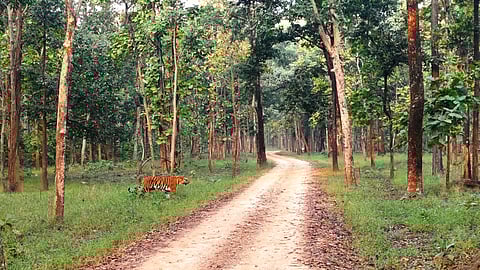
Kalapahad Female at Pench National Park Anwesha Santra
As we move deeper into the jungle, more life reveals itself—spotted deer scattered across clearings, langoors leaping overhead, wild dogs slipping through undergrowth. Wild boars roam even the property where I am staying; my group had encountered a herd of them earlier.
My heart feels full.
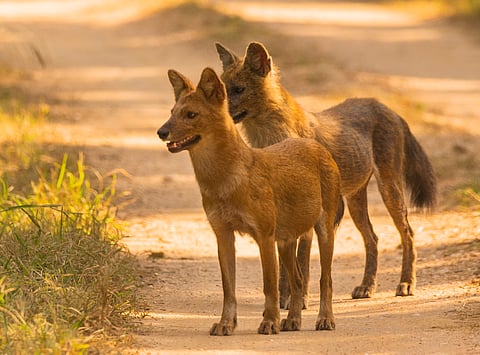
Wild dogs at Pench National Park Shutterstock
Later, outside the premises, I sip steaming hot coffee, the warmth grounding me as the forest stretches endlessly before my eyes.
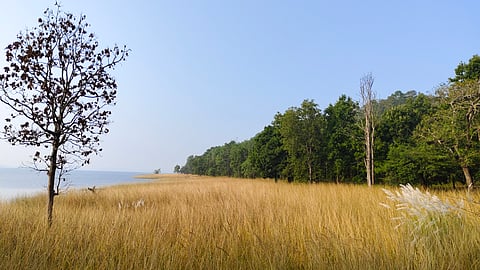
An area outside the forest, Pench National Park Anwesha Santra
The Kipling Hide At Pench Tree Lodge
Back at the property, we walk slowly through a vast expanse of flora that blankets the land. The jungle here feels different—closer, more intimate. Not the open anticipation of a safari track, but the quiet tension of knowing that life moves just beyond sight.
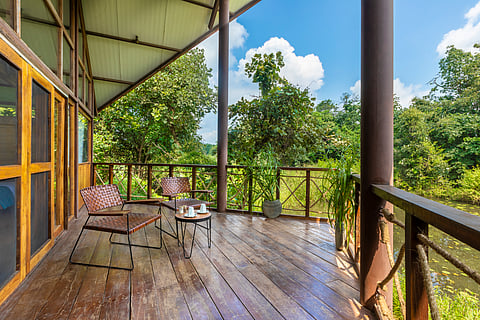
I stayed amidst the wilderness at Pench Tree Lodge, Madhya Pradesh Supplied/Pench Tree Lodge
Omkar Bhatt, the manager of Pench Tree Lodge, who also doubled as our driver during the safaris, leads us off the path and towards something unexpected.
We descend a flight of steps into what feels like a bunker.
Underground, the air shifts. The space is compact, chairs lined neatly against a fitted, table-like ledge. In front of us, a glass window stares outward, framing the forest like a carefully composed photograph.
“Sit on a chair and look out, lowering your head,” Omkar tells me.
A small pond-like structure lies just beyond the glass. The kind of place that pulls animals in without ceremony.
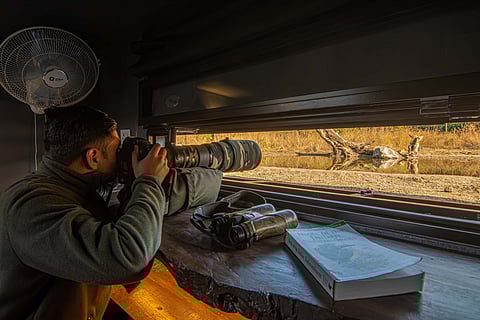
The Kipling Hide at Pench Tree Lodge Supplied/Pench Tree Lodge
“Animals come here often to drink water,” he says. “If you want to take the perfect shot, this is where you do it.”
This is the Kipling Hide.
It can be booked by individuals or teams, chair by chair, or the entire Hide, on an hourly basis.
We leave the Hide behind and move deeper into the property.
The vegetation thickens. Light thins. The air hums with unseen life. I’m told to be careful. Mosquitoes and insects thrive here, unnoticed but ever-present. I’ve already applied Odomos on my exposed skin.
As we walk, I realise something quietly profound.
The wilderness here does not perform.
It exists.
And for a brief moment, it allows you to exist within it too—on its terms, in its silence, without promise, without fear, without spectacle.
That, I think, is the real luxury of Pench.
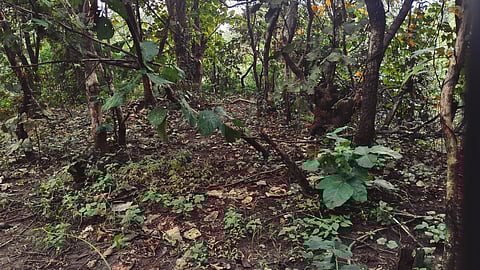
During my nature walk at Pench Tree Lodge Anwesha Santra
The Information
Safari timings at Pench National Park
The park operates two jeep safaris daily. Morning safari usually runs from around 6.30 am to 10.00 am. Afternoon safari generally takes place from about 2.00 pm to 6.00 pm. (Timings may shift slightly depending on the season, sunrise and sunset.)
Tariffs at Pench Tree Lodge
Luxury cottages are priced at approximately INR 27,000 per night for double occupancy. Single occupancy in a luxury cottage costs around INR 24,000 per night.
Tree houses are priced higher, at about INR 30,000 per night for double occupancy. Single occupancy in a tree house is around INR 27,000 per night.
Tariffs include meals and tea or coffee service.
A minimum stay of two nights is required.
All rates are subject to applicable 18 per cent GST.
(Rates valid from October 1, 2025 to September 30, 2026)
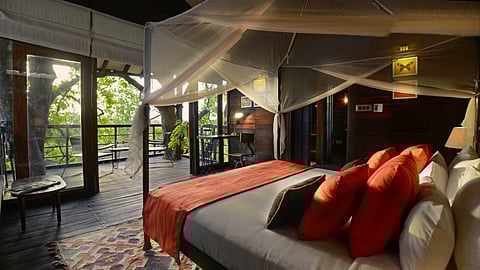
Interiors of a tree house, Pench Tree Lodge Supplied/Pench Tree Lodge
Safari prices through Pench Tree Lodge
Private jeep safari for Indian nationals costs roughly INR 13,500 on weekdays. Weekend safari rates for Indian nationals are around INR 14,000.
Safari rates for foreign nationals are approximately INR 16,500 on weekdays. Weekend rates for foreign nationals go up to about INR 17,500.
Prices are per jeep and generally exclude GST and additional meals.
Additional options such as buffer safaris or guided nature activities are charged separately.
How to reach Pench National Park and Pench Tree Lodge
Pench National Park and Pench Tree Lodge are best reached via Nagpur, about 140 kilometres away, with good air and rail connectivity. From Nagpur, the park is a three-hour drive, while road access is via the Nagpur–Jabalpur highway, with lodge transfers available on request.
FAQs
1. Where is Pench National Park located?
Pench National Park is located in central India across Madhya Pradesh and Maharashtra and forms the core of the Pench Tiger Reserve.
2. Is Pench good for a first-time safari?
Yes, Pench is considered one of the best parks for a first safari due to its strong tiger population, open forest terrain and well-managed jeep safaris.
3. What wildlife can you see at Pench National Park?
Visitors may spot Bengal tigers, leopards, wild dogs, sloth bears, deer species, birds, reptiles and diverse forest wildlife during safaris.
4. What is the best time to visit Pench for tiger sightings?
The best time for tiger sightings is from October to May, with peak visibility often between March and May when vegetation thins and animals visit waterholes.
5. Where can you stay near Pench National Park?
Luxury and eco-focused stays such as Pench Tree Lodge offer cottages and tree houses close to safari gates, blending comfort with wilderness immersion.
Published At: