Tutankhamun may not have been Egypt’s greatest king. Khufu and Ramesses II might have had a few things to say about that. But the most famous? Surely. Quite an achievement for a king who became a global celebrity largely because his tomb had remained hidden for centuries.
The Rubble That Saved Tutankhamun: Inside The Grand Egyptian Museum
At the Grand Egyptian Museum in Giza, Tutankhamun’s treasures tell a story of royal ambition, accidental protection and an extraordinary rediscovery

Advertisement
At the Grand Egyptian Museum (GEM), the ancient world announces itself on a monumental scale. Even before entering, the grounds begin telling Egypt’s story. The landscape takes its cue from the Nile and the fertile land it sustained, with a winding route representing the river’s journey through the desert. It is a reminder that behind the temples, tombs and royal treasures lay a civilisation shaped by its relationship with water.
Inside, a colossal statue of Ramesses II presides over the entrance hall. Beyond him, the Grand Staircase turns the ascent towards the galleries into an exhibition in its own right. Statues of kings, queens and deities share the space with columns and fragments of temple architecture. There is reason to pause at every level: a face carved in stone, a royal pose, a surviving piece of a building whose original scale can only be imagined.
Designed by Heneghan Peng Architects, the museum makes its setting part of the experience. The climb brings visitors towards the level of the desert plateau, where views of the pyramids connect the objects indoors with the landscape beyond. Egypt’s ancient monuments become part of the museum’s wider frame.
Advertisement
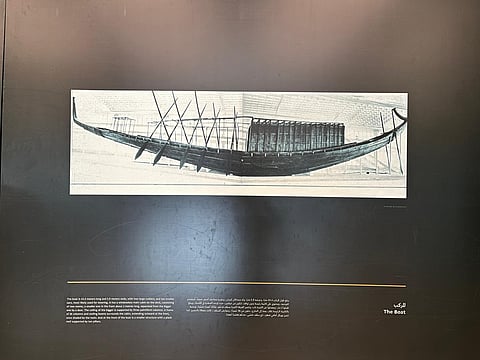
Discovered dismantled beside the Great Pyramid in 1954, Khufu's boat is around 4,500 years old and measures more than 43 metres. Its painstaking reconstruction reveals the craftsmanship of ancient Egyptian shipbuilders Reshom Majumdar
Then there is Khufu’s boat. More than 43 metres long, the assembled wooden vessel brings another dimension to the museum’s monumental scale. Discovered dismantled beside the Great Pyramid in 1954 and painstakingly reassembled, it is around 4,500 years old. Its long, slender hull makes the craftsmanship of ancient Egypt feel remarkably tangible. Here, too, survival is part of the wonder: something built from timber has endured across millennia.
Dare I say, the building deserves a place among the wonders of the modern world.
Yet amid this grandeur, a reconstruction of a small underground burial chamber draws me into a different story. Here, the wonder lies not only in what ancient Egyptians created, but also in how precariously those creations survived.
This is the burial chamber of Tutankhamun, the young pharaoh whose tomb transformed the modern world’s understanding of ancient Egypt. Its treasures are dazzling. But the explanation for their survival involves something far less precious: rubble.
Advertisement
A New Home For An Ancient World
The museum’s own journey stretched across presidencies. Hosni Mubarak laid its foundation stone in 2002, and construction began in 2005. By its official inauguration on 1 November 2025, Abdel Fattah el-Sisi was president. Two decades of construction had produced a setting vast enough to accommodate the ambitions of its subject.
For Tutankhamun’s possessions, the museum represents a remarkable change of surroundings. Objects once crowded into underground rooms can now be encountered within galleries designed to reveal their craftsmanship and purpose. The collection also brings together the king’s treasures on an unprecedented scale, allowing visitors to appreciate them as part of a single burial assemblage.
The Grand Egyptian Museum in Giza, inaugurated on November 1, 2025, brings together ancient Egyptian artefacts, royal statues and monumental architecture near the Giza Pyramid Complex Reshom Majumdar
Their owner, however, remains elsewhere.
Tutankhamun’s mummy still lies inside his original tomb, KV62, in the Valley of the Kings near Luxor, protected within a climate-controlled glass case. The recreation at Giza evokes his burial chamber; it does not contain his body. His treasures have travelled to a new home. The king has remained in the valley where he was buried more than 3,000 years ago.
Advertisement
The Staircase Beneath The Huts
On November 4, 1922, Egyptian workers excavating under British archaeologist Howard Carter uncovered a step cut into the valley floor. They had been clearing the remains of ancient workmen’s huts near the entrance to the tomb of Ramesses VI. Beneath one of these huts, the step led to a descending staircase cut into the bedrock. It was the beginning of a discovery that would change Egyptology.
Over the following weeks, Carter and his team cleared the staircase and reached a sealed doorway. On November 26, Carter peered through a small opening in a second sealed doorway. By candlelight, the contents of an extraordinary chamber began to emerge: furniture, chariots, statues and caskets, packed into a space that had remained concealed for centuries.
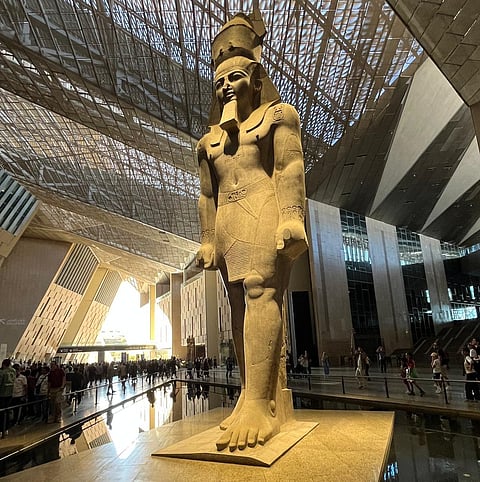
A colossal statue of Ramesses II greets visitors in the entrance hall of the Grand Egyptian Museum. The pharaoh ruled Egypt during the 19th Dynasty, from around 1279 to 1213 BCE Reshom Majumdar
But the tomb was not entirely untouched.
Ancient robbers had entered it, disturbing its contents before it was resealed. What distinguished this burial from so many others was that much of its original assemblage survived, along with the king’s mummy. After those early intrusions, the entrance had gradually disappeared from view, helping shield the tomb from further interference.
Advertisement
Understanding why requires looking beyond the tomb itself.
How One Burial Concealed Another
More than a century after Tutankhamun’s burial, workers were excavating the nearby tomb of Ramesses VI. Their labour generated quantities of broken stone and debris, which accumulated across the valley floor. Ancient workmen’s huts, built in connection with the later tomb, further obscured the entrance to Tutankhamun’s resting place.
This was not simply a case of one pharaoh placing his burial chamber directly above another’s. The protection was largely incidental. The work surrounding a later royal tomb helped conceal an earlier one, burying its entrance beneath layers of accumulated debris.
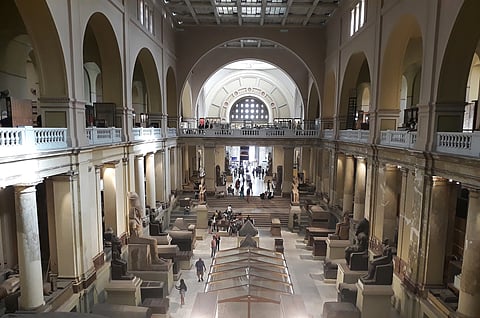
The main hall of The Grand Egyptian Museum (GEM), also known as the Giza Museum Gabriela Beres/ Shutterstock
There is something arresting about this meeting of royal ambition and ordinary labour. The people cutting rock, clearing rubble and building huts were preparing one king’s resting place. Without intending to, they helped preserve another’s.
The Splendour And The Accident
Inside the Grand Egyptian Museum, the reconstruction encourages a different way of seeing Tutankhamun’s treasures. They were not originally isolated masterpieces, displayed for admiration. They belonged to a burial, assembled within a confined space to serve a king in the afterlife.
Advertisement
Their craftsmanship speaks of skill, wealth and elaborate preparation. Their survival tells a less orderly story.
Standing before the recreated chamber, I find that uncertainty as compelling as the gold. A vast modern museum now reveals what centuries of accumulated debris and the work of ancient labourers helped hide.
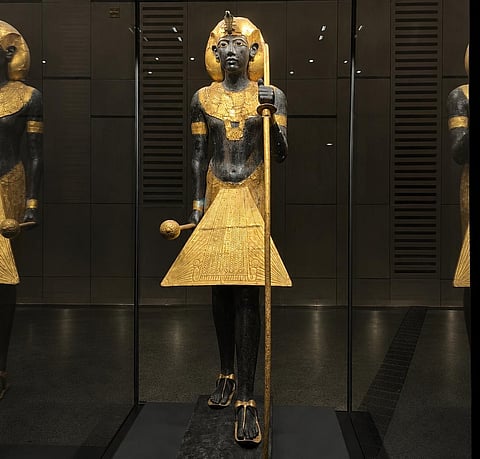
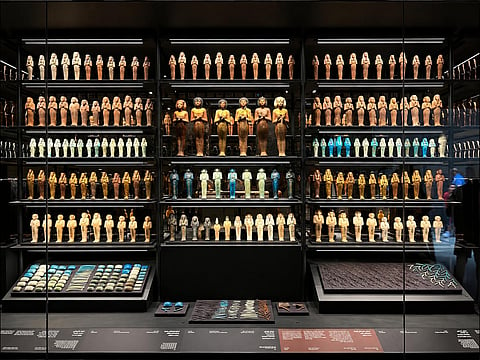
Tutankhamun's burial collection offers an extraordinary glimpse into ancient Egyptian royal life, funerary customs and the craftsmanship that went into preparing a pharaoh for the afterlife Reshom Majumdar
Tutankhamun’s fame rests on that unlikely reversal. Before his burial could become one of the world’s most celebrated archaeological discoveries, it first had to disappear.
FAQs
1. Where is the Grand Egyptian Museum located?
The Grand Egyptian Museum is located in Giza, Egypt, near the Giza Pyramid Complex.
2. What can visitors see at the Grand Egyptian Museum?
Visitors can explore ancient Egyptian statues, royal artefacts, architectural fragments, Khufu's boat and the treasures of Tutankhamun.
3. When was Tutankhamun's tomb discovered?
Tutankhamun's tomb was discovered by British archaeologist Howard Carter and his team on November 4, 1922, in the Valley of the Kings near Luxor.
Advertisement
4. How did rubble help protect Tutankhamun's tomb?
Debris from excavation work near the later tomb of Ramesses VI, along with ancient workmen's huts, helped conceal Tutankhamun's tomb entrance and shield it from further discovery for centuries.
5. Is Tutankhamun's mummy displayed at the Grand Egyptian Museum?
No. Tutankhamun's mummy remains in his original tomb, KV62, in the Valley of the Kings near Luxor. The Grand Egyptian Museum displays his treasures and includes a reconstruction of his burial chamber.

Published At: