Every year, World Tourism Day gives us a reason to pause and ask a simple question: why do we travel? I have often measured a journey by how much I managed to see, how many places I could fit into an itinerary and, inevitably, how many photographs I returned with. But one morning in Sarnath made me question that habit.
World Tourism Day 2026: A Journey Through Sarnath Taught Me Why Travel Is More Than Sightseeing
In Sarnath, a journey through Buddhist heritage becomes an invitation to slow down, look closer and experience a place beyond the itinerary

Advertisement
I arrived as the day was beginning. The surroundings were still quiet, with monks, pilgrims and visitors gradually making their way through the sacred site. There was no rush to the morning, and for once, I did not feel one either.
I already knew what had happened here more than 2,600 years ago. This was where the Buddha delivered his first sermon and set the Dharmachakra, or Wheel of Dharma, in motion. I had read about it, seen photographs and knew the significance of the place. But knowing the history and standing where it happened were two very different things.
Among the bodhi trees, pathways and ancient remains, something that had always felt distant suddenly felt present. I found myself less interested in what I had come to see next and more interested in simply being there.
A Shared Buddhist Heritage
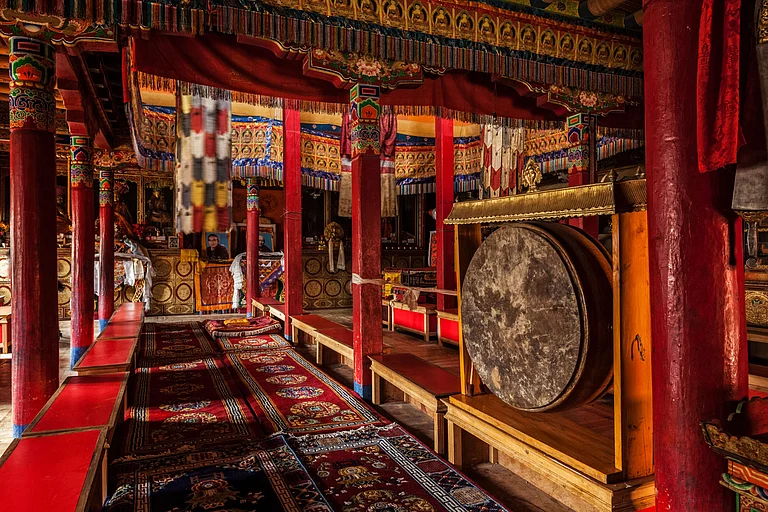
What fascinated me equally was the way Sarnath seemed to bring Asia together. Around the holy site are monasteries and temples representing different Buddhist traditions and countries. Monks and pilgrims arrive from across Asia, carrying their own languages, customs, robes and ways of prayer, yet sharing a connection to the same teachings.
Advertisement
As I walked through Sarnath, I began to see it as more than an ancient Buddhist site. In a way, it felt like a miniature Asia, a place where different cultures meet through a shared spiritual heritage.
It was striking to think that the teachings first shared here had travelled so far across borders and centuries, taking on different cultural forms along the way, only to bring people back to the place where the journey began.
At The Heart Of Sarnath

Dhamek Stupa, Sarnah Supplied
As I walked towards the archaeological remains, the Dhamek Stupa became the centre of my attention. Its enormous brick form has a presence that is difficult to ignore.
Standing before it, I found myself thinking about the Buddha’s first sermon, not simply as an event from the distant past, but as a teaching that offered a path towards understanding and transforming one’s life.
The Bodhi tree offered a quieter moment of reflection. At Chaukhandi Stupa, I felt another connection to that journey. The site is associated with the Buddha’s meeting with his first five disciples, adding another layer to the story I was gradually piecing together as I moved through Sarnath.
Advertisement
I began to realise that Sarnath’s story is not contained within a single monument. Over centuries, it grew into an important Buddhist centre through royal, monastic and lay patronage, with stupas, temples and viharas added during different periods.
UNESCO’s 2026 inscription of the Ancient Buddhist Site of Sarnath on the World Heritage List recognises this exceptional heritage, including its enduring spiritual significance and its direct association with the Buddha’s first sermon and his first disciples.
But even with all this history around me, it was not the age of the monuments that stayed with me. It was the feeling that the past here had never completely become the past.
When History Feels Present
The morning chants, the movement of monks, pilgrims pausing in prayer and the presence of Buddhist communities from different parts of Asia gave Sarnath a living character. Heritage, I realised, is not only what survives in stone and brick. It is also what people continue to practise, remember and pass on.
Advertisement
That changed the way I looked at the place around me. A sacred site asks for something more from a traveller than a photograph. It asks for attention, respect and an awareness that we are entering a place that continues to hold meaning for people today.
At one point, I put my camera away.
I had been photographing the monuments, trying to frame the details I wanted to remember later. But suddenly I felt that constantly looking at Sarnath through a screen was keeping me from experiencing it directly.
So I stopped.
I watched the changing light across the old bricks. A monk walked quietly through the grounds. Visitors paused without saying much. Nothing extraordinary was happening, and yet those were the moments I remembered later.
Perhaps travel does not always become memorable because something dramatic happens. Sometimes it stays with us because, for a brief period, we were completely present.
Advertisement

At Sarnath, with the Dhamek Stupa in view Sangye Thrinley
Beyond The Itinerary
That morning in Sarnath also made me think differently about the way we travel today.
Travel has become faster, easier and increasingly visual. We can reach a destination quickly, photograph it within minutes and share the experience before we have even left the place. There is nothing wrong with wanting to see and explore. I enjoy that part of travel too.
But Sarnath reminded me that seeing a place and experiencing a place are not necessarily the same thing.
Perhaps we also need to rethink the distance between tourism and pilgrimage. A traveller does not have to become a pilgrim to approach a revered place with respect. We can arrive with curiosity, appreciate its architecture and history, listen to its stories and still remain conscious of its spiritual meaning.
We can take photographs without reducing a hallowed site to a photograph. We can follow an itinerary without letting it dictate every minute of our experience.
Advertisement
What I Took Home From Sarnath
Looking back, I remember the monuments, but I remember the pauses more clearly.
I remember people from different parts of the world gathering around a place whose story began more than two millennia ago. I remember the morning light, the quiet pathways and the feeling of slowing down when everything around us encourages us to move on to the next destination.
I had come to Sarnath to see where the Buddha first turned the Dharmachakra. I left thinking about another kind of journey: the journey from seeing to understanding, from moving through a place to truly being present in it.
Perhaps that is what World Tourism Day can remind us. The value of travel is not always measured by how far we go or how much we see. Sometimes, it is measured by how deeply a place stays with us after we leave.
FAQs
Advertisement
1. Why is Sarnath important to Buddhism?
Sarnath is traditionally associated with the Buddha delivering his first sermon after attaining enlightenment, making it one of the important Buddhist pilgrimage sites.
2. What can you see in Sarnath?
Key sites include the Dhamek Stupa, Chaukhandi Stupa, ancient archaeological remains, Buddhist monasteries and temples representing different Buddhist traditions.
3. What is the Dhamek Stupa?
The Dhamek Stupa is one of the major monuments at Sarnath and is associated with the site where the Buddha is traditionally believed to have delivered his first sermon.
4. What is Chaukhandi Stupa associated with?
Chaukhandi Stupa is associated with the Buddha's meeting with his first five disciples.
5. Why is Sarnath significant for Buddhist pilgrims?
Sarnath is significant because of its association with the Buddha's first sermon and the beginning of his teaching tradition, making it an important destination for Buddhist pilgrims from across Asia.
Published At: