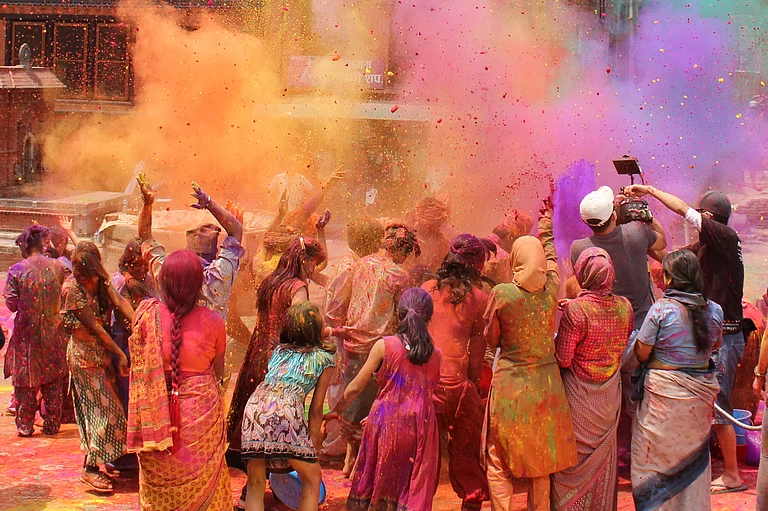
When most people think of Holi, they imagine North India: colours flying, water drenching, and bhaang in hand. But India is far more diverse, and Holi takes many different forms across the country. In West Bengal, it appears as Dol Jatra, a celebration of culture, songs, and community gatherings. In Uttarakhand’s Kumaon region, Holi is a nearly two-month-long musical festival, with classical ragas, Baithki and Khadi gatherings, reflecting the region’s rich cultural traditions. We take a look at some of these unique hyerlocal celebrations.
Holi 2026: A Journey Through India’s Hyperlocal Holi Celebrations
Holi is more than colours and water. Across India, the festival of Holi takes many hyperlocal forms—from Kumaon’s musical Holi to West Bengal’s Dol Jatra and Punjab’s martial Hola Mohalla—each reflecting local culture and tradition. Here's a look

Advertisement
Dol Jatra / Dol Purnima, West Bengal
In West Bengal, Holi takes a hyperlocal form as Dol Jatra, or Dol Purnima, observed on the spring full moon. While Holi in much of North India is tied to the legend of Prahlad, Dol Jatra centres on Krishna and Radha. The day is marked by the application of coloured powders, songs and community gatherings. You can head to Shantiniketan, the historic university town in West Bengal's Birbhum district which has been inscribed as a UNESCO World Heritage Site. It is observed as Basanta Utsav here, a tradition shaped by Rabindranath Tagore.
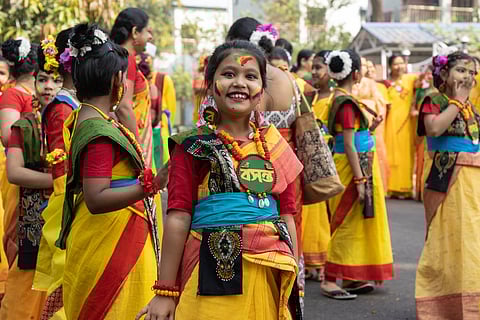
The colours of Dol Jatra light up faces in Shantiniketan soumen82hazra/Shutterstock
The hyperlocal festival is a unique, cultural celebration of both the spring season and Holi. Students and residents participate in a structured, cultural welcome to spring. It replaces North India's aggressive, watery Holi with a refined, artistic 'festival of colours' featuring traditional yellow attire, Rabindra Sangeet, dance, and organic abir.
Advertisement
Hola Mohalla, Punjab
Hola Mohalla is held in Anandpur Sahib and marks an important part of Sikh history. Started in 1701 by Guru Gobind Singh, it celebrates the formation of the Khalsa at Takht Sri Keshgarh Sahib in Punjab, where, in 1699, he baptised five men. The three-day festival begins the day after Holi. The festival sees Nihang Sikhs take part in gatka demonstrations and horse riding displays. Processions, devotional music, and free community meals bring locals and visitors together. The event reflects the principles of courage, unity, and the Sikh way of life.
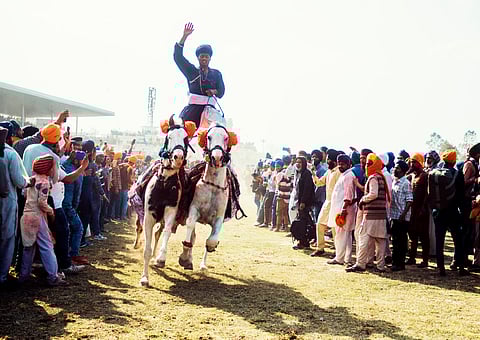
A glimpse of the annual fair of Hola Mohalla celebrations in Anandpur Sahib Siddharth Setia / Shutterstock
Kumaoni Holi, Uttarakhand
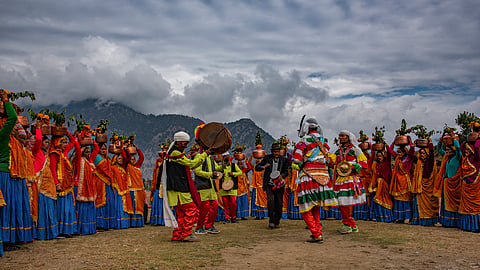
A Choliya dance ritual in Kumaon Shutterstock
This is a music-based festival that lasts nearly two months in the Kumaon region of Uttarakhand, beginning on Basant Panchami and continuing until Holi. Unlike the short, boisterous celebrations elsewhere, it focuses on classical music and community participation. Baithki Holi is held indoors, with men singing Hindustani ragas like Peelu and Bhimpalasi, accompanied by tabla and harmonium. Khadi Holi sees people in white kurta-pyjamas and topis singing and dancing from house to house, while Mahila Holi gives women their own high-energy space. The festival, dating to the 15th-century Chand kings, blends Krishna legends with local traditions and marks the end of winter and the start of spring sowing.
Advertisement
Phaguwa, Bihar
In Bihar, you can experience Phaguwa—a hyperlocal festival rooted in Bhojpuri and Maithili culture. The festival begins with Holika Dahan and stretches across weeks, often from Basant Panchami to the full moon of Phalguna. Neighbourhoods resound with dholak and manjira as Phaguwa geet recount tales of Radha and Krishna. In villages, the ritual of Dhurkheli brings mud-splashed revelry, while parts of Patna and Munger indulge in ‘kurta faad’, a "kurta-tearing" tradition. Plates of malpua circulate, and folk memory honours figures such as Babu Kunwar Singh.
Manjal Kuli, Kerala
In Kerala, Holi turns a luminous shade of yellow. Known as Manjal Kuli, or Ukuli, this hyperlocal celebration is observed largely by the Konkani and Kudumbi communities. Instead of gulal, turmeric mixed with water is splashed on friends and fellow devotees — a gesture of purification and renewal. Around the Kodungalloor Bhagavathy Temple, the ritual folds into temple worship, parikrama and, in some traditions, a bonfire called ‘The Phoddo’, aligning with the wider spring festival.
Advertisement
Laddu Holi, Vrindavan, Uttar Pradesh
This hyperlocal celebration is literally a sweet start to the Braj Holi celebrations. It takes place at Radha Rani Temple in Barsana, near Vrindavan. Priests shower laddoos from the rooftop, which devotees catch and toss at one another. The tradition recalls a priest from Nandgaon who, lacking colours, playfully threw laddoos when delivering Krishna’s Holi invitation to Barsana. Laddu Holi serves as a light-hearted prelude to Lathmar Holi, turning the village into a space of fun, affection, and playful rivalry.
Lathmar Holi, Barsana And Mathura, Uttar Pradesh
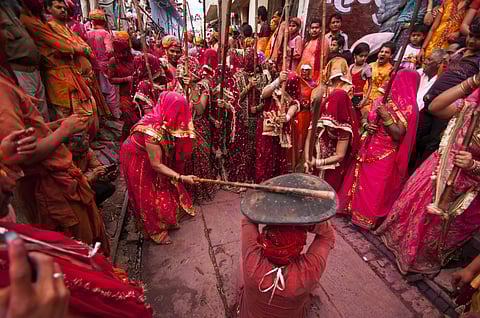
Women beat up men with long sticks as a ritual in the Lathmar Holi celebrations Shutterstock
In this hyperlocal Holi festivity, women playfully beat men with sticks in a reenactment of Radha-Krishna legends, while men shield themselves. The festival marks Krishna’s visit to Radha’s village, where he was chased away by local women. Held mainly at Radha Rani Temple, the morning celebrations feature folk songs, music, and coloured powders. The atmosphere is lively, with the most activity from 10:30 AM to 2 PM, drawing locals and visitors alike into the spirited, playful tradition.
Advertisement
FAQs
When is Holi celebrated?
The different festivals of Holi are held usually in March.
Is Holi celebrated the same way across India?
No. Traditions vary by region, from North India’s colour-throwing to Kumaon’s musical Holi and West Bengal’s Dol Jatra.
How can travellers enjoy Holi safely?
Wear old clothes, protect your eyes, and use natural colours where possible. Carry water and stay aware of crowded areas.
What should visitors know about local customs?
Respect local traditions—join in singing, dancing, and community meals, but follow guidance from locals.
Any travel tips for peak days?
Arrive early in the morning, stay hydrated, and plan transport in advance, as streets are crowded and public transport busy during Holi festivities.
Published At: