Evidence uncovered at an archaeological site near Coimbatore suggests that rhinoceroses once inhabited southern India, far beyond their historically assumed range. Researchers in Tamil Nadu have identified bone remains from the animal at a Neolithic settlement in the foothills of the Western Ghats, with analysis indicating the material is around 3,500 years old. The find calls into question prevailing views that the species was restricted to the northern and north-eastern regions of the subcontinent.
Rare 3,500-Year-Old Rhino Bones Unearthed In Western Ghats, Tamil Nadu
Archaeologists near Coimbatore have unearthed 3,500-year-old rhinoceros fossils at a Neolithic site in the Western Ghats, revealing that these massive animals once roamed southern India, challenging the belief they were confined to the northeast

Advertisement
Neolithic Site Yields Rare Fossils
The fragments were identified during archaeological work at a prehistoric settlement on the fringes of the Western Ghats, a region that once supported a far wider range of plant and animal life than it does today. Analysis of the surrounding soil layers suggests the bones were deposited during a period of significant environmental change, with scientific dating placing them about 3,500 years in the past. Researchers believe the bones may belong to the Indian one-horned rhinoceros, though years of exposure have made precise identification challenging.
The structure and thickness of the fragments indicate the animals were well adapted to the wetlands and open grasslands that once dominated the region. Ongoing comparisons with museum collections across Asia aim to clarify their origins, and future DNA analysis could uncover previously unknown evolutionary links. At that time, the landscape is thought to have included river-fed plains and open grasslands, conditions favourable for large herbivores, including rhinoceroses.
Advertisement
What The Discovery Means
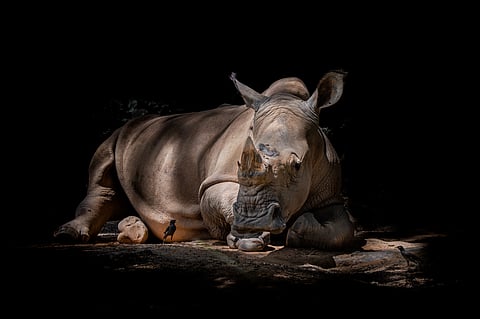
A Javan rhino sits in its habitat Pixabay
Rhinoceros fossils are extremely rare in southern India, with most previous finds concentrated in Assam, Bengal and the Himalayan plains. The discovery near Coimbatore has taken researchers and conservationists by surprise, and experts describe it as one of the country’s most significant prehistoric wildlife finds. Very few comparable specimens are preserved in national museum collections, making the Coimbatore fragment a valuable addition that sheds new light on India’s environmental history.
The discovery offers profound insight into India’s ecological history and serves as a stark reminder of the consequences of habitat loss. It fundamentally alters the known range of the Indian one-horned rhinoceros (Rhinoceros unicornis), showing that these enormous animals once thrived in the wetlands and grasslands of southern India long before their populations became confined to the northeast.
The Indication Of Habitat Changes
The presence of rhinos in the Neolithic (Stone Age) Tamil Nadu suggests the region was not always as densely human-populated or dry as it appears today. Instead, the Western Ghats foothills once supported vast, watery, and lush marshy wetlands and open savannahs suitable for mega-herbivores.
Advertisement
While prehistoric climate changes may have gradually driven them from the region, modern threats such as poaching, deforestation and shrinking protected areas make the preservation of wetlands and forest corridors more urgent than ever.
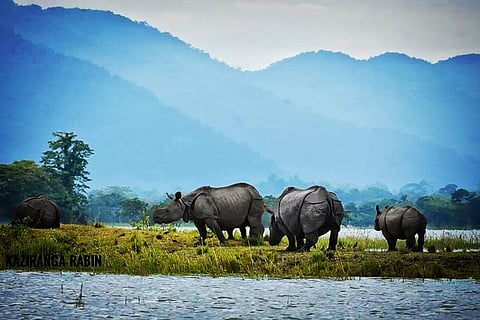
Rhinos at Kaziranga National Park, Assam kaziranganationalpark/instagram
The rhinoceros is a keystone species that depends on specific alluvial grasslands and riverine ecosystems. The disappearance of the rhino indicates that these habitats vanished, likely due to a combination of climate shifts (drier conditions) and increasing human land use.
Moreover, as human communities in the South shifted toward more intensive agriculture and, eventually, early urban settlements, the vast grazing lands necessary for rhinos were destroyed.
FAQs
What was discovered near Coimbatore?
Archaeologists uncovered bone fragments of a rhinoceros at a Neolithic site near the Western Ghats foothills.
How old are the fossils?
Carbon dating shows the remains are around 3,500 years old.
Why is this discovery important?
It proves that the Indian one-horned rhinoceros once lived in southern India, far beyond its previously known range.
Advertisement
What does it reveal about ancient environments?
The bones indicate the region once had wetlands, grasslands and slow-flowing rivers, capable of supporting large grazing mammals.
How rare are such fossils in southern India?
Extremely rare; most rhinoceros fossils in India come from the northeast and Himalayan plains, and very few are preserved in museum collections.
Published At: