The devastating flash floods along the Nepal-China border have left hundreds dead and thousands missing, with rescue teams still searching for survivors in some of the worst-hit areas.
Nepal Flash Floods: What We Know So Far About The Death Toll, Missing People, And Rescue Efforts
Nepal continues rescue operations after devastating flash floods killed hundreds and left thousands missing across the affected border region

Advertisement
The floods struck on Wednesday, August 26, after a powerful glacier collapse and landslide sent a huge wave of water, ice, rock, and debris through mountain valleys in northern Nepal and Tibet. The disaster swept away roads, bridges, homes, and entire sections of border infrastructure, while leaving many pilgrims, tourists, and workers stranded or unaccounted for.
Here is what we know so far.
Nepal Flash Floods Death Toll Crosses 626

Rescue operations continue in Nepal as hundreds remain missing after the disaster Instagram: @nepalunfiltered_official
The death toll in Nepal has is said to have crossed 600, according to the latest reports, while Chinese state media has reported seven deaths in Tibet.
The numbers are expected to change as rescue teams reach areas that remain difficult to access. Nepal's disaster authorities had earlier reported 579 deaths on Friday, showing how quickly the scale of the disaster has been emerging.
In India, authorities have also recovered seven bodies from rivers flowing from Nepal. They are believed to be victims of the flooding.
Advertisement
More Than 2,000 People Are Missing
The number of people still missing remains one of the biggest concerns. More than 2,000 people are reported missing across Nepal and Tibet. Nepal's disaster authorities had reported 1,924 missing people, including hundreds of foreign nationals and workers at hydropower projects.
In Tibet, Chinese authorities have reported more than 550 people still unaccounted for in Gyirong County, where the flood caused extensive destruction. The numbers include local residents, workers, tourists, and pilgrims who were travelling through the region when the disaster struck.
At Least 320 Indians Remain Uncontactable
The disaster has also affected a large number of Indian nationals travelling through Nepal and Tibet. India's Ministry of External Affairs said on Friday that at least 320 Indians remained uncontactable, while around 400 others were stranded on the Chinese side of the border.
Many Indians were travelling on pilgrimages to Mount Kailash, making the situation particularly difficult for families waiting for news.
Advertisement
So far, 96 Indian nationals stranded on the Chinese side have safely crossed into Nepal by land. Another 21 pilgrims reached New Delhi after being rescued from the affected areas and travelling through Kathmandu.
Several state governments are also trying to trace their residents. In Maharashtra, 404 people were reported stranded but safe in Nepal, while 60 tourists remained untraceable. In West Bengal, 39 people had initially been reported missing, of whom two were later contacted and confirmed safe.
A group of 77 pilgrims associated with the Isha Foundation also remained out of contact after the floods.
Thousands Rescued As Search Operations Continue
Despite the scale of the destruction, rescue teams have managed to evacuate thousands of people. More than 3,700 people have been rescued in Nepal, while Chinese authorities have evacuated hundreds of tourists and residents from Tibet.
The biggest challenge now is reaching areas cut off by the flood. Roads and bridges have been destroyed, while mud, rocks and debris have blocked access to several locations.
Advertisement
Nepal has also been searching for more than 100 people believed to be trapped inside a hydropower tunnel in Rasuwa district. Helicopters have been deployed as authorities try to establish whether those inside can still be reached.
India has offered specialised assistance for the difficult tunnel rescue, along with other technical support.
What Caused The Nepal Flash Floods?

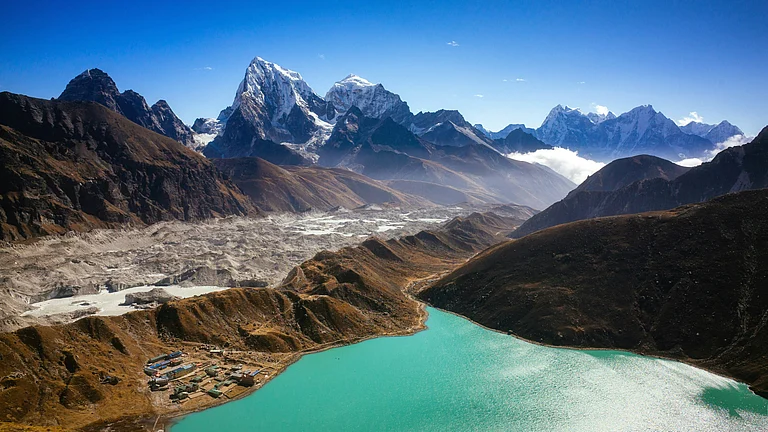
The Bhotekoshi River swelled following the glacial collapse and debris flow Unsplash
Scientists investigating the disaster believe it was not a conventional rain-triggered flash flood.
The event appears to have begun with a massive glacier collapse and landslide high in the Himalayas. The initial ground movement was detected at around 8:37 AM on Wednesday and was initially identified as an earthquake by an automated monitoring system. It was later understood to have been caused by the glacier's collapse and debris flow.
A large section of the glacier is believed to have broken away from the mountain and plunged roughly 7,000 feet towards the river below. A landslide may have occurred at the same time, adding huge amounts of rock and debris to the flow.
Advertisement
The resulting torrent entered the Lhende Khola River before moving into the Bhote Koshi River system.
Scientists estimate that the flood wave travelled around 22 kilometres at an average speed of 193 kilometres per hour. It carried water, ice, rock, and sediment through narrow Himalayan valleys, giving people very little time to react.
Climate Change May Have Increased The Risk
The exact chain of events is still being studied, but scientists say climate change could have contributed to the conditions that enabled the disaster.
The Himalayan region is warming rapidly, and glaciers across the Hindu Kush Himalaya are losing ice at an increasing rate. Research has found that the rate of glacier ice loss in the region has doubled since 2000.
As glaciers shrink, mountain slopes and ice formations can become less stable. This can increase the risk of glacier collapses, landslides and glacial lake-related floods.
However, scientists are still examining exactly how much climate change contributed to this particular event.
Advertisement
Risk Of Another Flash Flood Raises Concern
The danger has not completely passed. Authorities issued a fresh warning on Friday after water levels rose in the Bhote Koshi River area, raising fears of another flash flood.
Two new glacial lakes have also been identified near the apparent source of the ice-rock avalanche. Authorities currently do not have enough information about the volume of water stored in them or whether there could be a significant outflow.
This has added another layer of concern for communities and rescue teams working in the region.
Nepal Seeks Specialised Help For Rescue And Recovery
Nepal has said it needs specialised technical assistance for some of the more difficult rescue operations, including the search for the hydropower tunnel and the identification and storage of bodies.
The government has also asked India and China for Bailey bridges, which can be installed relatively quickly and could help restore access to areas cut off by the disaster.
Advertisement
India, the European Union and Canada are among those that have offered support. Canada has announced CAD 5 million in humanitarian assistance, while the European Union has pledged EUR 2 million for emergency relief.
For now, rescue teams remain focused on reaching people who are still missing, helping survivors and restoring access to some of the worst-hit parts of the Nepal-Tibet border. With several areas yet to be fully assessed, the final scale of the disaster is still likely to become clearer in the days ahead.
(With inputs from various sources)
FAQs
1. What is the latest death toll from the Nepal flash floods?
The death toll in Nepal has crossed 600, while seven deaths have been reported in Tibet.
2. How many people are missing after the Nepal floods?
More than 2,000 people are reported missing across Nepal and Tibet, although the numbers could change as rescue teams reach more areas.
Advertisement
3. How many Indians are still uncontactable?
India’s Ministry of External Affairs said around 320 Indian nationals remained uncontactable, while about 400 others were stranded on the Chinese side of the border.
4. What caused the Nepal flash floods?
The disaster appears to have been triggered by a major glacier collapse and landslide in the Himalayas, sending water, ice, rocks and debris into the river system.
5. Are rescue operations still continuing in Nepal?
Yes. Rescue teams are continuing to search for missing people and reach isolated areas, including a hydropower tunnel where more than 100 people are believed to be trapped.
Published At:
Tags