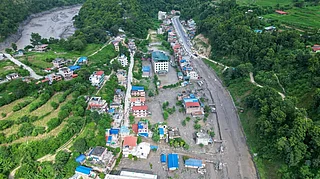


At least 157 people have been killed and more than 400, including around 133 Indian nationals, remain missing or out of contact after a massive flash flood swept through Nepal’s Rasuwa district on August 26. The disaster affected areas along the Bhotekoshi River near the Nepal-Tibet border, with Syapru Besi and Timure among the worst-hit locations. The flooding also caused extensive damage to roads and bridges, with authorities reporting 19 motorable bridges and around 40 kilometres of road damaged.
The disaster has disrupted an important route connecting Kathmandu with western Nepal, the Terai and the border with India. Search-and-rescue operations involving Nepal’s security forces are continuing, while India, China, the US and other countries have offered assistance. Indian authorities have also begun sending relief materials, and the Indian Embassy in Nepal has issued emergency numbers for affected nationals.
Rasuwa Among The Worst-Affected Areas
The flash flood swept through settlements along the Bhotekoshi River, which flows from Tibet into Nepal. Rasuwa, particularly Syapru Besi and Timure, has suffered extensive damage, while flooding and related damage have also been reported along the Trishuli River in neighbouring Nuwakot. The main road to Kathmandu remains closed, complicating access to the affected areas.


The disaster has also affected the Gyirong area on the Chinese side of the border, where fatalities have been reported. Several Nepalese security personnel, government officials and hydropower project workers are also among those missing.
The region is popular with trekkers and pilgrims, and hundreds of travellers are among those unaccounted for. Authorities have warned that the death toll could rise as rescue teams gain access to areas cut off by damaged roads and bridges.
Scientists Point To A Glacial Collapse
Initial reports suggested that a magnitude 4.4 earthquake near the Tibet-Nepal border may have triggered an avalanche and subsequent flooding. However, the US Geological Survey (USGS) later said its analysis indicated that the seismic event was not an earthquake but a glacial collapse and debris flow.
According to the USGS, analysis of seismic data and satellite imagery indicated that a glacial collapse generated the event and caused catastrophic impacts downstream. Geologists in Nepal and elsewhere have similarly suggested that an ice-rock avalanche may have fallen from high elevation, generating a large volume of water and debris.
Scientists have also pointed to climate change as a possible factor in the wider vulnerability of Himalayan glaciers, although they have stressed that it is too early to establish its role in this particular disaster. The exact sequence of events leading to the flash floods is still being assessed.
There are also concerns about the possibility of another flood. Scientists have warned that debris may have blocked a river upstream near the Nepal-China border, potentially creating another surge if the blockage gives way. Flood alerts have consequently been issued in parts of the Indian states of Bihar and Uttar Pradesh, where rivers originating in the Himalayas flow into the plains.

India And Other Countries Send Assistance
India has offered humanitarian assistance to Nepal, with the first tranche of relief materials and essential medicines dispatched aboard an Indian Air Force C-130J aircraft. New Delhi has also offered support for rescue and relief operations and expressed condolences to those affected.
China has mounted a parallel response on its side of the border, with President Xi Jinping calling for intensified search efforts and stronger monitoring and early-warning measures. The US has pledged USD 500,000 in emergency assistance and is deploying a disaster-response adviser. South Korea is also sending a rapid-response team after several of its nationals were reported missing.
Emergency Helpline Numbers
Indian Embassy in Kathmandu: +977 9851316807 | +977 9709107500
Armed Police Force (APF), Nepal: 1114
Nepal Police: 100
Ambulance: 102
District Emergency Operations Center (DEOC): 2019
Rasuwa
Assistant Chief District Officer (Assistant CDO): 9851164422
Rasuwa Police: 9851254960
Nuwakot
Assistant Chief District Officer: 9851248777
Nuwakot Police: 9851282380
Dhading
Chief District Officer (CDO): 9851247777
Dhading Police: 9851229860
Chitwan
Assistant Chief District Officer: 9855088891
Chitwan Police: 9855013999
Indian State Helplines
West Bengal: 033-24793311 | 9147890181
Uttar Pradesh: 1070
Maharashtra: 1070 | +91-9321587143
Kerala – NORKA Global Contact Centre: 18004253939 | +91-8802012345
Kerala CMO: 9447111844 | 9747132147
Sikkim: 03592-201145 | 03592-202461 | 03592-202256
Odisha: +91-7428135044 | +91-8527580245 | 011-23012807
Uttarakhand: 1070 | 0135-2710334 | 0135-2710335 | 0135-2664314 | 0135-2664315 | 0135-2664316 | 8218867005
Chhattisgarh: 1070 | +91-771-2223471
FAQs
1. How many people have died in the Nepal flash floods?
At least 157 people have been killed in the flash floods that hit Nepal’s Rasuwa district and surrounding areas.
2. How many people are missing in the Nepal floods?
More than 400 people are missing or out of contact, including around 133 Indian nationals.
3. Which areas of Nepal have been affected by the floods?
Rasuwa district, particularly Syapru Besi and Timure, is among the worst-affected areas. Damage has also been reported along the Trishuli River in Nuwakot.
4. What caused the Nepal flash floods?
The US Geological Survey said the event initially reported as an earthquake was instead a glacial collapse and debris flow. Scientists have suggested that an ice-rock avalanche may have generated the flooding, although the exact sequence of events is still being assessed.
5. Are more floods possible in Nepal?
Scientists have warned that debris blocking a river upstream near the Nepal-China border could potentially trigger another surge of floodwater. Flood alerts have also been issued in Bihar and Uttar Pradesh in India.