For ten years now, India’s biggest cities have lived under a permanent film of grey, a haze so familiar that many stopped noticing it, even as it silently reshaped daily life. A new analysis by a New Delhi organisation Climate Trends, based on long-term CPCB data across 11 major metros, has now confirmed the uncomfortable truth: from 2015 to 2025, not a single Indian city recorded air that could be called ‘safe’. The report may be technical, but its message lands with force—India is breathing dirty air all year round, and the reasons go far deeper than the usual winter villains.
A Decade Of Smog: No Indian Metro Has Breathed Safe Air Since 2015; Experts Weigh In
From Delhi to Bengaluru, India’s metros have lived under unsafe air for a decade. What’s going wrong?

Advertisement
Ten Years, No Relief
Delhi remains the biggest outlier in the worst way possible. Its annual average AQI has barely budged from the highs of the mid-2010s, slipping from peaks above 250 in 2016 to roughly 180 in 2025, marginal improvements that do nothing to pull it into safe zones. And while stubble-burning has long taken the blame, this year offered a reality check. Even with a dramatic fall in farm fires, the capital choked under an earlier, denser smog layer. With no rain since October 1, weak Western Disturbances, and a sharp temperature inversion, pollutants simply stayed put—a reminder that North India’s meteorology can overpower even the best-intentioned interventions.
This isn’t new to experts. As Anumita Roychowdhury, Executive Director Research and Advocacy, Centre for Science & Environment, points out, “Nowhere in India do we meet the WHO air-quality guideline… anything above that is technically unsafe.” The Indo-Gangetic Plain, she adds, is “a constrained geography with mountains on one side and no sea breeze; pollution here doesn’t just accumulate, it gets trapped.”
Advertisement
Lucknow, Varanasi and Ahmedabad echo the same pattern—high AQIs in the early part of the decade, slight dips after 2020, but no movement into genuinely healthy territory. Southern and western metros like Mumbai, Chennai, Pune, and Visakhapatnam show moderate readings, typically 80–140, but not one of them has crossed the line into what global standards would consider acceptable.
Even Bengaluru, which many Indians think of as a pocket of clean air, has never once touched the “Good” category. Its decade-long range of 65–90 is better than the north, but still above what’s considered safe for long-term exposure.
Why Solutions Stall
If the data feels repetitive, that’s because the underlying story hardly changes. India’s rapid growth has outpaced the systems needed to keep pollution in check. Roychowdhury puts it bluntly: “India is urbanising, motorising and industrialising, but without the safeguards we should have built into that growth.”
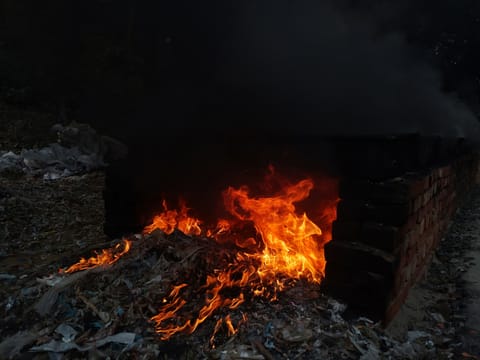
Open burning of waste adds toxic smoke to India’s already hazardous city air Unsplash
Her frustration is evident in the basics. Waste burning—a major source of local pollution—should have been eliminated by now. “Why should any waste burn in Delhi?” she asks. “Every municipality should have had the infrastructure to collect segregated waste and remediate legacy landfills.” Transport is no better. Delhi’s public transport share should ideally be 80 percent; instead, personal vehicles crowd every corner, feeding congestion and emissions.
Advertisement
There are bright spots, but they are isolated. Roychowdhury mentions Indore, which hasn’t seen a single waste-burning incident since 2021 and now runs 400 buses on compressed biogas produced from municipal waste. “Good practices,” she says, “but too small to change the national picture.”
The Psychology Of Inaction
But structural issues are only half the story. The other half is more human. If everyone knows the air is toxic, why doesn’t collective action match the scale of the crisis?
London-based Greg Klerkx, the founder of Climate Shift, a Community Interest Company (CIC) registered in the UK, argues that people react to lived experience, not data bombs. “Normalcy bias fools us into thinking poor air is simply how it is,” he explains. On the other hand, individuals who do want change often feel powerless against a problem so large it feels immovable. “That sense of paralysis,” he says, “is common—and completely wrong.”
Advertisement
Klerkx believes the key lies in small, community-driven wins: neighbourhood recycling drives, citizen letters to local representatives, collaborative climate groups. Think of them as momentum builders rather than miracle cures. “A million raindrops create a river,” he says. “Small actions matter because they add up.”
He also stresses that messaging needs a reset. Instead of abstract slogans, he focuses on values—health, family, dignity, quality of life. “What we value defines what we’ll work for,” he says. If people see how pollution harms the things they hold closest, action feels personal, not abstract.
And yes, collective norms can shift outcomes. Klerkx points to London’s congestion charge—driven by communities, embraced by politics, reinforced by media, that ultimately reduced traffic and improved air quality. It wasn’t easy, but it worked because thousands pushed consistently in the same direction.
For India, he suggests something similar: organised citizen voices, steady pressure, small steps that build confidence, and a culture that celebrates local successes rather than waiting for sweeping reforms. “Institutions pay attention when citizens are organised, clear, and consistent,” he says.
Advertisement
Bridging Data & Daily Life
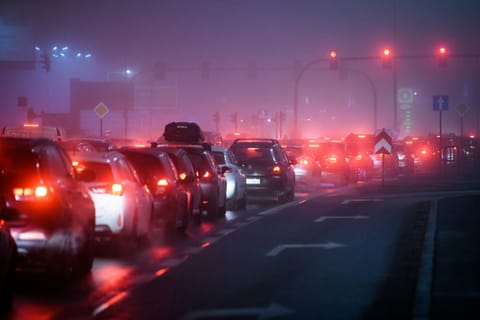
Traffic, industry, and geography combine to trap pollutants over northern India, creating year-round smog Unsplash
Experts also caution that awareness alone isn’t enough. Purnima Joshi, Communications Coordinator at Climate Action Network South Asia, stresses that “numbers don’t become behaviour because we rarely translate AQI into simple, immediate actions that fit a family’s daily choices.” She points out that urban residents often feel powerless when cleaner options cost time or money, or when public systems fail, leaving behaviour change stalled.
Messaging too often spikes only during crises, she adds, while “sustained change needs continuous storytelling, neighbourhood champions, routine feedback… and campaigns that normalise new habits by linking them to daily gains, health, money saved, cleaner commutes.” Local communities, she notes, show what works: small, visible wins such as compost corners, clean-street days, or demonstrations can shift norms. Digital tools, apps, and citizen science can turn “invisible” pollution into actionable insight, empowering residents, from street vendors to traffic police, to take targeted steps, while also holding authorities accountable with clear, measurable tasks. In short, bridging the gap between data and daily life is as much about communication, trust, and convenience as it is about technology or regulation.
Advertisement
The Way Ahead
Experts agree that technological and policy tools already exist. The missing piece is scale, speed and coordination. Roychowdhury says, “All the solutions are known. What we lack is the ability to translate them with the scale and speed the crisis demands.” She argues that India’s monitoring network, though expanding, must evolve into a multi-layered system combining regulatory monitors, sensors and satellite data, only then can cities act with precision rather than guesswork.
And perhaps most importantly, she warns against “false solutions”—more flyovers, wider roads, more space for cars. “Redirect that money to public transport and electrification,” she says. “That’s where real clean-air gains come from.”
Ten years of data leave little room for denial. Safe air is missing everywhere, meteorology is worsening the baseline, and cities are struggling to keep pace with their own growth. But the path forward, a mix of science, accountability and community-led momentum, is clearer than ever.
Advertisement
FAQs
1. Why do Indian cities have such poor air quality?
Rapid urbanisation, industrialisation, motorisation, and weak infrastructure for waste management and public transport have combined with geographical and meteorological factors to trap pollutants, keeping air unsafe across cities.
2. Have any Indian cities ever met safe air standards?
No. According to Climate Trends’ analysis of CPCB data from 2015–2025, not a single metro in India has consistently met the WHO guideline for safe air (5 µg/m³ of PM2.5).
3. Are southern and western metros better than northern ones?
Yes, cities like Mumbai, Chennai, Pune, and Visakhapatnam generally show lower pollution levels due to better natural ventilation and coastal geography, but even these cities have not reached truly safe air levels.
4. What solutions exist to improve air quality?
Experts say solutions are well-known: better waste management, electrification of vehicles, public transport expansion, clean fuels, and stricter emission controls. The challenge is scaling and implementing them nationwide.
Advertisement
5. Why don’t people act despite knowing the air is toxic?
Psychological factors like “normalcy bias” and feelings of powerlessness prevent collective action. Experts suggest small, local, community-driven initiatives can build momentum and pressure institutions to act.

Published At: