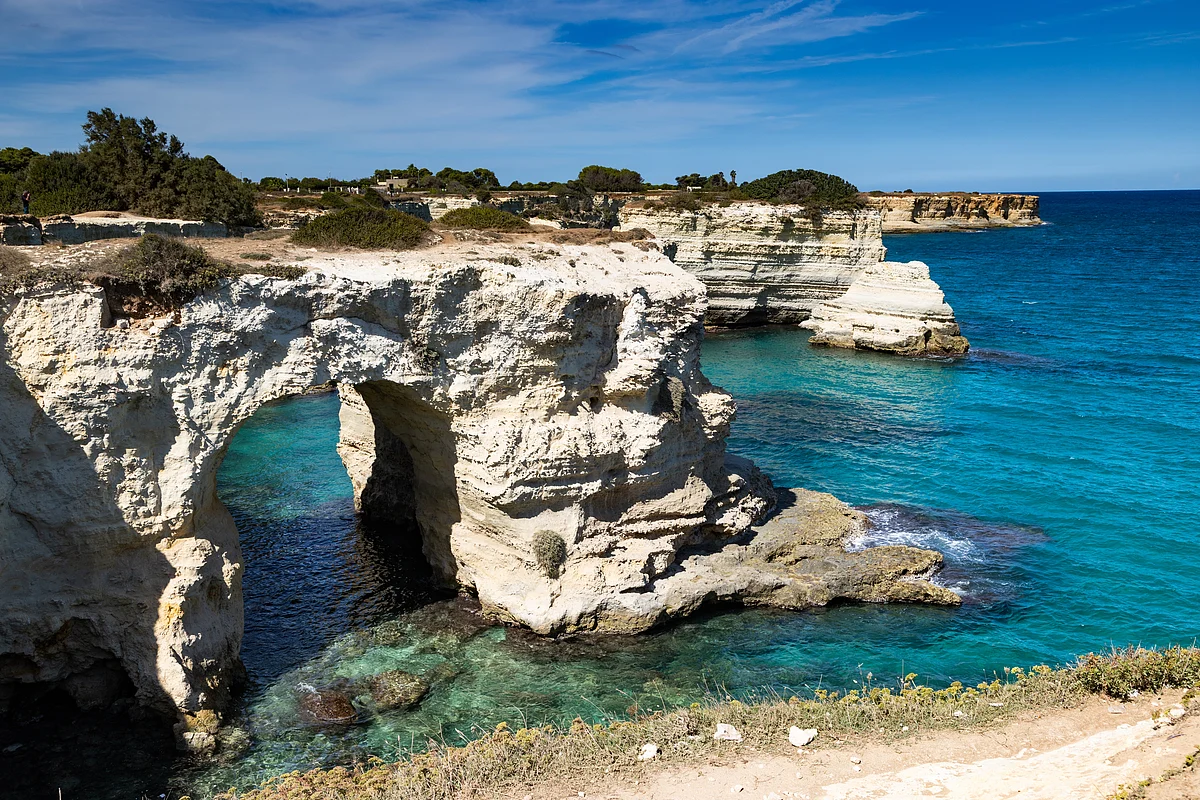
A renowned natural landmark on Italy’s Adriatic coast collapsed into the sea on Valentine’s Day, marking the sudden loss of one of Puglia’s most photographed rock formations.
About The Lovers' Arch Of Italy
The Lovers’ Arch, located near Sant’Andrea in the municipality of Melendugno in Puglia’s Salento region, gave way on February 14, 2026, following days of intense storms that battered southern Italy. Authorities confirmed that there were no injuries or damage to property in the incident.
For years, the natural limestone arch had been a romantic and tourist icon. In the days prior to its collapse, much of southern Italy endured severe weather patterns, including heavy rains, strong winds, and turbulent seas.
Officials said the adverse weather accelerated ongoing coastal erosion, weakening the calcarenite rock structure that supported the arch. Early on February 14, parts of the formation gave way, and the structure collapsed into the sea.


Local authorities monitored the site after residents reported visible cracks in surrounding cliffs in recent months. Experts have repeatedly warned that the Salento coastline remains vulnerable to erosion, particularly during periods of extreme weather.
Officials Announce Coastal Assessments
Maurizio Cisternino, mayor of Melendugno, described the collapse as “an unwanted Valentine’s Day gift” and acknowledged the emotional and economic impact on the community. He said the landmark played a central role in the area’s tourism appeal and local identity.

Antonio Decaro, president of the Puglia region, said the incident underscores the urgency of addressing coastal erosion and climate-related risks along Italy’s southern shores. He noted that other sections of the coastline show signs of structural weakness and require closer monitoring.
Authorities have not announced plans to reconstruct the arch, given the fact that it was a natural formation shaped entirely by geological processes. Instead, local authorities have indicated that they will perform technical assessments on the closeness of adjacent cliffs to determine how to best stabilise or prevent further land loss.
The collapse of the Lovers’ Arch has received international attention due to its ties to love during Valentine’s Day; while there were no fatalities involved, its loss will forever change the landscape of Puglia’s Adriatic Coast and increase concerns regarding the protection of natural resources for future generations.
(With inputs from various sources.)
FAQs
1. Where was the Lovers’ Arch located?
The Lovers’ Arch was a natural limestone formation near Sant’Andrea in the municipality of Melendugno, in Italy’s Puglia region along the Adriatic Sea.
2. When did the Lovers’ Arch collapse?
The arch collapsed on February 14, 2026, following days of severe storms and rough sea conditions along southern Italy’s coastline.
3. What caused the collapse of the Lovers’ Arch?
Officials said intense storms accelerated existing coastal erosion, weakening the calcarenite rock structure until it gave way and fell into the sea.
4. Were there any injuries reported?
No injuries or property damage were reported in connection with the collapse.
5. Will the Lovers’ Arch be rebuilt?
Authorities have not announced reconstruction plans, as it was a natural geological formation. Instead, technical assessments are being conducted to monitor nearby cliffs and prevent further erosion.