

There is something different about reaching a mountain lodge on foot. The road gradually falls behind, the sounds of traffic give way to birdsong, and the landscape reveals itself one turn at a time. By the time you reach your accommodation, the mountains are no longer just a distant view framed by a hotel window. You have walked through them, crossed their forests and fields, and encountered the people who call them home.
This is the idea at the heart of Shakti Himalaya, a collection of private walking experiences across the Indian Himalayas. In Kumaon, Uttarakhand, the journey leads through remote settlements and terraced hillsides before culminating at Shakti Prana, a mountain lodge that brings together thoughtful architecture, regional food, and sweeping views of the Himalayan ranges. Here, the luxury lies as much in the journey as in the place where it ends.
A Different Way To Discover Kumaon
Kumaon has long drawn pilgrims, spiritual seekers, and travellers looking for a quieter side of the Himalayas. Its landscape moves between pine and rhododendron forests, terraced villages, ancient shrines, and ridgelines opening towards Nanda Devi. Yet much of the region remains beyond the usual tourist circuit, partly because getting around its remote settlements requires time and a willingness to travel slowly.


Shakti's village walks offer a way into this landscape. Rather than returning to the same hotel every evening, guests move between restored village houses, accompanied by a guide, with porters carrying their luggage and a private chef preparing meals along the way. The walks can be tailored to suit different abilities, from gentle stretches through villages and forests to more demanding hikes. Picnics are arranged along the trails, while visits to temples and local homes add a cultural dimension to the experience.
A seven-night Kumaon itinerary, for instance, begins with a drive from Kathgodam or Pantnagar to Kana. From there, guests walk towards the ancient Jageshwar temple complex, whose stone shrines date largely from the early medieval period, before continuing along forest trails to Jwalabanj. The route then takes them closer to Panchachuli, through terraced fields and pine forests near Binsar Wildlife Sanctuary. Along the way, the landscape is as much a part of the experience as the destination: birds appear among the branches, villages emerge around bends in the trail, and the Himalayan peaks come into view when the skies are clear.
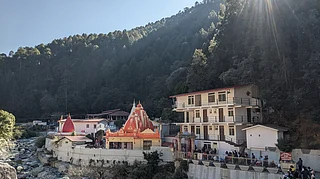
The village houses make these pauses feel like a continuation of the journey rather than a retreat from it. In Kana and Jwalabanj, traditional structures have been restored with contemporary comforts, retaining their connection to the surrounding settlements. At Panchachuli, a property positioned for expansive mountain views offers another stop along the route. Evenings are spent over home-cooked meals, by a fire, or simply watching the light fade across the hills.
The Mountain At The End Of The Trail
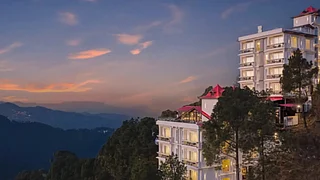
The final ascent towards Prana brings the Kumaon experience to a different scale. Set at around 7,000 ft, the lodge overlooks a landscape of mountain ridges and river valleys, with views towards the Himalayan ranges. Its seven accommodation units are arranged around a larger communal building, where a living room, library, and dining space encourage guests to spend time together.

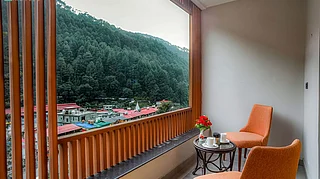
Designed by Mumbai-based Case Design, led by Samuel Barclay, Prana takes its cues from the terrain rather than imposing a decorative style upon it. Stone, timber, and copper form the main vocabulary of the buildings, which sit along the contours of the slope. The use of locally grounded materials gives the structures a sense of belonging to the mountain, while large windows bring the surrounding landscape into the rooms. A double-sided fireplace connects the living room and library, creating a warm gathering point as temperatures drop outside.
The lodge also tells a story of adaptive reuse. Its design draws on elements of Leti 360, Shakti's earlier property in the region, which was dismantled after closing, with its components transported to the new site and incorporated into Prana. The result is not a replica but a reworking of an earlier architectural experiment, adapted to a different setting.
The experience here is deliberately unhurried. Guests can spend their days on guided walks, with picnic hampers packed for longer excursions, or stay closer to the lodge and make use of its yoga pavilion, treetop meditation platforms, and forest sauna. There are cooking sessions with the private chef, too, offering a chance to learn about the food being served at the table. Meals draw on regional and local ingredients, while the service is designed around the needs of each private group rather than a fixed hotel schedule.
Prana's relationship with its surroundings also extends beyond its architecture. Solar power supports its energy needs, while rainwater and snowmelt are collected through a reservoir system. Greenhouses provide produce for the kitchen, and the landscape is planted with a mix of native shrubs and other vegetation suited to the mountain environment.
Beyond The Lodge: Discovering Kumaon's Heritage

A stay at Prana also offers an opportunity to explore the cultural and natural heritage of Kumaon, with several of the region's significant temples and historic sites within reach. Among the highlights is Jageshwar Dham, a complex of more than 100 stone temples dedicated largely to Lord Shiva, set amid a dense deodar forest beside the Jata Ganga stream. The neighbouring Dandeshwar temple group and the smaller shrines of Adi Jageshwar offer further glimpses into the region's medieval temple architecture and its long history of Shaivite worship. Another important stop is Kasar Devi Temple, believed to date back to the 2nd century CE. Perched above Almora, it is associated with Swami Vivekananda, who visited the shrine in the 1890s, as well as the international counterculture movement of the 1960s and 1970s. Travellers can also visit Chitai Golu Devta Temple, dedicated to Kumaon's much-revered deity of justice, where thousands of bells hang from the premises as offerings from devotees whose wishes have been fulfilled.
Beyond the temples, the region has plenty to offer those interested in its natural and archaeological heritage. The Katarmal Sun Temple, an 11th-century shrine dedicated to Surya, is another worthwhile excursion, reached by a walk through the surrounding hills. Nature lovers can spend time exploring Binsar Wildlife Sanctuary, known for its oak and rhododendron forests, rich birdlife and viewpoints overlooking peaks such as Nanda Devi, Trishul and Panchachuli. For a glimpse into the area's prehistoric past, Lakhudiyar, near Almora, has rock shelters bearing ancient paintings that offer insights into early human settlements in the Himalayan region. A visit to Almora itself can include the Nanda Devi Temple and the Govind Ballabh Pant Museum, which houses archaeological artefacts associated with the Chand and Katyuri dynasties, alongside examples of Kumaoni folk art.
Journeys That Stay With The Mountains
Shakti Himalaya was founded by Jamshyd Sethna, whose own connection with the mountains shaped the idea of creating comfortable, well-designed bases in places that conventional luxury travel had largely overlooked. The village walks grew from a simple proposition: travellers should be able to experience remote Himalayan communities without separating themselves from their everyday realities or compromising on comfort.

Local employment is central to this model. Staff are recruited from the villages in which the properties operate, allowing people to earn a livelihood without having to leave their communities. The company also says that a significant share of guest spending remains within the local economy. Its village houses and Prana are solar-powered, while waste is separated and food scraps are reused as animal feed.
The same approach extends beyond Kumaon. Shakti operates walking experiences in Sikkim and Ladakh, each shaped around the landscape and the time of year. In Sikkim, journeys between village houses pass through cardamom fields, rhododendron ridges, and Lepcha and Bhutia settlements, with stops at monasteries and traditional homes. In Ladakh, the experience shifts to a high-altitude desert of monasteries, river valleys, and stark mountain scenery. Guests can explore places such as Alchi and Lamayuru, visit local metalworkers in Chilling, and take rafting excursions along the Zanskar and Indus rivers.
The seasons determine where these journeys are best experienced: Kumaon and Sikkim are generally offered from October to April, while Ladakh's walking season runs from May to September.
At Prana, the mountains may be the first thing that catches the eye, but they are not the only reason to stay. The experience is shaped by the paths connecting one village to another, the meals prepared after a day's walk, the conversations along the way, and the quiet rhythm of life at high altitude. By the time travellers arrive at the lodge, they have already begun to understand the place around them. And that, perhaps, is the point of Shakti's approach to the Himalayas: not simply to find a beautiful place to stay, but to understand what lies beyond its windows.
The Information
Address: near Kasar Devi, Kumaon region (at roughly 6,300 to 7,000 feet elevation, accessed via a short walk from the nearest road in the Kumaon valley)
Tariff: The all-inclusive packages start at approximately INR 3 lakh per person for a three-night stay, going up to INR 7.96 lakh per person for a comprehensive seven- to eight-night village walk and lodge package.
Contact: +91 124 456 3899, info@shaktihimalaya.com
Website: shaktihimalaya.com
FAQs
1. Where is Shakti Prana located?
Shakti Prana is a mountain lodge in the Kumaon region of Uttarakhand, situated at approximately 7,000 feet. It offers views of the surrounding Himalayan ranges, mountain ridges and river valleys.
2. What makes Shakti Prana different from other luxury Himalayan lodges?
Shakti Prana is part of Shakti Himalaya's collection of walking experiences. Rather than focusing solely on the accommodation, the experience combines guided village walks, forest trails, stays in restored traditional homes, regional cuisine and time spent exploring local communities.
3. What activities can guests enjoy at Shakti Prana?
Guests can take guided mountain walks, enjoy picnics, participate in cooking sessions with the private chef, practise yoga, visit treetop meditation platforms and unwind in the forest sauna.
4. What is included in the Shakti Himalaya Kumaon walking experience?
The Kumaon walking itinerary includes guided trails connecting remote villages, stays in restored village houses and mountain properties, meals prepared by a private chef, cultural visits and excursions through forests and terraced landscapes. The seven-night itinerary can begin with a drive from Kathgodam or Pantnagar to Kana.
5. When is the best time to experience Shakti Himalaya's walking holidays?
Shakti Himalaya generally offers its Kumaon and Sikkim walking experiences between October and April. Its Ladakh walking season runs from May to September, depending on weather and local conditions.