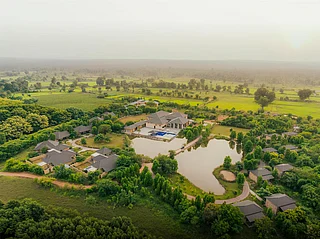


The road to Chavni Lohagad Heritage Resort winds through the Sahyadris, past villages, patches of farmland and hills that rise against the horizon. Here, the landscape carries traces of a history shaped by movement: ancient trade routes, rock-cut caves, and hill forts that once formed part of the Deccan’s military and commercial networks.
Situated between Lohagad and Visapur forts, Chavni takes its inspiration from this very landscape. Spread across 4.5 acres of hillside, the heritage resort recreates a chavni—a transit camp where soldiers, merchants, and travellers once stopped to rest during their journeys. The experience begins with cobbled courtyards and winding pathways, leading to canvas tents, bullock carts transformed into suites and a traditional wada inspired by the residences of Maratha chieftains. Yet, beneath its historical appearance, the property offers the comforts of a contemporary luxury stay.
Rather than recreating a palace, Chavni turns its attention to the more transient spaces of the Maratha world—the camps and caravans that formed an essential part of everyday life in the Deccan.
Following The Footsteps Of The Maratha Empire
To understand Chavni, it helps to look beyond its gates.
The Bara Maval region of the Deccan has long been shaped by movement. Its position between the Western Ghats and the Deccan Plateau made it an important passage for people, goods and ideas. The ancient Dakshinpath, a historic north-south trade route, connected settlements across the subcontinent, while the surrounding hills and valleys developed their own networks of forts and resting places. The region’s history stretches back to the Satavahana period, with successive dynasties leaving their mark on its landscape. Fortifications associated with the Shilahara dynasty and Raja Bhoj, along with the extensive network of forts developed under Chhatrapati Shivaji Maharaj, reveal how the terrain shaped the political and military history of the Deccan.
The rise of Hindavi Swarajya was closely connected to the people and geography of this region. The Deshmukhs of Bara Maval played an important role in its foundation, while the forts and mountain passes became integral to the Maratha military network. But the story of the region was not confined to its rulers and fortifications. Soldiers travelled on horseback, wealthy families moved in chariots, merchants transported goods in bullock-cart caravans, and ordinary travellers walked along winding paths. Caves, monasteries, wells and other facilities provided shelter and respite along these routes.
The chavni was one such resting place. These transit camps offered temporary shelter to soldiers, traders and other travellers, becoming spaces where food was prepared, animals rested and stories were exchanged before the journey continued. Chavni Lohagad Heritage Resort takes this idea as its starting point, bringing the architecture and atmosphere of these historical camps into a contemporary hospitality setting.


The Making Of A Living Heritage Resort
The vision for Chavni emerged from the shared interests of its four co-founders: architects and urban planners Tushar Shetye and Snehal Karlekar, social worker and banking professional Uday Jagtap, and restaurateur Ajit Ingawle. Their paths crossed through different projects, but a shared interest in Maharashtra’s cultural heritage and the potential of tourism to preserve it eventually brought them together.
For Karlekar and Shetye, both of whom have worked in urban planning and sustainable architecture for nearly two decades, the project offered an opportunity to explore how traditional architectural knowledge could inform contemporary hospitality. The site was a natural choice. Situated between Lohagad and Visapur forts, it lies within a landscape where the historical significance of the region remains visible. Its proximity to ancient caves and the Dakshinpath trade corridor further strengthened the connection between the resort and the history it sought to interpret.
The founders began exploring the land in 2017, with work commencing in 2019. The design was guided by a desire to create a space rooted in regional architecture and cultural traditions while accommodating contemporary travellers. For the founders, the distinction is important. Chavni is intended to function as a living heritage space, where historical objects, traditional materials and architectural forms are integrated into the experience of staying rather than confined to display.
Staying In A Maratha-Era Transit Camp
One of Chavni’s most distinctive features is its accommodation, which follows the idea of a travelling camp rather than a conventional hotel. The property has 18 rooms across three categories of mini carts, seven Rahuti tents, five Royal Carts and a two-bedroom Classic Suite, known as the Yashwant Wada. The accommodation is arranged along the hillside, with different levels of privacy, comfort and views. The layout also draws inspiration from historical military camps, where soldiers, commanders and royal figures occupied different sections.
Sarja-Raja Mini Carts
The Sarja-Raja mini carts occupy a relatively higher section of the property, offering views across the resort and the surrounding hills. Designed for hikers, trekkers and guests who prefer a simpler stay, these compact accommodations reflect the practical nature of historical transit shelters. They are also an option for travellers looking to spend more time exploring the surrounding landscape.
Rahuti Tents
Further down the hillside are the seven Rahuti tents, inspired by the temporary shelters of travelling communities and military camps. Set on stone platforms, the canvas tents combine the visual appeal of traditional encampments with air-conditioned rooms, attached bathrooms and outdoor sit-outs featuring charpoys. Traditional upholstery and Himroo textiles, known for their silk-and-cotton weave, add to the interiors, while the arrangement of the tents creates a sense of privacy amid the greenery.
Royal Carts
The five Royal Carts are among the resort’s most distinctive accommodations. Inspired by the bullock carts that once carried merchants and families across the Deccan, these structures combine the form of a traditional cart with the comfort of a luxury suite. Their design incorporates Indian rosewood, bamboo, jute and brass, while the interiors feature wooden flooring, spacious living areas, antique furniture and traditional textiles. The carts are named after the five sub-regions of Bara Maval—Rohida Khore, Hirdas Maval, Gunjan Maval, Pavan Maval and Nane Maval—bringing the geography of the surrounding landscape into the accommodation itself. The structures retain the visual character of traditional bullock carts, complete with wheels and frames, while their interiors offer a more indulgent experience with large beds, living areas and sit-outs.
Yashwant Wada
At the more luxurious end of the accommodation spectrum is the Yashwant Wada, a two-bedroom suite inspired by the residences of Maratha chieftains. Its two-storey layout draws from traditional Maratha homes, with wooden carvings, latticework and period-style furniture. The interiors feature antique elements and traditional textiles, while the Zharoka Room evokes the character of an older residence. The suite also offers a private garden and pool, creating a secluded experience within the resort. Across the accommodation categories, contemporary amenities include refrigerators, minibars and attached bathrooms. Books and scrolls detailing the history of Bara Maval are also incorporated into the rooms.
A Museum Beyond Its Walls

Throughout Chavni, traditional textiles, antique furniture and historical artefacts form part of the interiors. Rather than being arranged as isolated exhibits, these objects are incorporated into the design, allowing guests to encounter them during their stay. Paithani, Himroo, and Ilkal fabrics bring regional textile traditions into the living spaces, while antique elements and hand-painted details add to the historical character of the property.
The Shivshahi Museum offers a more direct encounter with the past. The privately owned museum houses a collection of Maratha- and Peshwa-era artefacts, including weapons, coins, household implements and objects associated with everyday life. Among its exhibits are historical weapons and armour, grinding stones, churning vessels and other domestic objects. The collection also includes original documents and scrolls bearing writings and signatures attributed to Chhatrapati Shivaji Maharaj, Nana Phadnavis, Chimaji Appa and other historical figures. For resort guests, the museum offers an opportunity to explore this collection as part of their stay, adding another dimension to the experience of living within a historically inspired setting.
From The Deccan Landscape To The Dining Table
At Chavni, the journey through Maharashtra’s heritage continues at the dining table. The resort’s culinary approach draws from regional traditions, local ingredients and cooking techniques associated with the state’s varied food cultures. The all-day dining restaurant, Randhanhaat, serves Maharashtrian preparations, while an exclusive dining space offers personalised meals.
The menu reflects the founders’ interest in recreating the relationship between food and place that characterised historical travel. Travellers moving through the region would have depended on local grain, vegetables and other ingredients available along their routes. Chavni draws from this ethos, emphasising regional dishes rather than treating food as an incidental part of the stay. Dishes like varan bhaat, pithla and jowar bhakri, alongside chicken gavran rassa, chicken kala rassa and masala wangi form part of the menu.
Other regional preparations include sattak, a spiced buttermilk; doodh saar, a spicy milk-based curry; kismur, a dry prawn preparation; and kacchya kelyache kebab, made with raw bananas. The menu also draws from the coastal traditions of Maharashtra, with dishes such as crab Lohagadi and narali bhaat offering a taste of the region’s varied culinary influences. Meals are served in settings that continue the resort’s architectural theme. Randhanhaat features brass serveware and traditional decorative elements, while its outdoor dining area opens towards the surrounding hills.
Exploring The Sahyadris
Chavni’s location between two of Maharashtra’s best-known hill forts makes it a natural base for travellers interested in exploring the history and geography of the Sahyadris.
Lohagad And Visapur Forts

Lohagad, whose name translates to ‘Iron Fort’, is one of the region’s prominent historical landmarks. Its strategic position made it an important part of the Maratha military network, and its fortifications continue to offer a glimpse into the military architecture of the Deccan. The trek takes visitors through rocky paths and stone steps, with expansive views of the surrounding hills. At the summit, fortifications, gateways, water tanks and other structures provide a closer look at its history. The views extend across the Western Ghats and Pawna Reservoir. Nearby Visapur Fort offers a more challenging trekking experience, with rugged terrain and extensive fortifications that make it appealing to those looking for a longer walk.
Bhaja, Karla, And Bedse Caves
The surrounding region is also home to remarkable rock-cut Buddhist cave complexes. Bhaja Caves, dating to around the second century BCE, feature stupas, viharas, a chaityagriha and intricate relief carvings. Their location along ancient trade routes reflects the relationship between commerce, travel and religious establishments in the Deccan. Karla Caves, known for their grand chaityagriha, offer another glimpse into the region’s Buddhist architectural traditions, while Bedse Caves provide a quieter setting for exploring this history.
Jungle Trails And Pawna Reservoir
For those who prefer a slower exploration of the region, the resort offers jungle trails through the greenery surrounding the property. The monsoon transforms the Sahyadris, with rain-fed streams and waterfalls appearing across the hills. Pawna Dam and its reservoir provide another excursion, with the water and surrounding mountains creating a setting for spending time outdoors. Horse riding, barbeques and farm-to-table experiences add to the range of activities available at the resort, while the gardens and pool offer quieter alternatives for guests who prefer to remain within the property.

Reimagining Heritage Through Responsible Tourism
For Chavni’s founders, the project is also an attempt to explore how heritage tourism can contribute to the conservation of Maharashtra’s cultural and natural landscapes.
The resort incorporates local materials and traditional techniques, while its landscaping emphasises native vegetation. According to the resort, the property has grown from a largely barren landscape with only three trees to one with approximately 1,300 trees and 2,000 native shrubs. Rainwater harvesting is another part of its environmental approach. The resort has developed pits and contours to encourage rainwater to percolate into the ground and replenish aquifers rather than allowing it to drain away.
The use of local resources, engagement with local people and traditional techniques also forms part of the founders’ approach. Ingawle describes the project as an effort to move beyond tourism that is purely luxury-driven towards a more conscious and inclusive model of travel. The intention is to create a setting where visitors can engage with Maharashtra’s history and culture while recognising the importance of its surrounding ecosystem and communities.
The Information
Address: Post Gat No. 167, Lohagad Fort, Lohagad Trek Rd, Pavana Nagar, Maval, Pune, Lohagad, Maharashtra
Tariff: Prices range from INR 7,600 to INR 40,000 for different kinds of rooms and cottages.
Contact: +91 77210 59999
Website: chavni.com
FAQs
1. Where is Chavni Lohagad Heritage Resort located?
Chavni Lohagad Heritage Resort is located near Lohagad Fort in Maval, Pune district, Maharashtra. Situated between Lohagad and Visapur forts, the resort is spread across 4.5 acres of hillside in the Sahyadris.
2. What is the inspiration behind Chavni Lohagad Heritage Resort?
The resort draws inspiration from the chavnis, or transit camps, where soldiers, merchants and travellers once rested during their journeys across the Deccan. Its architecture and accommodation recreate the atmosphere of these historical resting places while offering contemporary luxury.
3. What types of accommodation are available at Chavni Lohagad Heritage Resort?
The resort offers Sarja-Raja Mini Carts, Rahuti Tents, Royal Carts and the Yashwant Wada, a two-bedroom suite inspired by traditional Maratha residences. Each category combines heritage-inspired design with modern amenities.
4. What can travellers explore near Chavni Lohagad Heritage Resort?
Travellers can explore Lohagad and Visapur forts, the ancient Buddhist cave complexes of Bhaja, Karla and Bedse, and Pawna Reservoir. The surrounding Sahyadris also offer trekking, nature trails and opportunities to explore the region’s history and landscape.
5. What dining options are available at Chavni Lohagad Heritage Resort?
Chavni Lohagad Heritage Resort features Randhanhaat, an all-day dining restaurant serving traditional Maharashtrian cuisine and regional specialities. The menu includes dishes such as varan bhaat, jowar bhakri, chicken gavran rassa, masala wangi and coastal preparations, alongside personalised dining experiences.