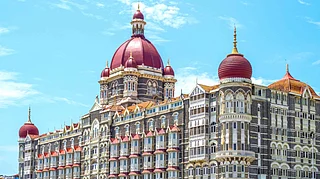


During the Second World War, an army officer checked into The Taj Mahal Palace in Mumbai with a tiger.
By the time hotel staff discovered what had happened, the animal was already inside his room. Rusi Daruwala, whose memories are recorded in Charles Allen and Sharada Dwivedi’s “The Taj at Apollo Bunder” (2010), recalled finding the officer with the tiger while three other terrified men stood on their beds.
It is the sort of story that could only have accumulated at a hotel that has spent more than a century watching Bombay pass through its doors.


When Jamsetji Nusserwanji Tata first announced his plans for the Taj, even his sisters were incredulous. They couldn't believe that while he was building a science institute in Bangalore, a great iron and steel factory, and a hydroelectric project, here he wanted to build a bhatarkhana (eating house).
The “eating house” opened at Apollo Bunder in 1903 and soon became much more than that. One account suggests Tata saw the hotel as part of an effort to restore confidence in Bombay after plague had damaged the city’s fortunes and driven visitors away.

Over the decades, fact and folklore became difficult to separate. One enduring tale claims the hotel was accidentally constructed facing the harbour rather than the city, and that architect W.A. Chambers was so horrified that he jumped to his death. The story has been repeated for generations, despite little evidence to support it. Its survival perhaps says more about the Taj itself: Bombay has been telling stories about this building almost since it opened.
Where Bombay Met
For generations of Bombaywallas, some of the most enduring memories were made not in its suites but over tea.
The Sea Lounge became one of the city’s favoured places for young men and women, often accompanied by their families, to meet prospective partners. Its reputation as a matchmaking venue eventually produced its own bit of lore: the “lucky couch,” sought out by couples hoping history might repeat itself.

For Vijaya Raje Scindia, later Rajmata of Gwalior, it did.
She wrote in “The Taj at Apollo Bunder” that Maharaja Jiwajirao Scindia had come to Bombay for the races when their families arranged an “accidental” meeting in his suite at the hotel. “I found in him a different kind of prince and within a month we were married.”
The Taj was thus not merely where visitors stayed. It became somewhere Bombay met itself: royals and businessmen, families and travellers, prospective couples and old friends.

A Hotel At War
The war years produced a different kind of guest.Daruwala recalled an American general arriving from the Burma border to find the hotel full. When told there were no rooms, he pulled out a revolver and threatened to shoot him unless accommodation was found.
Then came the officer with the tiger. Such episodes sound improbable now, but together they capture something of the role the Taj played in a port city through which soldiers, travellers, rulers and adventurers continually passed.
For those arriving in Bombay by sea, its great dome was once among the first landmarks of the city to come into view. Over time, however, its importance came to lie as much in what happened inside as in its silhouette on the harbour.
More than 120 years after Jamsetji Tata’s sisters teased him about building a bhatarkhana, generations of Bombayites have attached their own stories to the hotel: a first meeting at the Sea Lounge, a wedding, a family celebration, or simply the familiar sight of its dome against the waterfront.
Perhaps that is why The Taj Mahal Palace has endured so powerfully in the city’s imagination. It has never only stood beside Bombay. For more than a century, Bombay has been happening inside it.
The Information
Address: Apollo Bandar, Colaba, Mumbai, Maharashtra 400001
Keys: 560 rooms and 44 suites
Connectivity: Approx. 25–30 km from Chhatrapati Shivaji Maharaj International Airport and around 10 minutes by road from Chhatrapati Shivaji Maharaj Terminus. The Gateway of India is immediately adjacent
Website: tajhotels.com