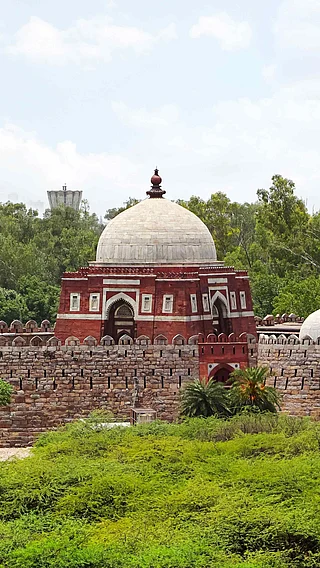


By 2011, the roof above the room where Baba Ala Singh's sacred flame is kept had been damaged, and part of Ran Baas, the royal residence within Qila Mubarak, had begun to collapse. A complex that witnessed the making of a kingdom was struggling against years of neglect, with little to hint that it would one day welcome guests again.
The fort was central to Patiala’s emergence. In 1763, Baba Ala Singh, founder of the Patiala state, established a kachi garhi, a mud-and-brick fortress around which the city grew. Spread across 10 acres, Qila Mubarak became the seat of a kingdom whose influence extended beyond its walls.


Under successive rulers, including Baba Ala Singh's grandson Raja Amar Singh, the fort grew beyond its defensive purpose and took on the life of a royal court. Within its walls stood Ran Baas, also known as Rani Vaas or Ranivas, the "abode of queens," now a 35-suite heritage hotel that forms part of the Qila’s larger story.
Few people know the fort's history as intimately as Simar Singh. The 19-year-old historian, who belongs to the erstwhile royal lineage of Mirpur, grew up in an ancestral haveli beside the fort. "History was not something I encountered only in books," he said. "It was part of my surroundings, my family conversations and the objects I grew up seeing." This familiarity shapes his understanding of Ran Baas, which he describes as one of Patiala’s most important centres of "royal power and hospitality."

But a house that received guests with such a ceremony also had to be defended, and the fort learned that early.
Barely three decades after its founding, Raja Amar Singh’s death left the throne to his young son, Sahib Singh, inviting Maratha aggression. In 1794, after an initial setback at Mardanpur, Sahib Singh’s sister, Bibi Sahib Kaur, rallied the state’s forces and helped repel the Marathas. She proved, Singh noted, "the defence of a kingdom was never limited to men alone."
Her courage became part of the royal household’s collective memory, passed down through sakhis, traditional accounts of notable deeds. According to Singh, the inner area of this second courtyard was historically remembered as "Sahib Kutiya" in her honour, now called Moulsari Garden.
Singh points to the fort’s architecture as a record of its royal life. Frescoes in the Rang Mahal depict Guru Gobind Singh, the 10th Sikh Guru, with his army, alongside scenes from Krishna Leela and the Narasimha Avatar, with the Naqqarkhana that once rang with music announcing royal guests.

A Palace Restored
In 2004, the World Monuments Fund listed Qila Mubarak among the world’s 100 most endangered monuments. An initial conservation project began in 2013, funded through the Union Government’s 13th Finance Commission, with conservation architect Abha Narain Lambah appointed as consultant.
Over three years, the team stabilised damaged walls, repaired timber structures and reconstructed brick arches and vaults using traditional techniques, local materials and craftspeople.
A new phase began in 2021, when the Park Group won the adaptive-reuse project bid, with hotelier Priya Paul bringing Lambah’s conservation expertise into Ran Baas’s transformation. The focus moved from stabilising the structure to giving it a sustainable future as a heritage hotel. It was officially inaugurated in January 2025. Restoration and interior design have retained the palace’s architectural features. The hotel preserves the character of spaces such as the Rang Mahal, Darbar and Sheesh Mahal, allowing guests to experience the palace’s artistic and architectural heritage. Singh describes the revival as "truly heartening," while noting that the frescoes still require continued conservation.
Ran Baas continues to overlook Patiala's old bazaars, a reminder that the fort and the city developed alongside one another. Singh describes Qila Mubarak as "almost a kingdom within a city," its history extending beyond its gates. A local legend holds that Patiala will flourish for as long as Baba Ala Singh's sacred flame continues to burn. By tradition, it has now burned for more than 250 years. Its survival is a reminder that resilience is not simply the ability to withstand time, but the work of keeping memory alive.
The Information
Address: Ran Baas The Palace, Qila Mubarak, Qila Androon, Qila Chowk, Adalat Bazar, Patiala, Punjab - 147001
Keys: 35 suites (inspired by Patiala's royal jewels, including categories such as Pearl, Topaz and the Naqqarkhana and Shikarbagh suites)
Connectivity: Chandigarh International Airport is about 65 km away, a 1.5 to 2-hour drive. Patiala is well-connected by rail and road to Chandigarh, Ambala and Delhi
Website: theparkhotels.com