For decades, the red-crowned roofed turtle slipped quietly out of the Ganga. Fishermen stopped seeing it. Nesting sites vanished. By the early 2000s, it had almost disappeared from the river that once sustained it. Today, its return depends not just on conservation efforts, but on whether the river itself can recover.
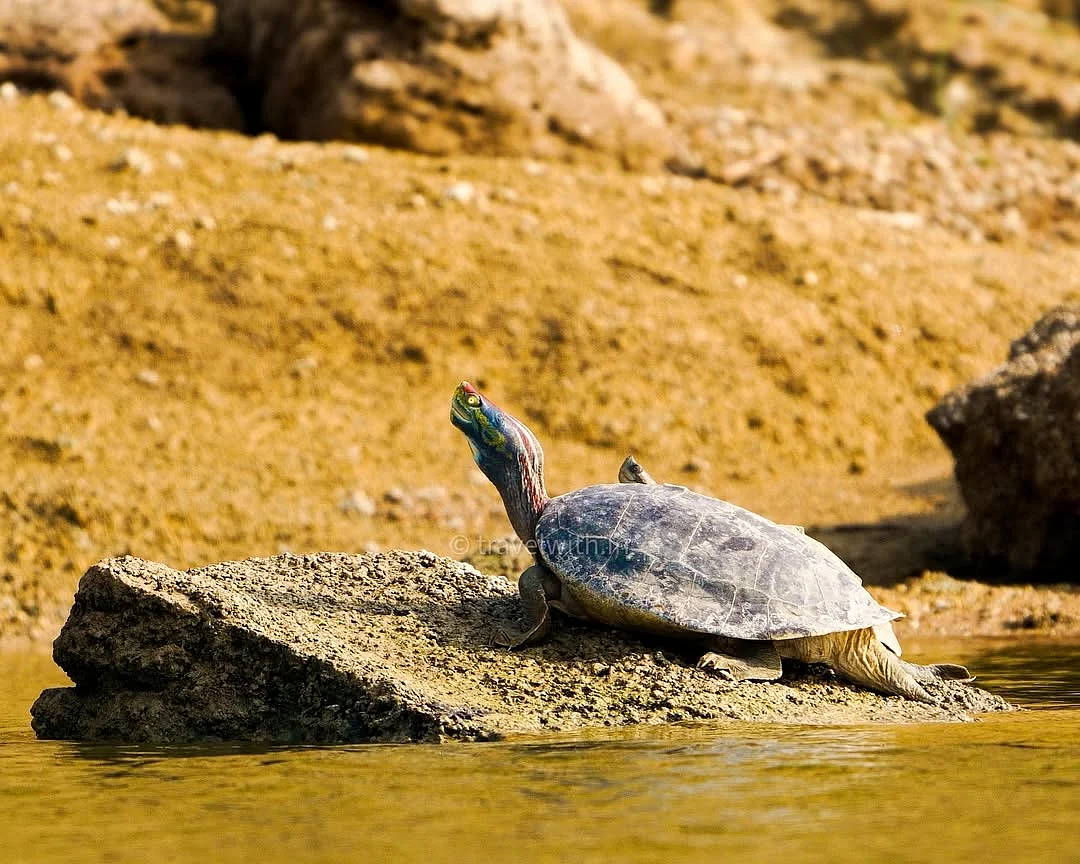
Often called the jewel of the Ganga, the red-crowned roofed turtle (Batagur kachuga) stands out for its vivid colours. During the breeding season just before winter, males transform. Their heads light up with bands of red, yellow, white and blue, while the crown turns a deep, bright red.
It is one of three large freshwater turtles from the Batagur genus found in India, all of which face an extremely high risk of extinction. The species is listed as Critically Endangered on the IUCN Red List and receives the highest level of protection under India’s Wildlife (Protection) Act, 1972, as well as international safeguards under CITES.
Built for life in large rivers, this turtle depends on deep, fast-flowing channels, clean water and wide sandy banks. Females can grow up to 56 centimetres in length and weigh around 25 kilograms, while males are smaller but far more colourful. They feed mostly on aquatic plants and spend hours basking on sandbars and riverbanks.
Historically, the species ranged across a vast 400,000 square kilometre stretch of the Ganga basin, including parts of the Brahmaputra, Nepal, and Bangladesh. Today, that range has shrunk dramatically.
How The Ganga Lost Its Turtles
The decline came slowly, almost unnoticed at first, as the Ganga began to change under growing human pressure.
Dams and barrages altered the river’s natural flow, breaking its rhythm and reducing the deep channels these turtles rely on. Heavy water extraction made matters worse.
At the same time, sand mining stripped away nesting banks. The firm sandbars where females once laid eggs began to disappear. Farming along river edges added further disturbance, turning nesting grounds into cultivated land.
The water itself also deteriorated. Industrial waste and untreated sewage found their way into the water, changing its quality and affecting not just the turtles, but also the plants they depend on for food.
Fishing added another layer of danger. Turtles got caught in nets and often did not make it out alive. Others were taken intentionally, along with their eggs. At the same time, hunting and illegal trade continued quietly in the background, with turtles captured for meat, their shells and the pet market, pushing the species closer to the edge.
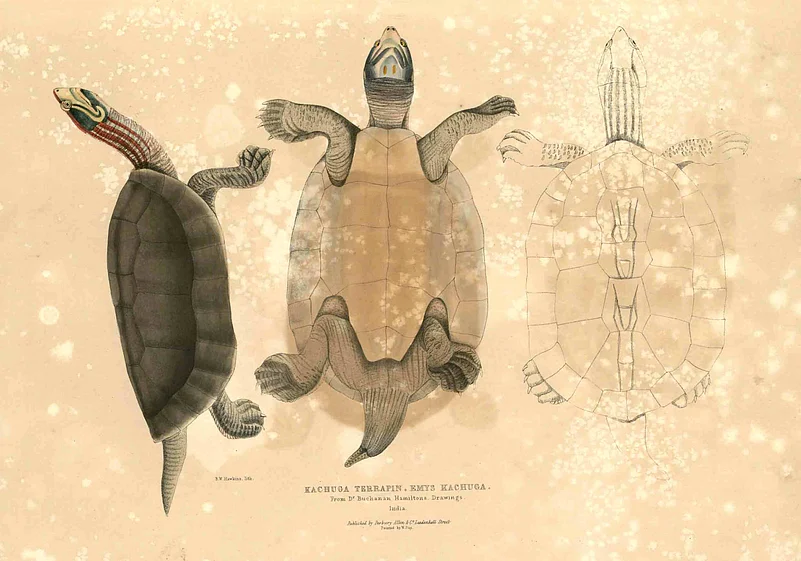

This combination of pressures led to a steep population crash of around 80 per cent. Surveys in the early 1990s recorded turtles in the upper Ganga between Rishikesh and Kanpur. But later surveys in 2006 and 2020 in places like Narora and Haidarpur found none.
Over the past three decades, confirmed sightings have been rare. In 2021, an adult female was spotted in Duhri village in Uttar Pradesh’s Hapur district. Two years later, villagers in Ahar in Bulandshahr discovered two nests, from which 21 hatchlings emerged out of 27 eggs. These sightings suggest a small remnant population still survives in parts of the upper Ganga.
A Fragile Comeback Hinges On The River
Today, the Chambal River serves as the last stronghold for the species. Stretching roughly 800 kilometres through Uttar Pradesh, Madhya Pradesh, and Rajasthan, it supports fewer than 1,000 adult turtles, including about 500 females.
Here, the turtles still find what they need. Flowing water, high sandbanks and relatively undisturbed stretches allow them to bask, feed and reproduce. Nesting begins in March, when females come ashore to dig into dry, elevated sandbanks near deep pools. Each lays around 15 to 20 eggs in fine sand. After about 60 to 65 days, hatchlings emerge and move toward shallow, fast-flowing sections of the river.
Beyond India, only small patches of habitat remain in Bangladesh and Nepal, with no confirmed wild populations.
The turtle does more than survive in these rivers. It helps maintain the ecosystem. By feeding on aquatic vegetation, it keeps plant growth in balance and supports nutrient cycling. Its presence reflects the health of the river itself.
Efforts to bring the species back have been underway for years. The Indian Turtle Conservation Programme, backed by the Namami Gange initiative and state forest departments, has spent years working on the ground. Teams protect nesting sites, collect and incubate eggs in hatcheries, and raise young turtles until they are strong enough to be released back into the river.
Some of these turtles are now being returned to the Ganga. Recently, around 20 sub-adults were released into the river. In 2025, another group fitted with tracking devices was released into connected wetlands in Uttar Pradesh to study how they adapt. Early signs show movement through the river system, but survival is far from guaranteed.
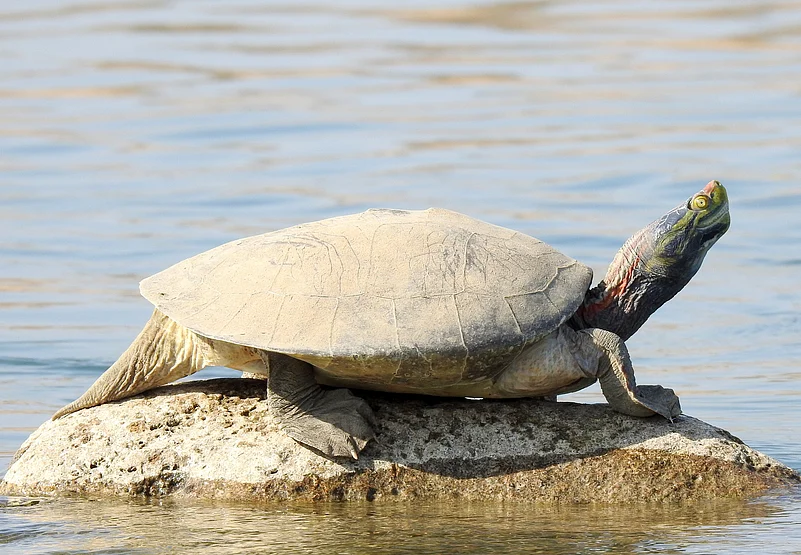
Reintroduction alone will not secure the species. The same pressures that drove it out of the Ganga still persist.
The future of the red-crowned roofed turtle remains tied to the future of the river. If stretches of the Ganga can regain stable flow, clean water and intact sandbanks, the species may slowly rebuild. Without that, each sighting will remain a brief moment of hope in a river that has changed too much.
FAQs
1. What is the red-crowned roofed turtle?
The red-crowned roofed turtle (Batagur kachuga) is a critically endangered freshwater species once found across the Ganga basin.
2. Why is the red-crowned roofed turtle endangered?
Habitat loss, pollution, sand mining, dam construction, and hunting have drastically reduced its population.
3. Where can the red-crowned roofed turtle still be found?
The Chambal River is currently its main stronghold, with small populations possibly remaining in parts of the Ganga.
4. What is being done to save the species?
Conservation efforts include protecting nesting sites, hatchery programmes, and releasing turtles back into the wild.
5. Why is this turtle important for the ecosystem?
It helps maintain river health by controlling aquatic vegetation and supporting nutrient balance.