India’s craft heritage lives in places where the work is still being made by hand. In these villages, looms, kilns and worktables are part of everyday life, and techniques are taught within families rather than preserved behind glass. Here are six such places where old crafts continue to find a place in the present.
Nirona, Gujarat: The Last Keepers Of Rogan Art


In the Kutch village of Nirona, a piece of cloth becomes a canvas for one of India’s rarest painting traditions. Rogan art is believed to have arrived in Kutch from Persia through the migration of Khatri artisans from Sindh, and has been practised in the region for around 300 years. The name comes from the Persian word for oil.
The technique is strikingly unusual. Castor oil is heated for hours until it becomes a thick, elastic paste, which is mixed with pigments. Artists then draw the paint onto fabric using a metal stylus, creating raised, symmetrical designs without a conventional brush. The famous Tree of Life motif is among the best-known compositions.
The craft came perilously close to extinction during the 20th century. Today, the Khatri family remains its principal custodian, with younger members learning the technique and continuing to make and demonstrate the work in Nirona. Recent reporting in 2026 described the family as the last major lineage still practising the craft, making a visit particularly significant for anyone interested in living traditions rather than museum pieces.
Ajrakhpur, Gujarat: A Village Built Around A Printing Tradition
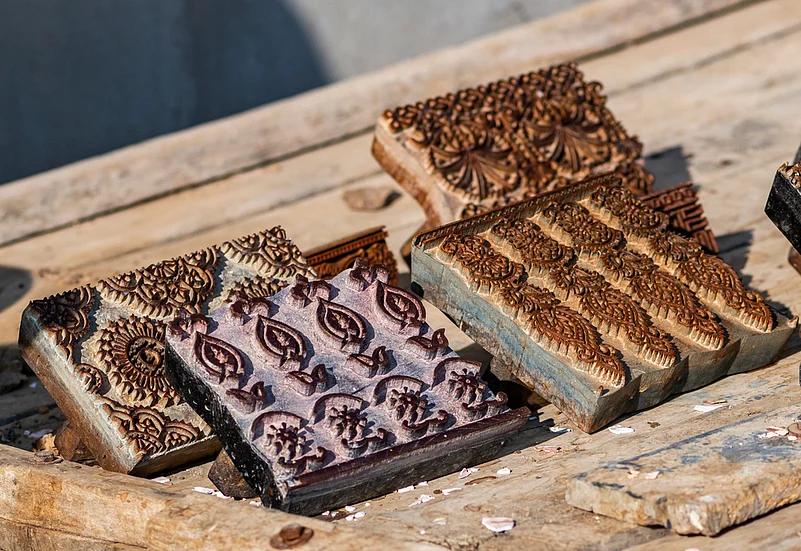
Ajrakhpur is unusual even by the standards of India’s craft villages because the settlement itself grew out of the need to protect a traditional craft. The Khatri community brought Ajrakh printing from Sindh to Kutch centuries ago. The craft uses carved wooden blocks, resist printing and natural dyes, particularly indigo and madder, to create dense geometric patterns.
The present village emerged after the 2001 Gujarat earthquake devastated Dhamadka, an older centre of Ajrakh printing. Water, essential to the washing and dyeing stages, was also affected. Artisans subsequently helped establish Ajrakhpur with homes, workshops and shared facilities designed around the requirements of the craft.
Traditional Ajrakh can involve numerous rounds of washing, printing, dyeing and drying, making each length of fabric a substantial manual undertaking. The craft has also adapted to contemporary markets, appearing on saris, scarves, clothing and home textiles. Today, Ajrakhpur remains an active printing centre, with family workshops continuing the practice while adapting designs and products for newer customers.
Naya, West Bengal: Bengal’s Village Of Storytelling Painters

In Naya village in Paschim Medinipur, painting is traditionally accompanied by song. The Patuas of Bengal create long scrolls known as Patachitra, filling them with sequential scenes from mythology, folklore, nature and contemporary social life. Historically, the scrolls were unfurled frame by frame while the artist sang the accompanying narrative, turning painting into a form of travelling storytelling.
The Patua community historically occupied a marginal position and sustained itself by travelling between villages, performing and painting. Naya gradually became an important centre for the tradition, and the craft now has a registered Geographical Indication as Bengal Patachitra.
The village is changing, however. Artists increasingly paint on sarees, apparel, stationery and contemporary formats alongside traditional scrolls. Women have also become prominent practitioners, helping expand the craft’s economic base. A 2026 academic study estimated around 75 households and 230 artists in Naya, including more than 110 women. The shift has brought wider markets and visibility, though it has also changed the older communal nature of Patua production.
Molela, Rajasthan: Terracotta Stories In Clay

On the banks of the Banas in Rajasthan’s Rajsamand district, Molela is known for an unusual form of terracotta that looks very different from conventional pottery. Instead of making primarily three-dimensional vessels, its Kumhar artisans create flat, hand-modelled plaques and relief panels depicting deities, legends, village life and scenes from the Ramayana. The tradition is believed to be more than 800 years old.
Local tradition traces the craft to a blind potter who is said to have regained his sight after making an image of Lord Devnarayan. Devotional plaques remain an important part of the craft, particularly for communities that traditionally commission them. The government’s handicrafts documentation records around 40 Kumhar families associated with Molela terracotta.
The craft has also moved beyond its religious roots. Artisans now make tiles, vases, toys and large murals for contemporary interiors, incorporating subjects such as classrooms, doctors and aeroplanes. The craft has a Geographical Indication, but pottery is still a seasonal livelihood for many families, with agriculture helping supplement income. That combination of continuity and adaptation has helped Molela’s distinctive clay tradition remain commercially viable.
Sualkuchi, Assam: The Silk Village On The Brahmaputra

Sualkuchi, on the north bank of the Brahmaputra, is one of Assam’s most important weaving centres, particularly for muga, pat, and eri silk. Its weaving history stretches back centuries, with accounts tracing organised silk weaving in the settlement to the medieval period. Over time, the village developed into a commercial weaving centre, with looms integrated into homes and small workshops.
Muga, Assam’s naturally golden silk, is especially associated with the region. Traditional mekhela chadors, gamosas and other textiles emerge from the looms, with motifs reflecting Assamese cultural vocabulary.
Sualkuchi remains a working craft centre rather than a heritage display frozen in time. Government programmes continue to support its weavers. Assam’s ARTFED has more than 400 captive looms in Sualkuchi and other areas, while a government-backed Mega Handloom Cluster project was approved to support 4,266 weavers. A yarn bank also provides subsidised mulberry yarn to thousands of beneficiaries.
The village nevertheless faces the pressures common to handloom clusters, including competition, raw-material costs and changing consumer preferences. Its survival depends on keeping handwoven silk economically worthwhile for the next generation.
Pipili, Odisha: The Appliqué Village Of Jagannath
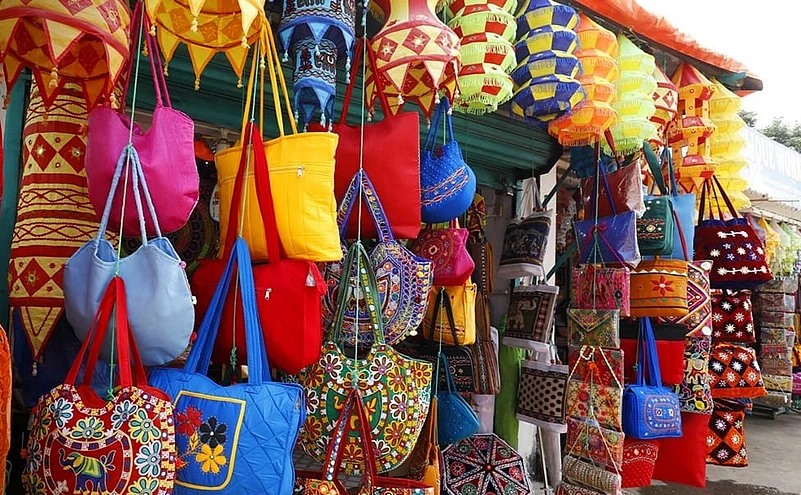
A drive through Pipili in Odisha reveals a craft tradition closely tied to the Jagannath temple in Puri. Appliqué, locally known as Chandua, involves cutting coloured fabric into motifs and stitching the pieces onto a larger textile. Floral patterns, animals, geometric forms and images associated with Jagannath appear on umbrellas, canopies, wall hangings, lampshades, bags and other objects.
Pipili’s identity as an artisan settlement goes back centuries. Odisha Tourism traces the village’s establishment as an artisan centre to the Somavamsi period, while the craft became particularly associated with temple rituals and the annual Ratha Yatra. Muslim artisans have historically played a significant role in producing appliqué for the Hindu temple tradition, giving the craft an especially interesting social history.
The tradition remains commercially important, with thousands of artisans in Pipili and surrounding villages involved in the cluster. Yet the local market has faced setbacks. In 2026, the Odisha government announced a Chandua Bazaar initiative after the diversion of traffic following NH-316 construction reduced tourist footfall and affected sales. The proposed revival effort is intended to reconnect artisans with visitors and buyers.
FAQs
1. Which are the famous craft villages in India?
Nirona, Ajrakhpur, Naya, Molela, Sualkuchi and Pipili are among India's notable craft villages, known for Rogan art, Ajrakh printing, Patachitra, terracotta, silk weaving and appliqué.
2. Which Indian village is famous for Rogan art?
Nirona in Gujarat's Kutch district is known for Rogan art, a rare textile painting tradition made using castor-oil-based paint.
3. Which village is famous for Patachitra in West Bengal?
Naya village in Paschim Medinipur is known for its Patua artists and Bengal Patachitra scroll paintings, traditionally accompanied by sung narratives.
4. Which Indian villages are famous for textiles?
Ajrakhpur is known for Ajrakh block printing, while Sualkuchi in Assam is renowned for muga, pat and eri silk weaving.
5. Which village is famous for appliqué work in India?
Pipili in Odisha is famous for Chandua appliqué, a textile tradition closely associated with the Jagannath temple and Puri's Ratha Yatra.