My earliest memory of Pataudi is of hurrying behind my father on a blazing summer afternoon, as he walked across the sunburnt grass in Kolhapuri chappals.
We had just driven in through the long approach, past the slightly battered iron gate, the car stopping halfway down the drive before the house had even fully appeared. My father would get out and take a detour to the left. I followed him.
At the end of an imaginary line drawn through the centre of the house and the land around it stood my grandfather’s grave: four pillars of otherworldly marble and a headstone adorned with fading calligraphy. The first thing my father always did at Pataudi was offer his prayers there. As children, we learned to do the same. So before the house, there was remembrance. Before rooms, meals, cricket, or even conversation, there was that small pilgrimage.
I never met my grandfather. He died playing polo on my father’s 11th birthday, after which he never celebrated it again. I discovered Pataudi Sr. like a detective or a historian, through what he had said, what others had said about him, old cricket writings, photographs, the books he read, the suits he wore, and the house he built.


Because of his absence, and because my father and grandmother are also buried there, Pataudi has always been a family home, but also something of a mausoleum. As a child, I was convinced parts of it were haunted. I must admit, I learned my prayers early, partly to protect myself on those long, dark walks to bed. Today, I know the spirits in Pataudi are benign, and they are welcome.
After the prayer, we would walk towards the house. Even before the luxury of air conditioning, I remember the cool relief of stepping inside when the heat outside was stifling. The walls were very thick, the ceilings very high, and the marble stairs very steep. Once you are older, you realise that whoever designed those stairs was thinking only of athletic knees. I have since added a lift, which Amma, as I call my mother, is rather pleased about.
Upstairs was an open chabutra, the centre of the house and the best place to sit and watch the moon on starlit nights. Five bedrooms, a dining room, a drawing room, and a study all connected around it. That was where our life gathered. Downstairs were musty rooms, unused and shut away. At the far end of what seemed like an interminably dark corridor was the library, though in truth it was a space stacked with old Godrej cupboards stuffed with books. I was certain it was haunted, and treated it with the respect one gives to haunted things.
That was my Pataudi then. Majestic, austere, and sparse. Quiet, but never boring.

The House That Held Time
We never lived in Pataudi. We were based in Delhi and would often leave for the palace spontaneously. Usually, my father would say, “Let’s go,” after lunch, or sometimes after dinner, and in an hour or a little more, past an empty, undeveloped Gurgaon and down the Jaipur highway, we would be there.
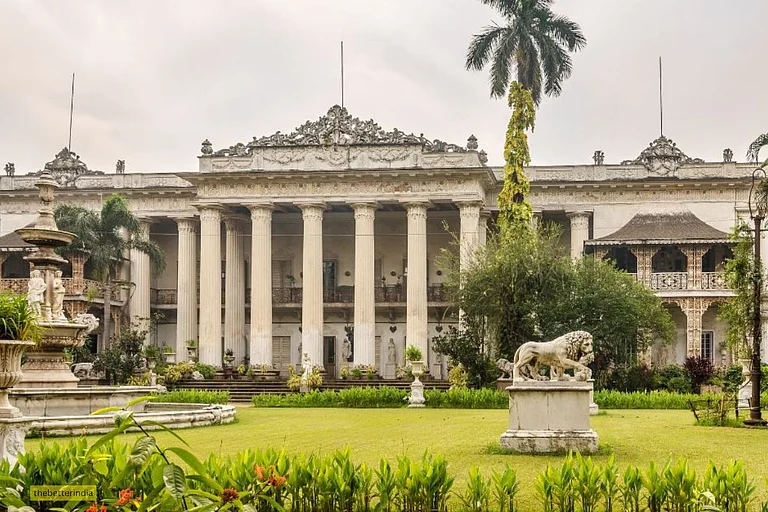
Like some interesting people, the house did not reveal itself to you all at once. You came through the gate, passed the mosque on the right, drove down the avenue of trees, and then suddenly, Pataudi appeared at an angle. It had a wonderful sense of arrival.
The house was never opulent in the way people may imagine. One often reads rather fanciful accounts of it, as though it were some endless palace of rooms and corridors. It is not that kind of place. It is minimal: straight lines, measured spaces, restrained. The Pataudis, I think, are like that too.
My grandmother would say there was to be no drinking, no partying, no misbehaving. The ancestors were watching. She had put on a white sari after my grandfather died, and that is all I remember her ever wearing. I can still see her sitting cross-legged on the chabutra, airing my grandfather’s old cricket blazers. Worcestershire, Oxford University, Vincent’s, the Authentics, the famous England blazer from the Bodyline series, and many, many more. They would cover the floor. To a child, it felt astonishing.

There were other images of her, too. I remember her fixing old chandeliers and warning me, quite calmly, as she sat in a room with pieces of crystal all around her, not to touch the liquid because it was hydrochloric acid. There was no fuss about it. Just a grandmother, a chandelier, and a bowl of acid!
Outside, she was in the lawns, garden scissors in hand, grafting and pruning. She would explain how one could take the bud from one rose and attach it to another stem, taping it on so it might grow as though it had always belonged there. The gardens were created and curated by her. She could drive sports cars fast and safely, shoot high-powered rifles accurately, and bathe in ice-cold water daily at 5 am.
I should begin writing these things down because I know how easily they can vanish. Recipes, like memories, are easily lost
The rest of our days followed a simple pattern. We would wake early and go for drives through the fields. My father drove beautifully. There was grace in almost everything he did. The jeep would move across rough land, and somehow one barely felt the bumps. We would stop for kakri on the roadside, which we would eat with salt. Then we would come back and play cricket. My father would join us for a while, which made the game feel very special.
In winter, the same house took on a different character. In the evenings, we would sit on gaddas around a large wooden table on the upstairs chabutra. Beneath it would be a metal plate with a bowl of hot coals, a sigri. The table would be covered with a huge blanket that came up to our waists. Our legs would be warm and our faces cold. Meals would happen there. The adults would play cards and talk. We would lie around, read, listen, and feel completely held by that warmth.
The food was as much a part of everything as the drives and cricket. Kebabs, mutton cooked with potatoes, chapatis, kalakand from the area, and roti rolled with balai (the thick cream that gathers on slowly heated milk) and shakkar. I should really begin writing these things down because I know how easily they can vanish. Recipes, like memories, are easily lost.

The Library That Came Alive
Much later in life, when I began thinking about building a home for myself away from the fast pace of Bombay, my mother said something that changed the way I looked at Pataudi.
“Why don’t you restore your own family home instead of building a new one?”
So I did.
It was only while restoring the house that I began to understand how much of it had already been held together by Amma. Pataudi is full of photographs and history: portraits, cricket pictures, inherited objects, and traces of people who lived there before us. Strangely, there is not a single photograph of her. And yet, you feel her everywhere.
You feel her presence in the colours, the crystal, and the care with which Pataudi has been maintained. Amma has been a loving and meticulous custodian of our family home.

In my own way, I have tried to contribute too. I did not play cricket like my father or grandfather, nor was I particularly academic. I chose a different path, but I feel one meaningful contribution I have made to the family has been reclaiming and restoring that house, completing it in some sense.
The clearest symbol of that completion is the library. The room I feared as a child is now my favourite corner. We lit it, cleaned it, restored the books, put in wooden floors, bookcases, furniture, and fixed the fireplace. The old books stamped with the palace library mark finally have a library around them.
That room coming alive feels like the house coming full circle.
Of course, homes like this are never truly complete. There is always something to repair, replaster, rework, or restore. These are not just romantic ideas. Love for an old home cannot remain only in memory. You have to look after it.

A Living Home Again
Pataudi is still full of memory, but it is not trapped in time. Over the years, the house has become alive again, not because the past has been put away, but because new life has entered it.
My sisters have their own memories of that life, and my children have begun making theirs. Sara and Ibrahim, the older ones, often go even when I am not there, taking friends with them and leaving behind the kind of young energy an old house needs. Tim and Jeh know it differently: through swims, cricket matches, drives through the fields, ghost stories, old tales of cricket and the jungle, and by asking to return barely a week after getting back to Bombay. The place holds them all, each differently, as it once held me.
The house has become alive again, not because the past has been put away, but because new life has entered it
In Bombay, life can scatter us: work, traffic, phones, appointments, noise. At Pataudi, we come together. Almost always, it is my wife, Kareena, who brings us there. She has seen Pataudi grow from an idea of restoration into the home it is today. The first time she and I went there together, it was still leased to a hotel, and it disturbed me to see certain sacred spaces treated that way. She said little then, but once I had reclaimed the house, she said, “Now I can feel that your ancestors are happy.”
She loves Pataudi deeply, and her ideas often shape the rhythm of our days there: breakfast spots, morning swims, farm drives, kitchen nights, and cricket. Always cricket! As I watch her sitting in her pyjamas and shawl, cheering us on during a game while the kids run around the lawns, I feel very lucky. That is the point of a large home, I think: not grandeur, possession, or display, but filling it with people you love.

Old titles mean very little today. What matters is to live with dignity, to be a good father, husband and citizen, and to leave places like Pataudi cared for and intact, perhaps even improved, for the next generation.
That may sound like a strange conversation to have with a child, but at Pataudi, life and death do not feel separate in the usual way
Recently, after dinner, Tim and I went for a stroll and found ourselves sitting on a bench under a tree by my grandmother’s grave. We spoke about her and about days gone by. He asked if I would be buried there too. When I said yes, he thought for a moment and said, “I would like to be buried here too, right next to you.”
That may sound like a strange conversation to have with a child, but at Pataudi, life and death do not feel separate in the usual way. They sit together naturally.
We walked back to the house holding hands under an almost-full orange summer moon. Inside, we stopped at the old photographs in the corridor, with him asking questions that kept those people alive through curiosity and conversation.
My heart was full. As I lay in bed that night, I messaged Amma and told her how happy I felt. She replied, simply: “Pataudi’s stillness has a way of binding people together.”
Lying there, I thought of her and my father, and of the peace they must have found here, and how much that stillness might have bonded them. Perhaps that is what Pataudi has been for all of us, an escape, a haven of peace and quiet, a place where at least three generations have found their own happiness, and where I have always felt protected by an invisible blanket of atavistic love.
Looking for more such exciting and meaningful stories? Grab our issue on Amazon.