

It is 1757. Robert Clive is in Bengal, the Battle of Plassey has just altered the political map of the region, and Calcutta is still a young colonial settlement growing around three villages. At Shobhabazar, Raja Nabakrishna Deb is preparing something rather unusual.
Within months of the British victory at Plassey, he organises a lavish Durga Puja at his newly built palace. The British are invited. Robert Clive and Warren Hastings are among the guests associated with the celebration. There is food, music, and entertainment, and the Puja becomes a grand social occasion where Bengal’s elite and the new colonial establishment find themselves in the same courtyard.
Durga Puja of Kolkata was not always the city-wide spectacle it is today. For generations, worship of the goddess was centred in aristocratic households, inside the thakur dalan, the pillared courtyard of a zamindar or merchant family. These were private family ceremonies with their own priests, artisans, recipes, music, idols, and rituals.
The public (sarbajanin), theme-driven pandal circuit came much later. The old family Pujas survived repeating the same rituals year after year.

There is an old Calcutta saying that neatly captures the hierarchy of these grand household Pujas: Goddess Durga dressed in her finery at Shib Krishna Daw’s house, sat down to a feast at Abhaycharan Mitra’s house in Kumartuli, and spent the night watching music and dance at Shobhabazar Rajbari. It was folklore, of course, but folklore rooted in the extraordinary scale of these celebrations. Shib Krishna Daw’s family was famed for adorning the goddess with lavish jewellery; Abhaycharan Mitra’s Puja was known for its enormous spread of food and sweets; and Shobhabazar Rajbari became synonymous with music, dance, and all-night entertainment.
That makes a Bonedi Bari trail one of the most revealing ways to experience Durga Puja in Kolkata. The six stops below move broadly from North Kolkata towards the south, beginning with the Puja that helped establish the city’s grand aristocratic tradition and ending at one that predates Kolkata itself.
Shobhabazar Rajbari: Begin Where Kolkata’s Grand Bonedi Puja Tradition Took Shape
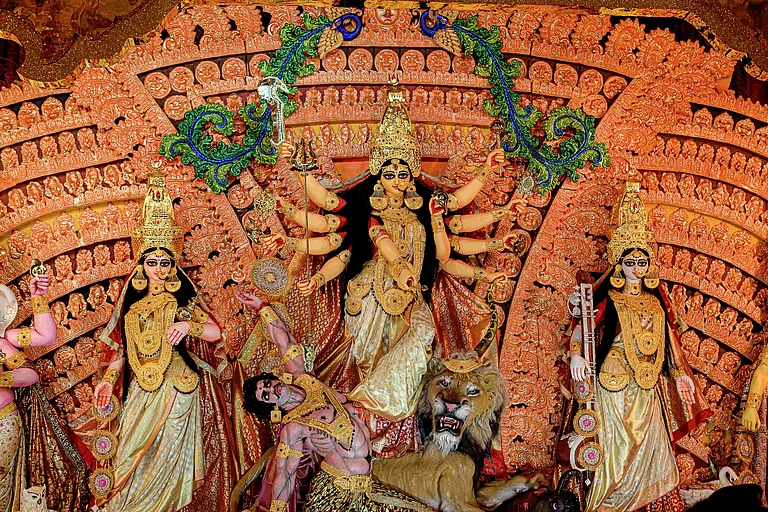
If there is one place to begin, it is Shobhabazar Rajbari. Raja Nabakrishna Deb started the family Durga Puja in 1757, making it one of the most historically consequential household Pujas in Kolkata. The palace is divided into two family branches today, with the Puja associated with the Boro and Choto Torof traditions.
The first celebration was extravagant by the standards of the time. Contemporary accounts and later histories describe a lavish feast, music and dancing, with British officials invited into the household celebration. The Puja subsequently became a model for wealthy Bengali families who began using Durga Puja as both a religious ceremony and a major social occasion.
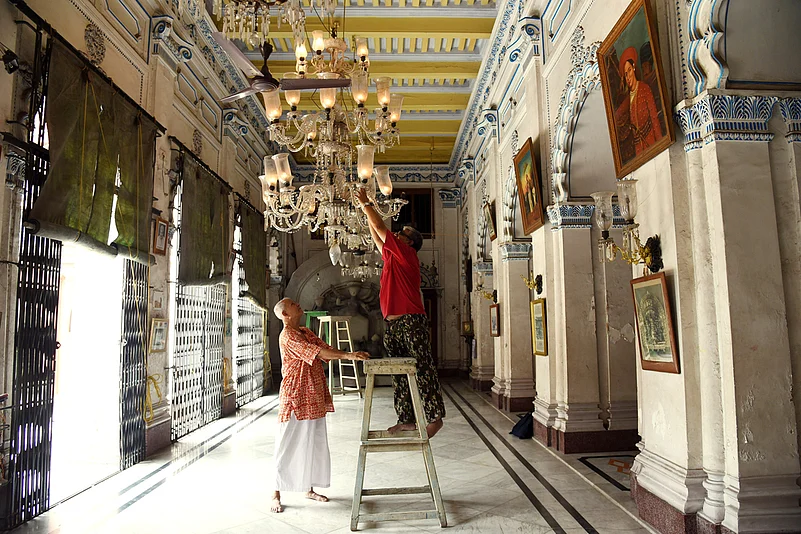
The palace itself is part of the attraction. Its Nat Mandap, open courtyard, columns and surviving sections of the old dancing room evoke the world of 18th-century Calcutta. The Puja is also associated with daaker saaj, the silver and zari ornamentation traditionally associated with Bengal’s Durga idols.
One of its best-known old traditions involved releasing the Nilkantha, or Indian roller, on Dashami. The bird was believed to carry news of Durga’s return to Shiva. Since capturing live birds is no longer permitted, the tradition has continued symbolically with clay representations.

The Puja has another unusual historical detail: its festivities were once known for elaborate musical performances in the Nachghar, reflecting the way Durga Puja became a major cultural gathering for Kolkata’s elite.
Address: 33 & 36, Raja Nabakrishna Street, Shobhabazar, Kolkata 700005
Jorasanko Shib Krishna Daw Bari: Time Your Visit For The Cannon Salute
From Shobhabazar, make your way towards Jorasanko. The lanes become narrower, the old houses more closely packed, and the history of merchant Calcutta becomes increasingly visible.
At Shib Krishna Daw Bari, the family Puja dates to the 19th century and is associated with the Daw family’s mercantile past. The house is particularly known for one of Kolkata’s most dramatic Sandhi Puja traditions.
The Sandhi Puja marks the 48-minute junction between Ashtami and Nabami. Traditionally, this is the moment associated with Durga assuming her Chamunda form and defeating Chanda and Munda. Across Bengal, the ritual is often marked by lamps, conch shells, drums, and devotional chanting.
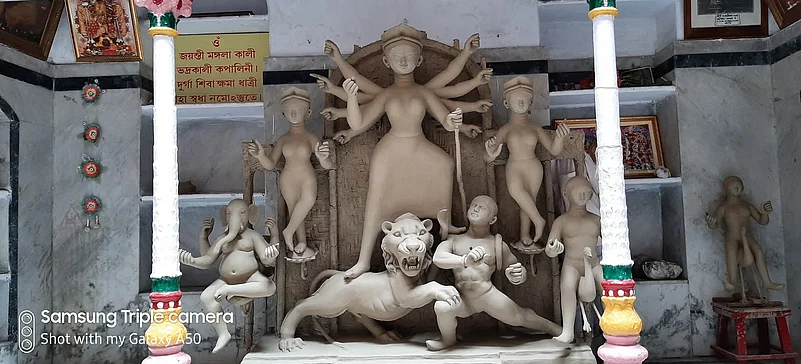
At the Daw household, the tradition has a distinctly martial character. The family’s association with the arms trade is linked to the firing of a cannon during Sandhi Puja. Historical accounts describe the use of a small cannon and gun salute, making this one of the more unusual sounds associated with Kolkata’s heritage Pujas.
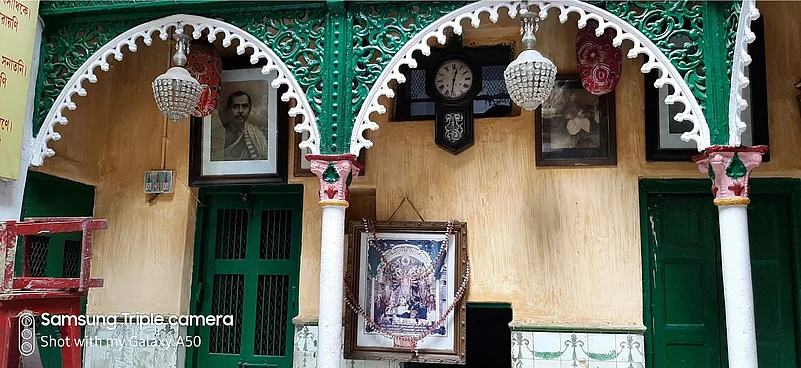
The family’s traditions also extend to the food offered during the Puja, while the old house itself gives visitors a glimpse into the merchant families who helped shape 19th-century Jorasanko.
Address: 12, Shib Krishna Daw Lane, Jorasanko, Kolkata 700007
Pathuriaghata Khelat Ghosh Bari: Look Up At Kolkata’s Longest Thakur Dalan
Continue towards Pathuriaghata, where the architecture becomes as important as the Puja itself.
The Ghosh family’s association with Durga Puja goes back to Ramlochan Ghosh, while his grandson Khelat Chandra Ghosh established the grand Pathuriaghata mansion and shifted the family Puja into the new house in the mid-19th century. Sources date the present Khelat Bhawan tradition to the 1840s-1850s.
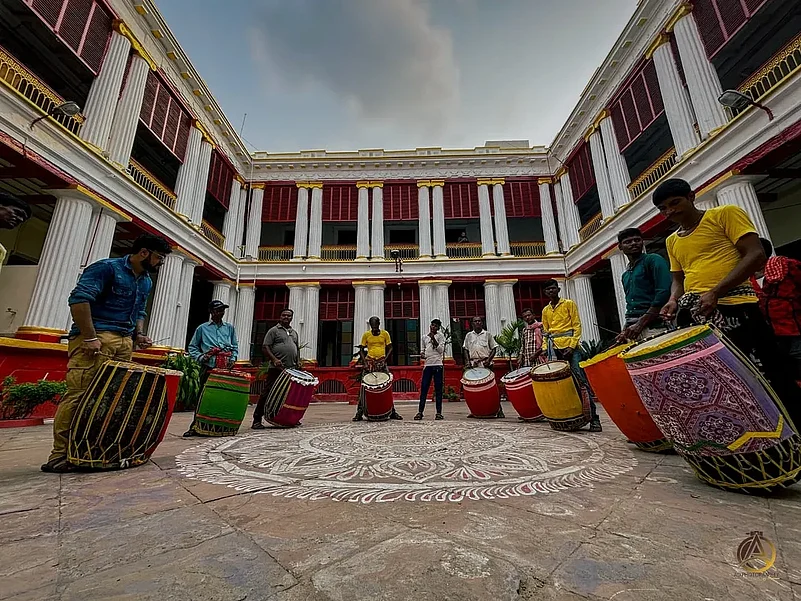
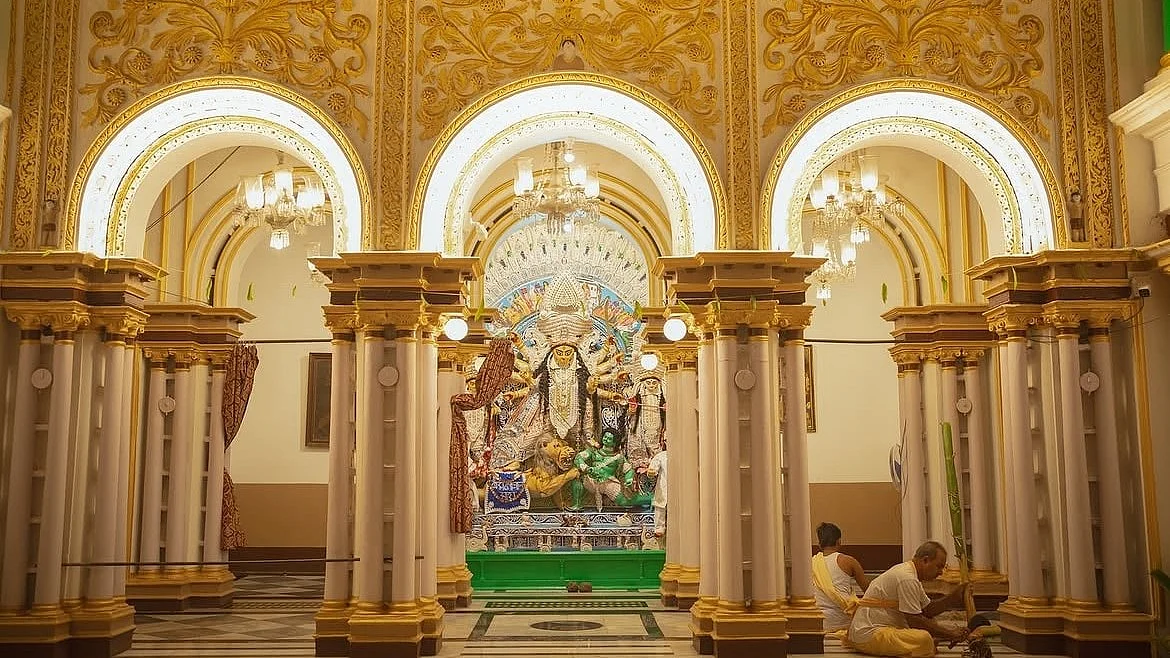
The first thing to look for is the thakur dalan. The marble courtyard is exceptionally long, with Corinthian-style columns and old decorative details. The house also preserves a collection of objects associated with the family’s aristocratic past.
Then look closely at the Puja rituals.
One distinctive tradition involves the ritual preparation of the idol with water collected from 13 rivers, followed by washing with the juice of 12 fruits. The goddess is also associated with a family preparation of chandana kheer.
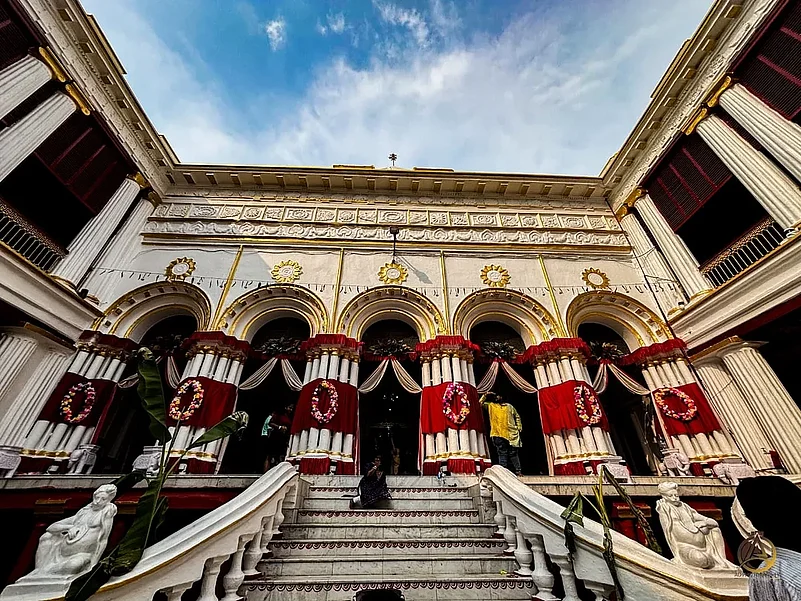
The family’s Puja is also associated with the traditional ekchala arrangement, where Durga and her children appear within a single architectural frame rather than as separate figures in the modern pandal style.
Address: 47, Pathuriaghata Street, Kolkata 700006
Chatu Babu Latu Babu Bari: Meet The Millionaire Merchant’s Puja
The next stop takes you back towards Beadon Street.
The Puja at Ramdulal Nibas began in 1770, when Ram Dulal Dey, also known as Ram Dulal Deb Sarkar, established the family celebration at his Beadon Street residence. His sons Ashutosh and Pramathanath later became known as Chatu Babu and Latu Babu, giving the Puja the name by which it is known today.
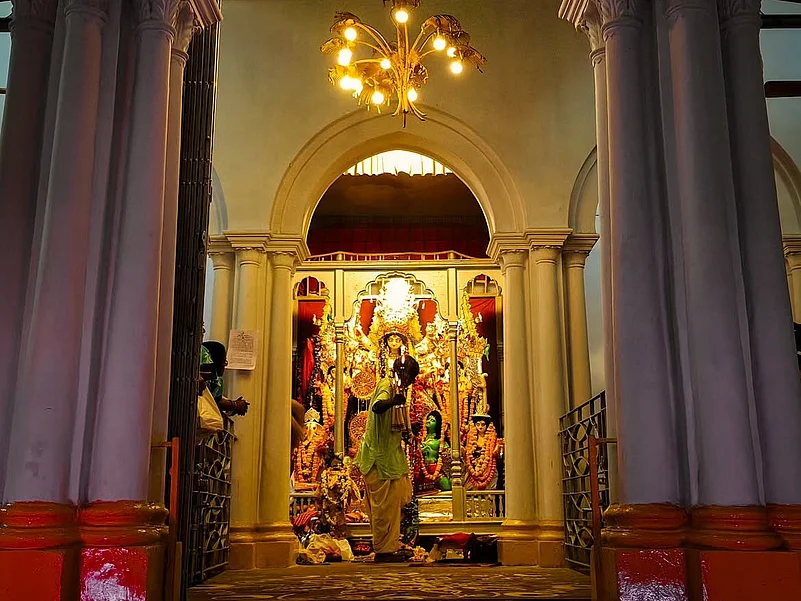
Ram Dulal built his fortune through maritime trade and became one of early Calcutta’s best-known Bengali entrepreneurs. The family mansion and Puja consequently belong to the period when the city’s Bengali merchant class was gaining considerable economic power.
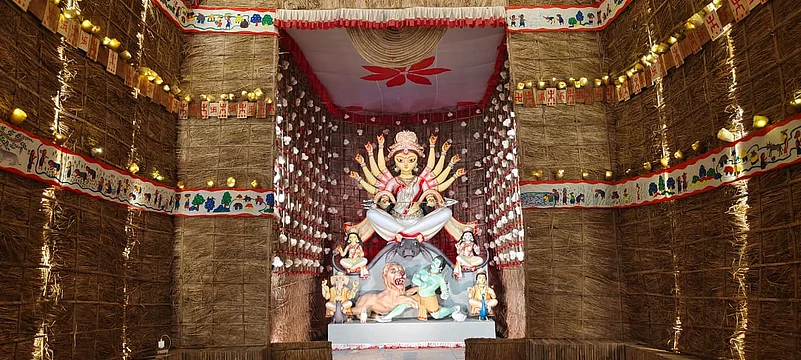
The idol is immediately recognisable. Jaya and Bijaya, Durga’s companions, flank her on lotuses. Unlike the conventional representations of Lakshmi and Saraswati, these figures do not carry their familiar attributes.
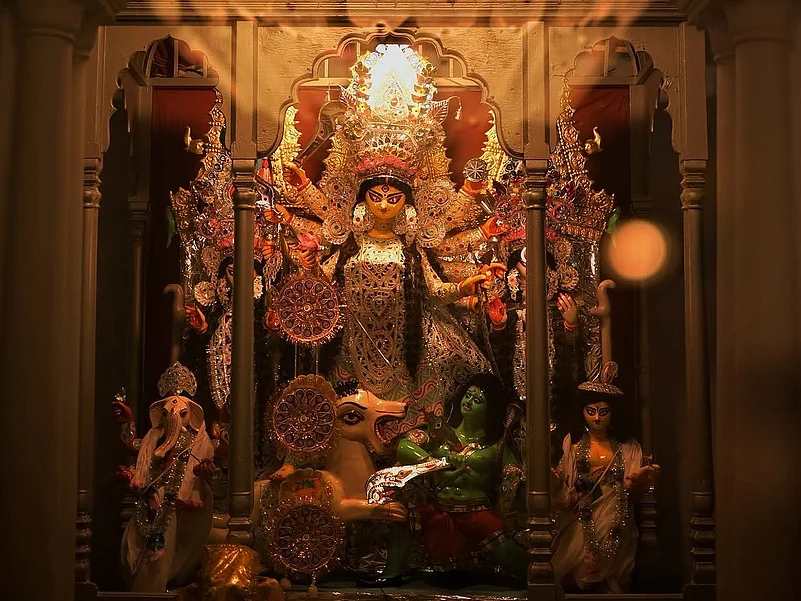
The Puja also carries a story about animal sacrifice. According to family tradition, Ram Dulal stopped goat sacrifice after an incident involving a frightened goat seeking refuge. The family subsequently adopted a symbolic Ripu Boli, using vegetables such as chalkumro (ash gourd) and sugarcane instead.
Another Dashami custom once involved releasing Nilkantha birds. The practice ended after wildlife protection laws prohibited the release of live birds, but the tradition survives in symbolic form.
The bhog tradition is equally distinctive. Historical accounts describe offerings of luchi and vegetables cooked without salt, alongside fruits, sweets, curd and other naivedya.
Address: Ramdulal Nibas, 67E Beadon Street, Kolkata 700006
Darjeepara Mitra Bari: Look For The 108 Aparajita Flowers
Leave Beadon Street and continue towards Darjeepara. This is another Puja where a small ritual detail tells you more than an elaborate theme ever could.
The Mitra family traces its history to Durgacharan Mitra, a prominent businessman who served as court jeweller to Nawab Siraj-ud-Daulah. After the family’s fortunes declined, Radhakrishna Mitra restored the family’s position and established the Durga Puja in the early 19th century. Sources variously date the beginning to 1807 or 1809, so it is safest to describe it as an early-19th-century Puja.
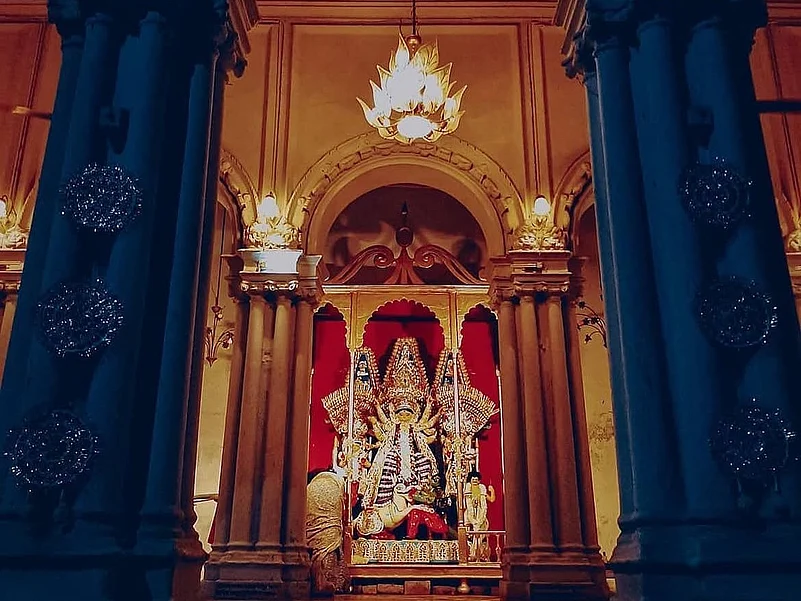
The Mitra Bari was once considered one of the three major Bonedi Bari Pujas of Calcutta, alongside Shobhabazar Rajbari and Jorasanko Daw Bari.
Its most distinctive ritual is the offering of 108 Aparajita flowers to Durga in place of the 108 lotuses commonly associated with the ritual.
The Dashami traditions are equally evocative. The family once released two Nilkantha birds before immersion: one was sent symbolically towards Kailash to tell Shiva that Durga was returning, while the other represented the bird returning to the family with the message that the goddess would return the following year. The live-bird ritual has since stopped because of wildlife protection regulations.
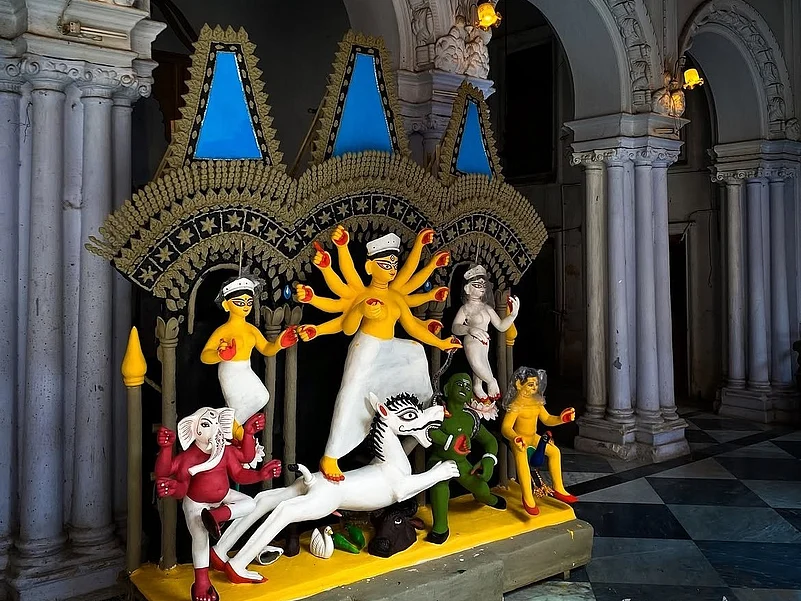
Look closely at the idol too. Historical descriptions note that while Durga, Lakshmi and Saraswati have divine faces, Kartik and the asura are depicted with human faces, giving the tableau a character distinct from the standard contemporary Durga image.
Address: 19, Nilmani Mitra Street, Kolkata 700006. Another family property is at 42, Beadon Row.
Sabarna Roy Choudhury Aatchala Bari, Barisha: End With A Puja Older Than Kolkata
For the final stop, leave North Kolkata behind and head south-west to Barisha.
The Sabarna Roy Choudhury family’s Durga Puja is traditionally dated to 1610, making it older than the city of Kolkata itself. The family’s history is deeply intertwined with the city’s origins: in 1698, the East India Company acquired the villages of Kalikata, Sutanuti, and Gobindapur from the Sabarna Roy Choudhurys, the three settlements that became the foundation of colonial Calcutta.
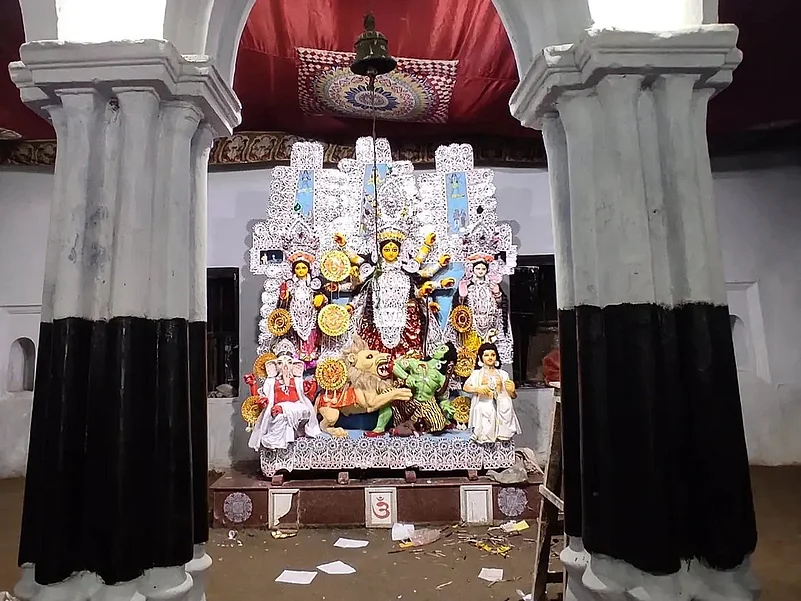
The family tradition credits Lakshmikanta Majumdar and his wife Bhagabati Debi with beginning the autumn Puja in 1610. As the family expanded, the Puja tradition spread across several branches. Today, multiple Sabarna family Pujas are held in Barisha and elsewhere, with the Aatchala Bari retaining the central place in the family history.
The Puja follows the ritual system prescribed in Durgabhaktitarangini, attributed to Vidyapati, and the family has preserved a number of distinctive customs. The traditional idol is associated with the full family of Durga within the same chaalchitra, a format that later became characteristic of Bengali Durga imagery.
The family also follows rituals that reflect Bengal’s Shakta heritage alongside Shaiva and Vaishnava influences. One unusual offering associated with the Puja is mashabhaktaboli, performed on Ashtami and Navami. Historical accounts also record aakh boli, the symbolic sacrifice of sugarcane, and non-vegetarian offerings as part of the family’s traditions.
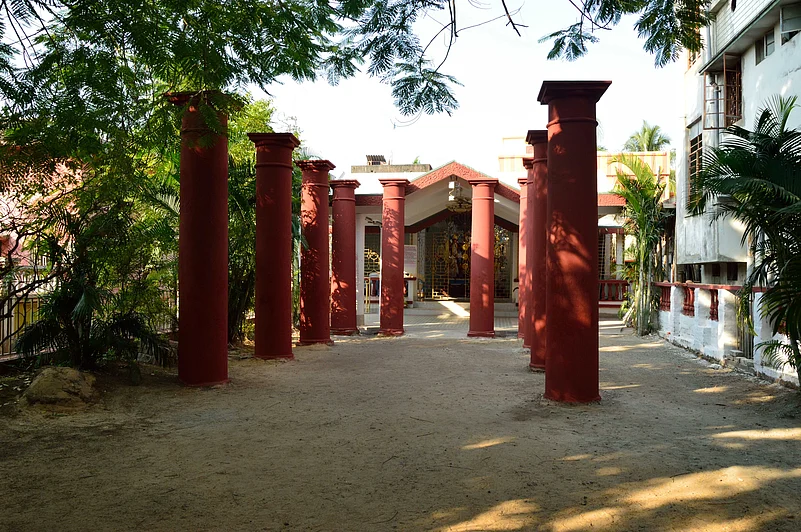
This is the appropriate final stop because it changes the scale of the story. At Shobhabazar, you began with an 18th-century Puja entwined with the rise of colonial Calcutta. At Barisha, you arrive at a tradition that the family dates to a time when Kolkata did not yet exist as a city.
Address: 26, Sabarna Para Road, Barisha, Kolkata 700008
Where To Stay
If you want to club your bonedi bari pujo trip with a relaxed stay, these are the properties worth considering.
The LaLiT Great Eastern Kolkata
For a trip built around old Kolkata, it is hard to ignore a hotel with its own place in the city’s history. The LaLiT Great Eastern occupies one of central Kolkata’s historic addresses, close to Dalhousie Square and within easy reach of the older quarters. It works particularly well for travellers who want to combine the Bonedi Bari trail with walks through colonial Kolkata, College Street, and Bow Barracks.
Address: 1, 2 & 3 Old Court House Street, Dalhousie Square
Raajkutir Kolkata - IHCL SeleQtions
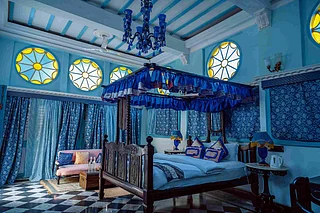
Raajkutir is a good fit if you want the hotel itself to carry some of the Bengali character of the trip. Its design draws from Bengal’s artistic and aristocratic traditions, giving it a distinctly Kolkata personality rather than the interchangeable feel of a large international hotel. Its eastern location also makes sense if you are combining the heritage trail with Salt Lake or New Town.
Address: 89C Narkeldanga Main Road
ITC Royal Bengal
If you prefer a contemporary hotel with plenty of space, ITC Royal Bengal is a convenient base. The property has 456 rooms and suites, 82 service apartments, several dining venues and a large spa, so it works particularly well for a longer stay when the Puja trail is only one part of the itinerary. Its location on the eastern side of central Kolkata also puts it within reach of both the old city and the southern route.
Address: 1 JBS Haldane Avenue
JW Marriott Hotel Kolkata
Just across the road from ITC Royal Bengal, JW Marriott is another contemporary option. It is particularly convenient if food is going to be part of the Kolkata trip, since you can pair days of heritage walks with the city’s newer restaurant scene. The location is also useful for moving between central Kolkata, the eastern neighbourhoods, and the southern part of the city.
Address: 4A JBS Haldane Avenue
Taj Bengal
If Barisha is high on your list, consider moving south for the second half of the trip. Taj Bengal in Alipore puts you considerably closer to the Sabarna Roy Choudhury family Pujas than the hotels around North Kolkata. It also gives you easy access to Alipore’s cultural and heritage attractions.
Address: 34-B Belvedere Road, Alipore
FAQs
1. What is Bonedi Bari Durga Puja?
Bonedi Bari Durga Puja refers to traditional Durga Puja celebrations held by old aristocratic, zamindar and merchant families in their ancestral homes.
2. Which are the famous Bonedi Bari Pujas in Kolkata?
Notable celebrations include Shobhabazar Rajbari, Jorasanko Shib Krishna Daw Bari, Khelat Ghosh Bari, Chatu Babu Latu Babu Bari, Darjeepara Mitra Bari and Sabarna Roy Choudhury Aatchala Bari.
3. Which is the oldest Durga Puja in Kolkata?
The Sabarna Roy Choudhury family dates its Durga Puja in Barisha to 1610, predating the establishment of Kolkata as a city.
4. What makes Bonedi Bari Pujas different from Kolkata pandals?
These family Pujas follow inherited rituals, idol designs, food traditions and household customs that have often remained within the family for generations.
5. Can tourists visit Bonedi Bari Pujas in Kolkata?
Some Bonedi Bari Pujas welcome visitors during specific parts of the festival, while others have restrictions. Check access arrangements before visiting.