


At 90° North, there is no town to arrive at, no monument to stand before and no familiar landmark to mark the achievement. There is only the frozen ocean, shifting sea ice and the knowledge that you have reached the northernmost point on Earth. For Savi and Vid, the travellers behind Bruised Passports, this absence was part of what made the Geographic North Pole so extraordinary.
The couple had visited 119 countries together before setting out on their Arctic expedition in August 2026. Yet this journey was different from moving between cities, countries and recognisable attractions. Here, reaching the destination meant spending days travelling through an unpredictable landscape, with no guarantee of what each day would bring. And for two people accustomed to documenting their travels, it also brought an unexpected realisation: some experiences are difficult to capture and perhaps better left outside the frame.
In conversation with Outlook Traveller, Savi and Vid reflected on a journey that took them from Longyearbyen in the Svalbard archipelago to the Geographic North Pole and back.
The Long Passage
The expedition began in Longyearbyen, where the couple boarded PONANT’s Le Commandant Charcot on 28 August. From Spitsbergen’s coast, the ship ventured towards the Arctic sea ice, navigating ice fields and channels of open water over the following days. “The Geographic North Pole felt like the ultimate expedition—a place where the journey would be just as important as the destination,” Savi said.
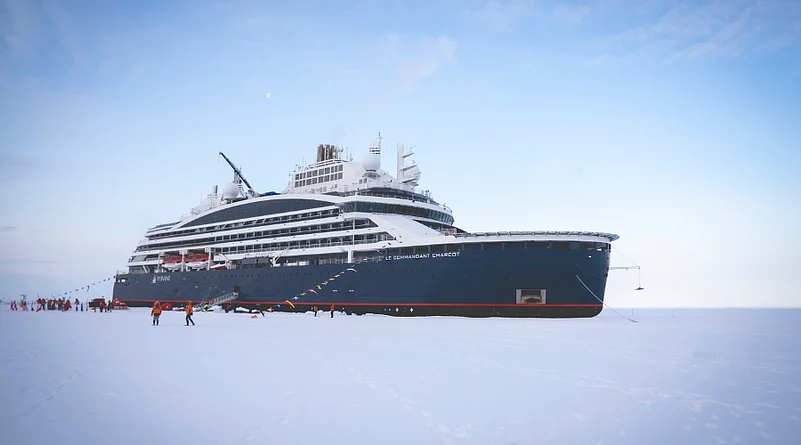

For Vid, the experience challenged a familiar idea of travel: that a destination is a point on a map, reached after a series of transfers and stops. At the Pole, he said, travellers spend days moving through ice and unpredictable weather before the coordinates finally read 90° North.
That shift shaped life aboard the ship. Mornings began with briefings, followed by Zodiac excursions or ice landings when conditions allowed, wildlife spotting and lectures by naturalists and scientists. At other times, the activity was simply observing the landscape. The itinerary did not unfold around a predictable succession of attractions; the ice, weather and sea determined what was possible.
Patience became essential. “You can’t say, ‘Today we’ll see a polar bear at 10:30 am,’” Vid said. Hours could pass with little apparent change before an unexpected wildlife encounter altered the day. Sometimes, the most exciting announcement was that the captain had spotted bowhead whales in the distance.
The landscape itself was constantly shifting, from flat expanses of ice to pressure ridges and dark channels of open water. Unlike conventional travel, where the appeal often lies in moving from one place to another, the passage through the sea ice was an experience in its own right.
Beyond The Lens
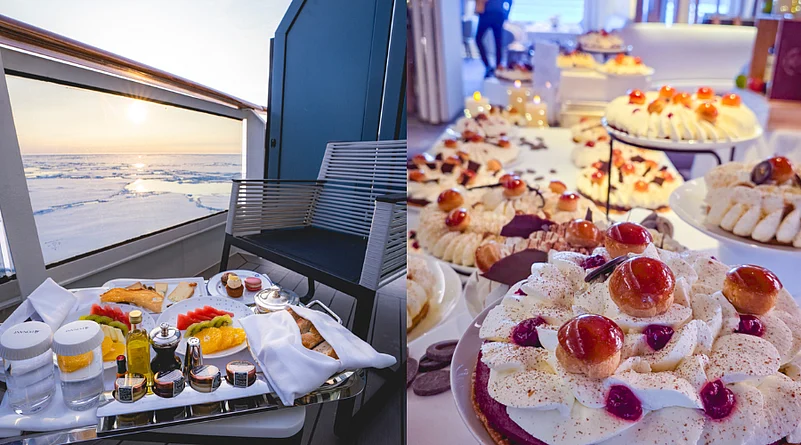
The contrast between the Arctic outside and the ship’s interior was equally striking. After spending time in a remote environment, the couple could return to a warm cabin, a hot shower and a comfortable bed. Savi described how these familiar comforts acquired a different value in the wilderness. Meals, too, offered a sharp change of scene, with French cuisine, menus curated by Alain Ducasse, cocktails and fine wines.
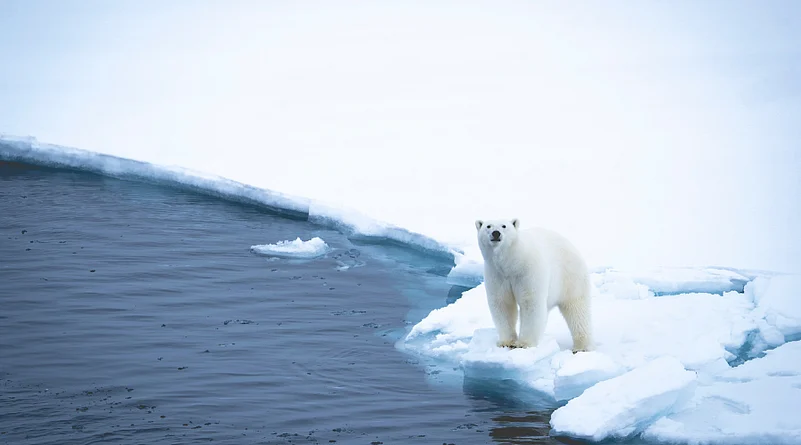
Polar bears were a highlight for Vid, alongside seals, seabirds and other Arctic animals going about their day. The naturalists taught the group to observe quietly, allowing the animals to determine the distance between themselves and their human visitors. “That fundamentally changed the way we photograph wildlife, too,” Savi said. “Sometimes the best thing you can do is put the camera down and just watch.”
Savi recalled moments when the impulse to compose a photograph or imagine a reel simply disappeared. The vastness of the landscape, she said, was impossible to convey fully through an image. There were times when she and Vid put their cameras away and stood together in silence.
“After so many years of creating travel content, experiencing something without immediately trying to document it felt incredibly special,” she said.
The experience also carried a more intimate meaning for her. Standing at 90° North was more emotional than she had expected. After days of travelling towards a coordinate that had existed largely in her imagination, the moment of arrival prompted her to think of her father, who had passed away a few years earlier. She wished she could somehow share the experience with him.
At the Pole
Vid, meanwhile, found the lack of a dramatic landmark humbling. Ice and frozen ocean stretched in every direction, offering little by way of a conventional arrival moment. What stayed with him was the realisation that they had travelled all the way from India to this singular point in the Arctic Ocean.
After their time at the Pole on September 2 and 3, the couple began travelling south through the sea ice. The expedition continued through north-western and south-western Spitsbergen, with its fjords, glaciers and wildlife, before returning to Longyearbyen on September 11. For Vid, exploration today is not necessarily about reaching a place where no one has set foot before. It is about experiencing sensitive places with humility and responsibility. Savi similarly emphasised the importance of respecting wildlife protocols and landing guidelines, and of choosing operators that take environmental sustainability seriously.
Their expedition did not end with a new country added to a list or a collection of photographs alone. It left them with the memory of a landscape that could not be fully reproduced on a screen, unexpected encounters shared in silence and the feeling of standing together at the top of the world.
Among the ordinary moments that stayed with them were evenings spent watching the Arctic drift past, dressing up for dinner while the sun was still blazing outside, and turning to each other in disbelief. As Savi recalled, sometimes all they could say was: “Can you believe we’re actually here?”
FAQs
1. Where is the Geographic North Pole?
The Geographic North Pole is located at 90° North latitude in the Arctic Ocean. Unlike a conventional destination, it has no permanent landmass or settlement, and its surroundings consist of shifting sea ice over the ocean.
2. Who are Savi and Vid of Bruised Passports?
Savi and Vid are the travellers behind Bruised Passports, a travel platform documenting their experiences around the world. Before their Arctic expedition in 2026, the couple had visited 119 countries together.
3. How did Savi and Vid travel to the North Pole?
The couple travelled aboard PONANT’s Le Commandant Charcot, departing from Longyearbyen in the Svalbard archipelago on 28 August 2026. The expedition crossed Arctic sea ice and reached the Geographic North Pole on 2 and 3 September before returning to Longyearbyen on 11 September.
4. What wildlife can travellers see on an Arctic expedition?
Depending on weather, location and wildlife activity, travellers may encounter polar bears, seals, seabirds and bowhead whales. Sightings are unpredictable, and responsible wildlife observation requires following naturalists’ guidance and maintaining appropriate distances from animals.
5. What made Savi and Vid’s North Pole journey different from conventional travel?
The expedition required patience and flexibility, as the sea ice and weather determined daily activities. Beyond reaching 90° North, the couple valued the wildlife encounters, the vast Arctic landscape and the experience of putting their cameras away to appreciate moments without documenting them.


