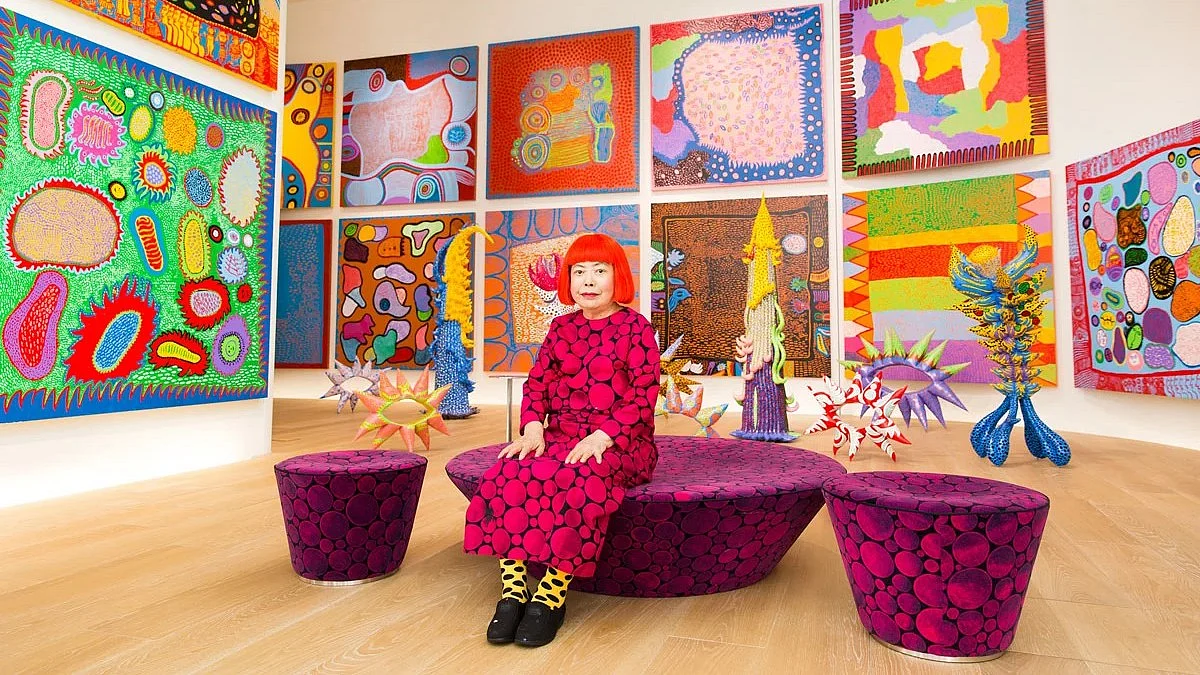
A girl grows up among flower fields in Matsumoto, Japan’s castle city in central Nagano Prefecture, surrounded by seeds, plants and the mountains of Nagano. She begins seeing dots, nets, and flowers that seem to spread across walls, ceilings, her own body and the universe. She draws them down. Decades later, those same dots will cover galleries, pumpkins, handbags, trees and entire rooms around the world.
That girl was Yayoi Kusama, the Japanese artist who made obsession into an artistic method and repetition into a way of imagining infinity. Over a career spanning paintings, sculpture, installations, performance, film, fashion, poetry, and fiction, she built a visual universe that was at once intensely personal and startlingly public.
Kusama died in Tokyo on August 14, 2026, aged 97. By then, the girl from the seed farm had become one of the most recognisable artists in the world.
From Matsumoto To The New York Avant-Garde
Born on March 22, 1929, Kusama was the youngest daughter of a family that ran a plant nursery and seed business in Matsumoto, Japan. The natural world was everywhere around her, and plants, flowers, seeds, and tendrils would remain recurring subjects throughout her career. But home life was difficult, and the hallucinations she experienced as a child could be frightening. She began drawing what she saw, turning the visions into something she could observe rather than simply endure.
Her early drawings already contained the ingredients of the Kusama universe: dots, nets, organic forms, and proliferating patterns. During the Second World War, she worked in a parachute factory, an experience that would contribute to her later pacifist outlook. After the war, she studied traditional Nihonga painting in Kyoto, but soon found its conventions restrictive.

In 1955, she boldly wrote to Georgia O’Keeffe, whom she had never met, asking how a young Japanese woman might establish herself as an artist in America. O’Keeffe replied, encouraging her to take her work to the United States. Kusama eventually left Japan in 1957 and arrived in New York in 1958.
New York was where her ambition became enormous. Her early Infinity Net paintings consisted of vast canvases covered in thousands of tiny, repeated marks. Rather than the dramatic gestures associated with Abstract Expressionism, Kusama offered an almost obsessive accumulation of identical gestures. The effect was hypnotic and seemingly endless. She wanted, quite literally, to cover the world.
Then came sculpture. In 1962, she began covering chairs, tables and other domestic objects with hand-sewn stuffed forms resembling phalluses. Her Accumulation works turned familiar furniture into strange, fleshy landscapes and brought sexuality, anxiety, and repetition into the same frame.
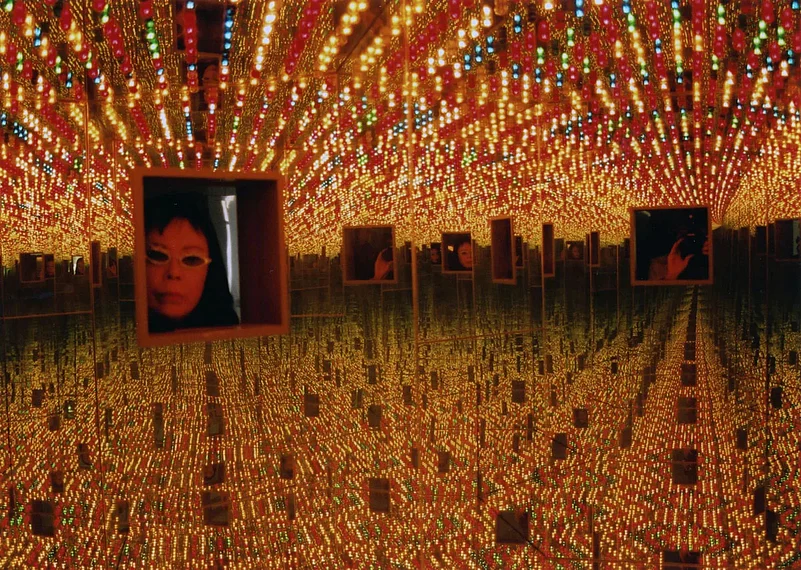
She moved beyond objects into environments. In 1965, Infinity Mirror Room—Phalli’s Field transformed her repeated forms into an immersive space, using mirrors to multiply them seemingly forever. It was the beginning of the Infinity Mirror Rooms that would eventually become her most famous works.
And Kusama was never content to keep art politely inside galleries.
In the 1960s, she organised Happenings, body-painting events and anti-war performances, frequently covering naked bodies with brightly coloured dots. Her Anatomic Explosions brought these interventions into public spaces, including around the New York Stock Exchange and the United Nations. Her art became performance, protest, and spectacle at once.
In 1966, she staged perhaps her cheekiest intervention at the Venice Biennale. For Narcissus Garden, she arranged 1,500 mirrored spheres across the exhibition grounds and attempted to sell them to visitors for USD 2 apiece. It was part sculpture, part performance, and part provocation about vanity and the commercial machinery of the art world.
Self-Obliteration, Pumpkins, And Infinite Rooms
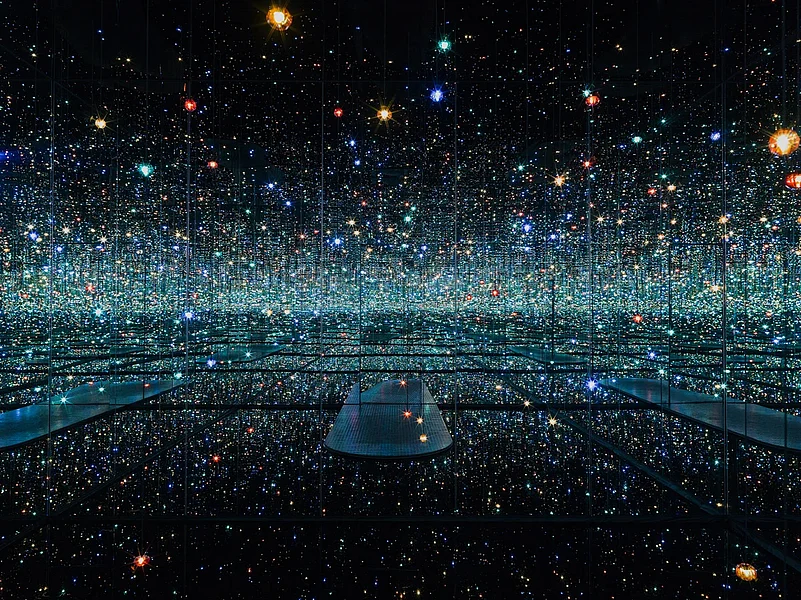
Kusama called her philosophy “self-obliteration”. The idea was simple but profound: through endless repetition, the boundaries between the individual, objects and the surrounding universe could dissolve. A dot could be one small thing, or one particle in an infinite cosmos.
Mirrors became crucial to this idea. In rooms filled with reflected lights, dots or pumpkins, a visitor could lose any straightforward sense of scale and place. Works such as Love Forever, Infinity Mirrored Room—The Souls of Millions of Light Years Away, Dots Obsession—Love Transformed Into Dots, and Aftermath of Obliteration of Eternity turned the spectator into part of the artwork.
Then there were the pumpkins.
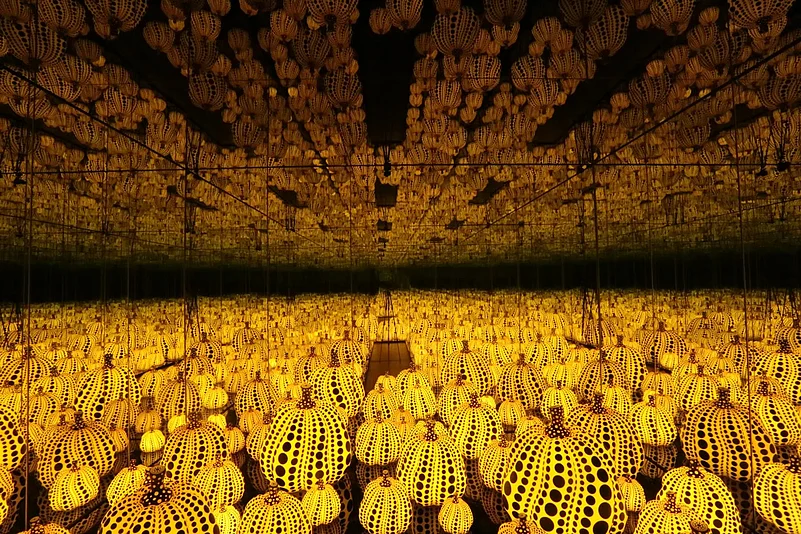
Kusama’s pumpkin sculptures, particularly the bright yellow, black-spotted forms that became associated with her, drew on her childhood fascination with the vegetable and her affection for its comforting, familiar shape. Her 1994 pumpkin on Japan’s Naoshima island became one of her most photographed works, but pumpkins appeared across paintings, sculptures, and installations.
Another major work, The Obliteration Room, took the idea of dots in a different direction. An entirely white domestic interior is gradually covered with coloured dot stickers by visitors. What begins as a blank room becomes an explosion of colour through collective participation.
Kusama’s practice, however, was never limited to the installations that dominate Instagram today. She made drawings, collages, paintings, sculptures, films, and environments. She experimented with clothing and fashion, founded Kusama Enterprises in 1969, produced her own publications and newsletters, and made the 1967 film Kusama’s Self-Obliteration, which won several awards.
She was also a writer. After returning to Japan in 1973, Kusama increasingly devoted herself to poetry and fiction. Her novel Hustlers Grotto of Christopher Street won a literary prize in 1983, and she went on to publish numerous novels and collections.
The Artist Becomes The Icon
Kusama returned to Japan in 1973 after years in New York. From 1977, she voluntarily lived in a psychiatric hospital in Tokyo while maintaining a nearby studio and continuing to work. Rather than marking the end of her career, the period became another chapter in an extraordinarily prolific life.
Recognition returned strongly in the late 1980s and 1990s. In 1993, she became the first woman to represent Japan at the Venice Biennale. She later received honours including the Praemium Imperiale, the Order of the Rising Sun, and Japan’s Order of Culture.
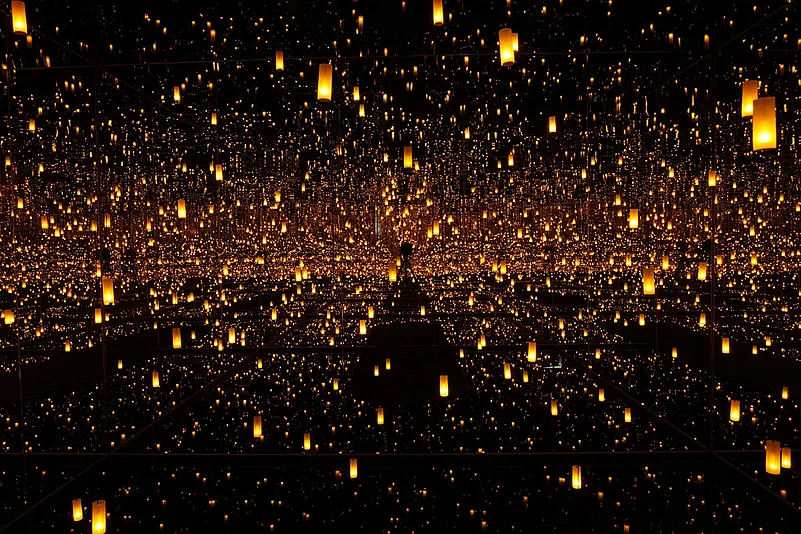
Her work subsequently travelled through major museums and galleries across the world. The 2017 Infinity Mirrors exhibition at Washington’s Hirshhorn Museum travelled to several North American institutions, introducing a new generation to the extraordinary physical experience of her rooms. Her first dedicated museum, the Yayoi Kusama Museum, opened in Tokyo in 2017.
The 21st century also brought Kusama into fashion. Her collaboration with Louis Vuitton, beginning in 2012 and returning in 2023, put her dots, pumpkins and mirrored aesthetic onto bags, clothing, and stores around the world.
Yet the simplest way to understand Kusama may still be through that little girl in Matsumoto, drawing what she saw.
The dots were never merely decoration. The nets were never simply patterns. The mirrors were never only tricks of perception. Across eight decades, Kusama kept returning to the same questions: Where does the self end? Where does the universe begin? What happens when one mark becomes thousands, when one object becomes endless, when the individual disappears into the pattern?
She spent her life answering those questions with more dots.
And then more.
FAQs
1. Who was Yayoi Kusama?
Yayoi Kusama was a Japanese contemporary artist known for her polka dots, Infinity Mirror Rooms, pumpkins, paintings, sculptures, installations and performances.
2. What is Yayoi Kusama most famous for?
Kusama is best known for her immersive Infinity Mirror Rooms, polka-dot artworks, pumpkin sculptures and repetitive Infinity Net paintings.
3. What do Yayoi Kusama’s dots mean?
Dots are central to Kusama’s idea of “self-obliteration”, through which repeated forms can dissolve the boundaries between the individual, objects and the wider universe.
4. Why are pumpkins important to Yayoi Kusama?
Kusama developed a longstanding fascination with pumpkins, drawing on their familiar shape and her childhood experiences. Her yellow-and-black spotted pumpkins have since become among her most recognisable works.
5. Where can you see Yayoi Kusama’s art?
Kusama’s work is held and exhibited by museums and galleries around the world. The Yayoi Kusama Museum in Tokyo, which opened in 2017, is dedicated to her work.