ROSALIND (as Ganymede): Now tell me how long you would have her after you have possessed her?
A Round Of Drinks With Shakespeare, Sagan, And A Sun God At The Library Bar
Eight novels, one Inca Sun God, and a glass of banana-infused gin later, I worked through The Library Bar’s new literature-themed menu at The Leela Palace New Delhi—here’s what an evening inside its leather-bound bar book actually feels like

Advertisement
ORLANDO: Forever and a day.
It’s been more than 12 years since I read “As You Like It,” and I still remember this playful dialogue. Shakespeare used the exact expression “for ever and a day” in another play, “The Taming of the Shrew,” too—he more or less coined the phrase, and generations of writers have borrowed it since. Ian Fleming’s world got its own version decades later, when Anthony Horowitz wrote “Forever And A Day,” a prequel to “Casino Royale” imagining the mission that turned a young naval officer into 007.
So when I sat down at The Library Bar, inside The Leela Palace New Delhi, and saw Forever And A Day sitting on the new cocktail menu, I knew exactly where I was starting the evening. What followed was closer to working my way through a small, well-curated shelf, one glass at a time.
The menu itself arrives as a bookmark, slipped inside a leather-bound edition of one of the novels that inspired the collection. So before a single drink is poured, you’re handed a book. I received Toni Morrison’s “Beloved”. This is Literary Mixology, Volume II, the follow-up to the bar’s earlier literature-themed programme, and according to the team, it’s the product of two years spent trading techniques and ideas with more than 60 bars from around the world. Atul Tiwari, the hotel manager, calls it the “culmination” of that exchange. Sitting there with the bookmark menu in hand, that ambition felt like the honest premise for the night ahead.
Advertisement
The First Chapter: A Raft Named After A God
I circled back to Forever And A Day, the drink I’d come for. Banana-infused gin, elderflower, chardonnay, citrus, rosemary milk clarified, and curry leaf oil—subtler than I expected, the curry leaf oil sitting underneath everything as a faint, savoury counterweight that keeps the drink from turning sweet. Horowitz’s novel is itself a slow build toward the man Bond eventually becomes; the cocktail plays the same long game, revealing itself gradually rather than all at once.
It was a humid Sunday evening, and the bartender pointed me towards Kon-Tiki next —aged rum, Metaxa, pineapple, lemon juice, grapefruit and lemon bitters, homemade falernum, and passionfruit. It arrived in a glass shaped with a nod to Inca design, and the whole drink made more sense.
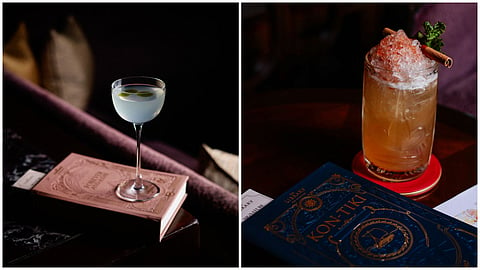
(L-R) Forever and a Day, Kon-Tiki Supplied
The name comes from Thor Heyerdahl’s 1947 expedition, in which the Norwegian explorer and five companions sailed a hand-built balsa-wood raft nearly 7,000 kilometres from Peru to Polynesia, hoping to prove that ancient South Americans could have settled the Pacific islands using nothing but the currents and materials available to them. He named the raft Kon-Tiki after Viracocha, the Inca sun god once known by that older name—and his 1948 book about the 101-day voyage sold out in fifteen days. It has since become one of the most famous stories in the history of exploration, an underdog project that becomes a legend. The cocktail leans into that same spirit. Bright, tropical, a little reckless in a good way, and the Inca-inspired glass turns out to be a small but deliberate detail rather than decoration for its own sake. It’s a strong, welcoming way to enjoy the night.
Advertisement
Deeper Into The Stacks
From there, I moved to Cosmos, after Carl Sagan’s 1980 book and television series of the same name, which turned the scale of the universe— billions of galaxies, billions of years—into something a general audience could actually sit with. The cocktail, dill-infused gin, tequila, mastiha, tomato water, elderflower, and Supasawa, is savoury rather than sweet, closer to a dry, herbal cousin of a Bloody Mary than anything else on the menu.
Next came Infinite Jest, David Foster Wallace’s sprawling 1996 novel about entertainment, addiction, and the way pleasure can tip into its own kind of trap. Pandan vodka, ripe pineapple, coconut elixir, bright citrus, milk-clarified. It’s rich without turning heavy, the clarification keeping it clean rather than cloying. Reading the novel takes weeks; the cocktail takes about four minutes and somehow still gestures at the same tension between indulgence and control.
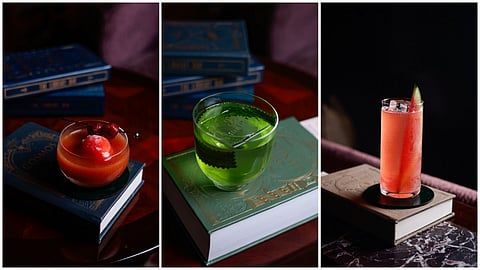
(L-R) Cosmos, Infinite Jest, Still Life Supplied
Beside it sat Still Life, after Louise Penny’s 2005 debut novel, the first in her Chief Inspector Armand Gamache series. It opens with the death of a beloved retired schoolteacher in the small Quebec village of Three Pines, and unfolds less like a conventional thriller than a slow, careful study of a close-knit community keeping its secrets. The cocktail matches that register—bourbon whisky, an almond-sage distillate, watermelon, Supasawa, and a homemade spice blend—restrained, a little wistful, built for sitting with rather than rushing through.
Advertisement
Turning To The Darker Chapters
By this point, the bartender mentioned the drink getting the most attention on the pass: a cocktail chilled not with ice but with deep-frozen tomatoes, repurposed from surplus produce at Le Cirque, the hotel’s Franco-Italian restaurant next door. The idea is borrowed from Bar Sathorn’s “Bangkok Brunch,” and as the tomatoes slowly melt, they change the drink’s flavour over the course of the pour—sustainability turned into an actual part of the drinking experience rather than a line on a menu.
I moved on to The Agony and the Ecstasy, named for Irving Stone’s 1961 biographical novel about Michelangelo—a book built around the sheer physical and emotional strain of making great art, the ceiling of the Sistine Chapel included. The cocktail matches that intensity: tequila blanco, lychee distillate and cordial, fresh lime, a habanero-saffron tincture, and mango-chilli foam. It’s the boldest pour on the menu, and it earns that reputation.
Advertisement
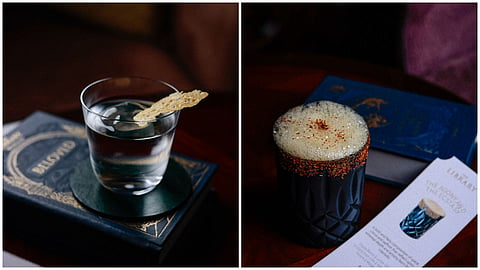
(L-R) Beloved, The Agony and the Ecstasy Supplied
Beloved, after Toni Morrison’s 1987 novel about a formerly enslaved woman haunted, quite literally, by her past, came next—gin, sake, mezcal, a house rhubarb distillate, a saline accent, and Parmesan crackers on the side. It’s smoky and bittersweet, built to sit heavy the way the novel does. I followed it with Farewell, My Lovely, after Raymond Chandler’s 1940 noir featuring private eye Philip Marlowe, all shadowed Los Angeles and doomed romance—a truffle fat-washed rye with Fernet Branca, sweet vermouth and chocolate bitters, dark and a little bitter at the finish, exactly as it should be.
Closing The Book
If you’re looking for more options in cocktails, end the night with the two holdovers from the bar’s earlier menu, filed here as Legacy Cocktails. Gravity’s Rainbow, after Thomas Pynchon’s dense, notoriously difficult 1973 novel about paranoia and rocket science in the closing days of the Second World War, arrived as whisky, pineapple, lactose, coconut, caramel and a vanilla-Campari foam—dense and dessert-like, in its own way as much of a commitment as the book it’s named for. And Pablo Picasso, the one drink on the menu without a novel attached to it, built instead around the artist himself—tequila, hot spiced brine, grapefruit, peach and mint salt, bold, and a little unpredictable, which is a fair tribute to a man who kept reinventing his own style every decade or so.
Advertisement
The Last Page
The Library Bar has deliberately built a whole evening around the idea of reading as a physical, edible thing. A book usually asks for hours alone and a quiet room; here, a novel’s entire emotional weather. Sagan’s wonder, Morrison’s grief, Chandler’s cynicism, Heyerdahl’s stubborn optimism—had been distilled into something you could hold in one hand and finish in fifteen minutes. That’s a harder trick than it sounds, and the fact that it mostly works, drink after drink, says more about the two years of craft behind this menu than any single tasting note could. I left without a hangover, but with a small stack of book titles I now intend to re-read, which is probably the only measure of success a literary cocktail menu should be judged by.
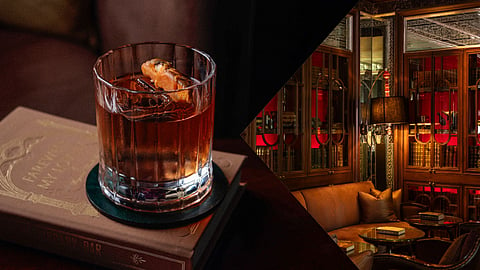
Farewell, My Lovely Supplied
FAQs
1. Where is The Library Bar located?
The Library Bar is located inside The Leela Palace New Delhi in Chanakyapuri, one of the capital's premier luxury hotels.
Advertisement
2. What is special about The Library Bar's new cocktail menu?
The menu draws inspiration from classic literature, with cocktails influenced by iconic books, authors and historical characters, pairing storytelling with inventive mixology.
3. Does The Library Bar serve only cocktails?
No. Along with signature cocktails, the bar also offers premium spirits, wines, classic drinks and a curated food menu.
4. Is The Library Bar suitable for non-hotel guests?
Yes. The bar welcomes outside guests, subject to availability and the hotel's entry policies.
5. What makes The Library Bar one of Delhi's notable hotel bars?
Its refined ambience, book-lined interiors, creative cocktail programme and personalised service make it a popular destination for those seeking a premium drinking experience in Delhi.
Published At: