Maharashtra is famous for festivals such as Ganeshotsav, Wari, and Lavani, yet across the state, there are dozens of local celebrations that most visitors never encounter. Below are six lesser-known Maharashtrian festivals, each described individually, so you can understand their age, what happens, why they matter, when they take place, where they are held, and practical notes on how to get there.
Regional Festivals In Maharashtra You’ve Probably Never Heard Of
Discover Maharashtra’s little-known regional festivals, from tribal mask dramas to ancient cattle rites and rural chariot rituals, each rooted in community memory, seasonal rhythms and centuries-old devotion

Advertisement
Bagad Yatra

Bagad Yatra Instagram/no_thikana
Bagad Yatra is an agrarian chariot ritual celebrated in parts of western Maharashtra around Holi Pournima; the name bagad refers to a wooden chariot built and pulled to fulfil promises made to the village deity and to mark vows kept to the god. The ritual is centuries old and local histories and news features place its origins many hundreds of years back, with some communities tracing the practice back over eight centuries; village carpenters still fashion the massive wooden bagads, and only strong local bullocks are used to haul the cart because the carved wooden vehicle can weigh several tons.
On the day itself, there is a striking mixture of devotion and physical daring: devotees decorate the cart with flowers and sandalwood, processions move through the village and a small number of volunteers known as bagad holders perform severe vows and austerities; in some villages, people perform extreme feats such as hanging from hooks as a public vow. The festival’s significance lies in communal thanksgiving and the public fulfilment of vows to Bhairavnath and local guardian deities, and it draws large crowds from surrounding talukas. Bagad Yatras are normally held on or just after the full moon of Holi and are most visible in rural pockets of Pune, Satara and Solapur districts.
Advertisement
To witness a Bagad Yatra travel by road from Pune or Satara, many of the participating villages are connected by state highways, and local buses run from district centres, while the nearest railway stations will be in the district towns and taxis or shared jeeps complete the last stretch.
Bohada (The Mask Festival)

Faces of faith and folklore, the Bohada masks bring ancient village myths vividly to life. Jhinku Banerjee
Bohada is a mask-dance festival celebrated by tribal communities in the north Konkan and northern Maharashtra belt, and it reads like a living repertoire of myth acted out in colour and papier-mâché. The festival is a long-established tribal practice that local scholars and cultural records treat as centuries old, and in some oral histories, the masked dramas were formalised several hundred years ago; Bohada performances are associated with the Kokna, Warli and related tribal groups, and the tradition has been handed down across generations.
The heart of Bohada is the mask procession and night-long performances in which performers don dozens of masks representing gods, goddesses and mythic characters and enact stories accompanied by drums and singing; masks are displayed, paraded, and reverently returned to family shrines after the festival. Bohada is both a thanksgiving to the village deity and a social theatre that reaffirms tribal identity and seasonal rhythms; it usually takes place in late spring, around Akshay Tritiya or in the weeks after Gudi Padwa, and festival dates vary by village and by the lunar calendar.
Advertisement
You are most likely to find Bohada in Thane, Palghar and Nashik district tribal pockets, where performances may last three days or, in some areas, extend up to a fortnight. To attend, travel to the nearest town—Mokhada in Palghar district is one frequent host—and then hire local transport or ask local guides arranged through district cultural offices, because many of the village venues are reachable only by rural roads.
Gondhal (Devotional Drama And Praise Of Khandoba)

Gondhal Shutterstock
Gondhal is a ritual theatre form performed across rural Maharashtra and is less a single-date festival than a professional ritual practice that intensifies around particular temple events, weddings, and Navratri; Gondhalis are specialist performer-singers who enact mythic praise songs and dramatic sequences dedicated to deities such as Khandoba, Renuka, and Bhavani. The form has medieval roots that scholars connect to the Bhakti movement and to earlier regional devotional practices, giving it an origin that stretches back many centuries. During a Gondhal performance, the troupe will sing long narrative songs, play traditional instruments and sometimes fast and keep vigil through the night; the ritual is thought to sanctify major family and village events and is performed to invite divine blessings, avert misfortune and celebrate martial and local myths. Gondhal remains an important ritual across central and western Maharashtra and into bordering Karnataka; it is most often encountered in rural talukas where patrons still call Gondhalis for weddings, harvest vows and temple festivals.
Advertisement
To witness Gondhal arrive at the village or temple where a scheduled jatra or family ceremony is taking place, district cultural centres and local temples can share calendars, and Gondhal troupes can be engaged through village organisers.
Enadakshi (The Bhiwdawad Cattle Ritual Often Reported As Govardhan Practice)
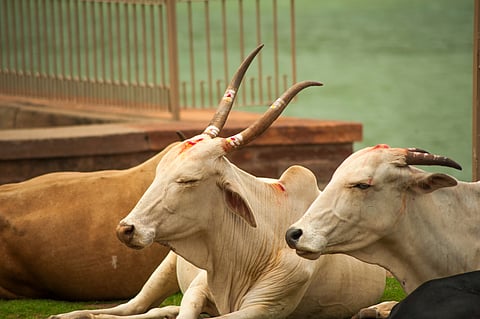
Cow worship (representational image) Shutterstock
Enadakshi is a remarkable village rite from Bhiwdawad and a handful of neighbouring settlements that takes place on the day after Diwali, when villagers observe an intense form of Govardhan worship. The custom is locally famed and appears in feature reports on unusual rituals: families fast for days, bathe and decorate their cattle with flowers, turmeric and henna, and then allow the animals to pass over devotees who lie prostrate on the ground as an act of supplication and faith. The ritual’s age is difficult to date precisely from records, but it is described as a long-standing local tradition, and the practice is rooted in agrarian gratitude and petitionary ritual common to many rural communities in western India. Enadakshi’s significance rests in promises made to the rain and fertility powers embodied by cattle and in the belief that extreme self-surrender will secure blessings; it is held annually on the set calendar day immediately following Diwali.
Advertisement
Bhiwdawad is a small village and reachable by road from the nearest district centre; visitors should arrange permission from village elders before attending out of respect for local privacy and ritual protocols, and use local buses or hired vehicles from the district headquarters to reach the village.
Naldurg Yatra (The Naldurg Festival / Khandoba Yatra)

Khandoba Yatra Shutterstock
Naldurg’s annual yatra is a regional pilgrimage and fair centred on the Khandoba tradition and the historic Naldurg fort town in what is now the Dharashiv (Osmanabad) area. The yatra includes cultural performances, processions, food stalls, heritage walks, and large congregations, and is timed around Paush Purnima in the lunar calendar, usually in January. The modern fair, by contrast, includes laser shows and organised exhibitions, but its religious core is the centuries-old veneration of Khandoba and local guardian deities. The yatra draws devotees from multiple states and serves as both a religious festival and an economic event for the town, with devotees making vows and participating in ritual observances at the shrine. Naldurg is best reached by road from Osmanabad and Solapur; the town is connected by state buses and local taxis, while the nearest major railheads are Osmanabad and Solapur, from where private hire completes the journey to Naldurg. If you plan to go, check district event listings because the fair now combines modern programming with older temple rites.
Advertisement
Pola (Bail Pola, The Bull Festival Of The Farming Belt)

Pola festival in Maharashtra Shutterstock
Pola is a farmers’ thanksgiving festival observed across rural Maharashtra to honour bullocks and their role in agriculture; it is an ancient agrarian observance practised for generations and is the region’s counterpart to cattle festivals elsewhere in India. On Pola, farmers wash, decorate and sometimes colour the horns of their bulls, change tethers and bells and take their animals in procession through the village, accompanied by music and sweets; many villages treat Pola as a holiday by excusing field work for the day. Its significance is practical and spiritual at once, thanking animals that make cultivation possible and asking blessings for the next cropping cycle. Pola falls in the monsoon-to-post-monsoon period, frequently in August, with specific dates set by local lunar observance; the festival is widespread in Marathwada, Vidarbha and parts of western Maharashtra.
To attend Pola, travel to agrarian towns and villages in the relevant districts during the month of August; district tourism pages and local newspapers publish dates each year, and the easiest access is usually by road via the nearest city or railway junction.
Advertisement
FAQs
1. What are some lesser-known regional festivals in Maharashtra?
Festivals like Bagad Yatra, Bohada, Gondhal, Enadakshi, Naldurg Yatra and Pola are deeply local celebrations rarely seen by mainstream travellers.
2. When do most regional festivals in Maharashtra take place?
They follow the lunar calendar and agricultural cycles, with major festivals spread across Holi, Gudi Padwa, monsoon months, Diwali and Paush Purnima.
3. Are these festivals open to visitors and travellers?
Many are community-led rituals. Visitors are welcome, but it is important to seek local guidance, respect photography norms and follow village customs.
4. Which regions of Maharashtra host these traditional festivals?
They are found across western Maharashtra, Marathwada, Vidarbha, north Konkan and tribal belts of Palghar, Thane and Nashik districts.
5. Why are these festivals culturally important?
They preserve oral history, agrarian traditions and devotional practices that have been passed down for centuries within village communities.
Advertisement
Published At: