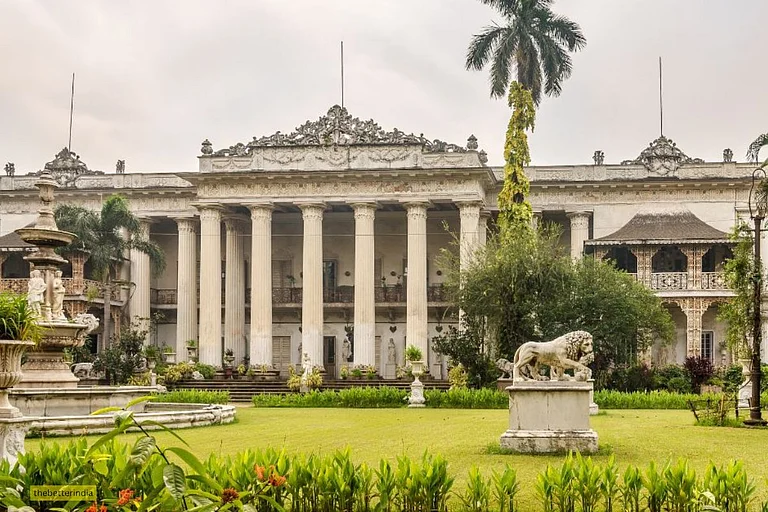
On the road from Kolkata to Basirhat is Dhanyakuria, recognisable by its distinctive architecture. Behind imposing gateways rise domed towers, arched verandahs and ornamental figures that seem at odds with the surrounding countryside. One house has statues arranged along its rooftop; another has an L-shaped plan, classical columns and a ceremonial courtyard; further along stands a castle-like building with stepped gables and sculptures set into its façade. The village has earned its reputation as the ‘city of palaces’.
Dhanyakuria: A Village Of Palaces, Trade And Forgotten Histories
About 50 kilometres from Kolkata, Dhanyakuria’s mansions tell a story of trade, architectural ambition and philanthropy. As the village draws day-trippers and film crews, the question is how its heritage can survive beyond the frame of a camera

Advertisement
Dhanyakuria’s story also complicates the familiar association between European-style architecture and colonial rulers. Many of its most distinctive buildings were commissioned by Indian merchants who accumulated wealth through trade with the British and agricultural commerce in the surrounding region. Their residences borrowed from European architectural traditions while retaining spaces central to Bengali domestic and religious life. Schools, hospitals and other civic institutions formed part of the same landscape. Today, some of these mansions remain family homes where traditional pujas continue; others stand empty or have found new uses. As tourism grows, Dhanyakuria must negotiate a difficult balance between making its history accessible and preserving the buildings, communities and traditions that give it meaning.
From A Forest Settlement To A Merchant Township
Historical accounts describe the area around Dhanyakuria as once belonging to the Sundarbans, with dense vegetation and saline water bodies. Its transformation into a habitable settlement is associated with Jagannath Das, who is said to have arrived with his family in 1742. The nearby town of Basirhat, situated along the Ichhamati river, developed as a trading centre during the colonial period. As commerce expanded, Dhanyakuria attracted other prosperous families, including the Gaines, Sawoos, Ballavs and Mandals.
Advertisement
These merchants dealt in agricultural produce and goods such as jute, rice and jaggery, building fortunes through commercial networks that connected the countryside with British buyers. Their prosperity found expression in large residences, country retreats known as baganbaris, and buildings that announced their owners’ social standing. Yet the families’ ambitions extended beyond their private properties.
“Everyone naturally fixates on the grand rajbaris with their Corinthian pillars and fairy-tale domes, but what really gets missed is how smartly the whole place was planned,” say Deboleena Ghosh and Sayak Mondal of Crosswalks by OCA, who conduct tours in the region. They describe the development of the settlement as an attempt by wealthy merchant families to create “a complete, self-sustaining township”.

The intricate carvings Amar Mukherjee
The families’ philanthropic work became part of this transformation. Mahendranath Gaine and Upendranath Sawoo are credited with establishing an English-medium school in 1885. Sawoo is also associated with a charitable hospital built in 1888, followed by a girls’ school in 1893. During periods of famine, these families were known to distribute food to local residents.
Advertisement
The result was a settlement in which displays of private prosperity sat alongside institutions intended for public use. Ghosh and Mondal describe this as “a brilliant mix of 19th-century merchant ego and genuine civic responsibility.”
An Architectural Stage, Built In Rural Bengal
The buildings of Dhanyakuria reflect this mixture of commercial ambition and cultural negotiation. Their façades carry European influences, including Corinthian and Ionian columns, classical arches, domes and ornamental stucco work. Yet the houses were not replicas of European residences. Their layouts also accommodated the domestic and ceremonial requirements of Bengali family life, with inward-facing courtyards and thakur dalans where religious rituals could be performed.
For Ghosh and Mondal, this is what distinguishes Dhanyakuria from other heritage settlements in the region. They describe its character as one of “unabashed, whimsical theatricality,” arguing that the wealthy traders were “actively playing at being European barons.” The architectural result, they say, is “rural Bengal wealth translated through a wildly eclectic, globalised imagination.”
Advertisement
The Gaine Mansion exemplifies this fusion. Its L-shaped plan, open corridors and columns frame a domestic world organised around the thakur dalan. Roofline domes and towers lend the building a more overtly European appearance, while the family’s religious traditions remain part of the house’s identity. The Ballav residence, known locally as Putul Bari, or the Doll House, takes ornamentation further. Figures in European attire decorate its rooftop, making the façade as much an exercise in display as an architectural composition.

Two Storied Rashmancha with a nine-pinnacled roof Wikimedia Commons
The village’s religious architecture offers a different perspective on this history. A short distance from the mansion stands a two-storeyed Rashmancha with a nine-pinnacled roof, associated with the Vaishnava traditions that once had a strong presence in Dhanyakuria. During the annual Raas festival, idols of Radha and Krishna are worshipped here. The structure serves as a reminder that the village’s architectural identity was not shaped by imported influences alone.
The religious life of the mansions remains equally significant. Families continue to hold traditional pujas, including Durga Puja, in their ancestral homes. For history and heritage storyteller, Amar Mukherjee, this continuing use is a defining feature of the village. Reflecting on his visit, he says, “What struck me was that, apart from Gayen Castle, the heritage houses we visited appeared to be actively maintained and cared for. Their connection with the community has not disappeared along with the commercial world that made them possible.”
Advertisement
The Castle At The Edge Of The Village’s Past
On the approach to Dhanyakuria, the Gaine Baganbari, also known as Gaine Castle or Gayen Castle, is among the most striking structures in the village. A grand gateway, topped with figures depicting two men fighting a lion, leads towards a building with stepped gables, ornamental faces and an eagle emblem. The estate once served as a garden retreat for the affluent Gaine family.
Unlike the better-maintained family residences, the castle has suffered considerable deterioration. Mukherjee, who received special permission to enter and document the property, found it architecturally striking despite its condition. He describes its Italianate character and the unusual setting, with water bodies on either side of the estate. During his visit, he was also told of a fire that had damaged the property and its subsequent use as an asylum.

Ballav Bari Wikimedia Commons
The building later served a social purpose as a state-supported residential home and orphanage for underprivileged girls. Following administrative changes and concerns about the building’s condition, the residential facilities were moved into newer quarters across the road. Since the orphanage’s closure at the site in 2018, the old structure has largely stood vacant, with access restricted. The castle’s cinematic appearance has also made it an attractive location for film shoots, as have other mansions in the village. But while a film crew can provide a property with a temporary source of income, neither the camera nor the interest it generates guarantees that a building will be preserved.
Advertisement
The Challenge Of Keeping Heritage Alive
The contrast between the occupied mansions and the abandoned castle points to a broader problem. Dhanyakuria’s privately owned properties depend substantially on the resources and decisions of the families who maintain them. The upkeep can be as ordinary as repairing a leak, patching damaged plaster or supporting a weakened section of a building. Some owners can draw on income from film shoots or accommodation to finance more substantial work; others have fewer options.
Ghosh and Mondal identify fragmented family ownership and legal disputes between descendants as significant obstacles to conservation. Another difficulty is the dwindling availability of artisans familiar with traditional construction materials. Older buildings often rely on chun-surkhi, a lime-based mortar, and require specialised masonry skills. They warn that hurried repairs using modern cement can trap moisture and accelerate damage to historic brickwork.
Tourism and adaptive reuse offer one possible source of support, but neither is a straightforward solution. Ghosh and Mondal describe converting heritage properties into boutique stays as “a double-edged sword”, while arguing that tourism can provide revenue for roof repairs, maintenance and security. The risks arise when commercial requirements begin to dictate alterations to the structure. Installing modern plumbing or air-conditioning, for instance, can involve interventions that are difficult to reconcile with fragile walls and historic materials. Unmanaged visitor numbers can also increase wear on old woodwork and stucco.
Advertisement

The castle-like towers Amar Mukherjee
For Mukherjee, the conservation challenge is bigger than any single building. He argues that expecting the government alone to restore every historic house in Bengal is unrealistic, given the number of estates and architectural landmarks spread across towns and villages. He sees a future in which public intervention is combined with family ownership, heritage organisations, responsible adaptive reuse and community participation. Gayen Castle, in his view, is an especially urgent case for serious conservation.
Beyond The Photograph
Dhanyakuria’s increasing visibility has begun to change how people from Kolkata experience the region’s heritage. The village is an accessible day trip, and its combination of unusual architecture, family pujas and proximity to other attractions in North 24 Parganas makes it appealing to visitors seeking something beyond conventional sightseeing.
For Ghosh and Mondal, this interest reflects “a real, palpable fatigue with standard vacations and checklist travel”. They see travellers looking to reconnect with regional histories and explore places closer to home. Social media and heritage initiatives have helped make local stories more accessible, but the attention can also narrow the experience. As the two point out, film tourism sometimes becomes a “spot-and-selfie” culture, with visitors searching for a particular doorway or façade while overlooking the place around it.
Advertisement
For residents, the influx brings both opportunity and friction. Small shop owners, toto drivers and families offering home-cooked meals can benefit from weekend visitors, particularly during festivals. At the same time, large seasonal crowds place pressure on parking and waste management, while the presence of visitors in residential courtyards raises questions about privacy. The challenge is not to prevent people from discovering Dhanyakuria, but to ensure that tourism does not overwhelm the everyday life that makes the village worth visiting.

Aerial shot of the Gayen Bari Amar Mukherjee
One conversation during Ghosh and Mondal’s visits gave them a different perspective on the families who built its mansions. Speaking to local residents, they found that many continued to regard the babus, or zamindar families, with considerable affection. A restaurant owner told them that schools, hospitals, roads and much of the village’s civic infrastructure were still maintained largely by these families. The two were surprised by how much influence the old estates appeared to retain in local life. They recount the response they heard about the families’ continuing role: “It’s still the babus who are the real MVPs, if you will.”
Advertisement
Ghosh and Mondal’s approach to heritage storytelling offers a useful way of looking at the village. Rather than treating buildings as isolated architectural specimens, they try to approach them as “character studies of the people who dreamed them into existence”. That means connecting columns and courtyards to the trade that financed them, the artisans who built them, the rituals performed inside them and the lives that continue around them.
Seen this way, Dhanyakuria is not merely a collection of palaces waiting to be photographed. Its history lies as much in the institutions its merchant families established and the festivals that residents continue to celebrate as it does in the sculpted figures on a rooftop or the fading ornamentation of a castle. The question facing the village is whether its growing popularity can help sustain these connections—or whether the buildings will increasingly become backdrops detached from the community that surrounds them.
Advertisement
FAQs
1. Where is Dhanyakuria located?
Dhanyakuria is a village in West Bengal, about 50 kilometres from Kolkata. Located near Basirhat in North 24 Parganas, it is known for its distinctive historic mansions and architectural heritage.
2. Why is Dhanyakuria called the Village of Palaces?
Dhanyakuria is known as the Village of Palaces because of its grand merchant mansions, featuring domes, classical columns, ornamental façades, stepped gables and sculpted figures. These buildings reflect the wealth and architectural ambitions of the families who built them.
3. Who built the historic mansions of Dhanyakuria?
Many of Dhanyakuria’s most distinctive mansions were commissioned by prosperous Indian merchant families, including the Gaines, Sawoos, Ballavs and Mandals. Their wealth came from trading agricultural produce and other goods, including jute, rice and jaggery.
4. What are the main heritage attractions in Dhanyakuria?
Notable landmarks include the Gaine Mansion, the Ballav residence, locally known as Putul Bari or the Doll House, Gaine Castle and the village’s Rashmancha. Together, they reflect the area’s merchant history, architectural influences and religious traditions.
5. What are the challenges of preserving Dhanyakuria’s heritage buildings?
The main challenges include the cost of maintenance, fragmented family ownership, legal disputes and a shortage of artisans skilled in traditional construction techniques. Although tourism and adaptive reuse can generate funds for repairs, unsuitable alterations and unmanaged visitor numbers may put the historic structures at risk.
Published At:
Tags