In Bishnupur, a historic town in West Bengal’s Bankura district, Durga Puja begins well before the familiar autumn festivities sweep across Bengal. Cannons announce the arrival of the goddess, hand-painted patachitras accompany an ancient clay idol, and rituals passed down through generations continue inside a temple founded more than a millennium ago. At the heart of these traditions is Maa Mrinmoyee, an incarnation of Goddess Durga whose worship is believed to have begun in 997 CE under King Jagat Malla of the Malla dynasty.
All You Need To Know About Bishnupur’s 1,030-Year-Old Durga Puja
Explore the history of Bishnupur’s Durga Puja, from its origins in 997 CE to its cannon firings, patachitra art, and midnight rituals

Advertisement
Now in its 1,030th year in 2026, the Puja remains closely tied to Bishnupur’s royal heritage, local religious customs, and the stories that shaped the town. While the Malla kingdom has long disappeared, its descendants continue to preserve a festival that offers a glimpse into Bengal’s older traditions of goddess worship.
The Legend Behind Bishnupur’s Mrinmoyee Temple
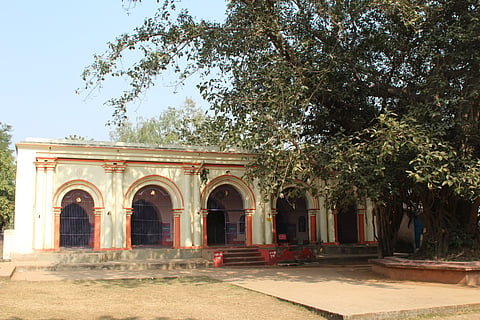
The Mrinmoyee Temple preserves centuries-old rituals associated with the Malla dynasty of Bishnupur Wikipedia
The story of the Puja begins with King Jagat Malla, the 19th ruler of the Malla dynasty. According to local legend, the king was hunting in a dense forest when he lost his way while pursuing a deer. During his search, he encountered an extraordinary sight involving a bird and a banyan tree, followed by a divine vision of a woman who identified herself as Mrinmoyee Devi.
The goddess is believed to have instructed Jagat Malla to move his capital from Pradyumnapur to the forested location that would become Bishnupur. She also told him that digging at a particular spot would reveal a small representation of her face, which was to be incorporated into an idol made of clay from the River Ganga. The king followed these instructions, and a temple was constructed at the site. The first Durga Puja is traditionally dated to 997 CE.
Advertisement
The Mrinmoyee Temple, established under Jagat Malla, remains the centre of the celebrations. The principal idol is believed to retain its original sacred foundation, and unlike the Durga idols commonly immersed at the end of the festival, it remains permanently inside the temple. Its continued presence connects contemporary worshippers with a tradition that has endured through successive generations of the royal family.
A Puja That Begins Before The Rest Of Bengal
One of the defining features of Bishnupur’s Durga Puja is its extended calendar. While the main celebrations elsewhere generally gather momentum around Mahalaya and the days leading up to Shashthi, the Mrinmoyee Temple begins its rituals much earlier. The festivities traditionally commence around Jita Ashtami, with the overall observance extending across approximately 15 to 18 days, depending on how the ceremonial period is counted.
The opening rituals centre on Boro Thakurani, represented by a painted scroll that is ceremonially brought to the temple. Members of the royal family participate in the initial worship, marking the beginning of the festival. Mejo Thakurani and Chhoto Thakurani arrive at later stages, with their appearances linked to specific days of the ritual calendar.
Advertisement
These three painted forms represent Mahakali, Mahalakshmi, and Mahasaraswati, aspects associated with the divine feminine. Their presence alongside Maa Mrinmoyee gives the celebrations a distinctive character, bringing multiple representations of the goddess into the same sacred space.
The patachitras are prepared anew each year by traditional artists associated with the Foujdar family, known for its role in Bishnupur’s ritual painting traditions. Their work is an important part of the festival, combining religious observance with a regional art form that has been preserved across generations.
Why Cannons Are Fired During Durga Puja
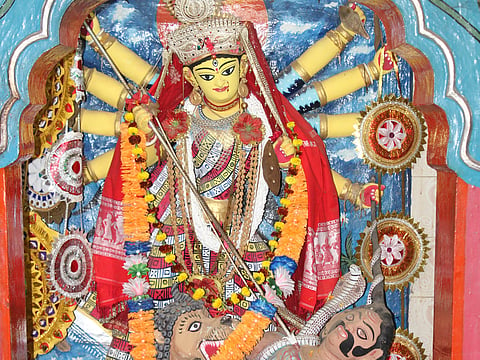
Cannon fire, patachitra paintings, and a secret midnight ceremony distinguish Bishnupur’s Durga Puja from other celebrations in Bengal Wikimedia Commons
The sound of cannon fire is among the most recognisable features of Bishnupur’s celebrations. The practice dates to the 16th century, when cannon-making techniques are believed to have reached Mallabhum during the period of Mughal military influence. Over time, firing cannons became integrated into the royal Puja’s ceremonial schedule.
Cannons are traditionally fired at three intervals between dawn and dusk, with nine firings across the day. The practice continues through Dashami, connecting the festival to the military history of the Malla kingdom. Restrictions on the use of larger cannons led to changes in the equipment used, but the custom itself has survived.
Advertisement
The rituals also reflect changes in the kingdom’s religious history. Animal sacrifice was once part of worship at the temple, but it was discontinued under King Bir Hambir, who ruled from 1565 to 1620 and is associated with the Malla dynasty’s conversion to Vaishnavism under the influence of the saint Srinivasa Acharya. Vegetables are now offered in place of animal sacrifices.
Another important observance is Sandhi Puja on Ashtami, which includes the worship of Vishalakshi Devi, an aspect of the goddess associated with Gauri. The deity undergoes a ritual bathing using eight urns, followed by offerings that include a gold champa flower. The ceremony is also accompanied by the firing of cannons.
The Secret Midnight Ritual Of Navami
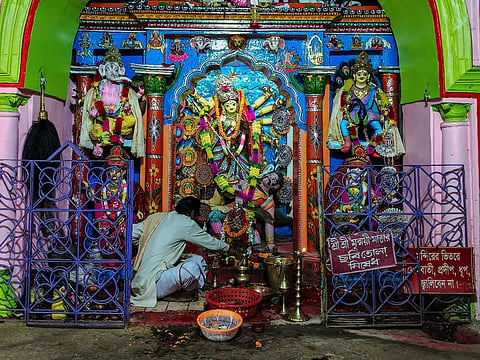
The principal idol of Maa Mrinmoyee remains inside the temple throughout the year, unlike Durga idols that are immersed after Dashami el_magnifico_8637/Instagram
Among the most unusual traditions is the worship of Mahamayi Devi, also known as Khachchar Vahini, a fierce form of the goddess depicted riding a mule. The ritual takes place at midnight on Navami and is associated with King Bir Hambir, who is believed to have introduced the worship to protect his kingdom from the threat of epidemics.
Advertisement
Unlike the public ceremonies, this observance is conducted behind closed doors. The temple remains dark apart from the light of an earthen lamp, and entry is restricted to the priests and members of the royal family. The ritual involves worshipping the patachitra in reverse and must be completed before daybreak.
The secrecy surrounding the ceremony is an important part of its tradition. It also distinguishes Bishnupur’s Puja from celebrations in which the principal rituals are performed in public pandals, allowing visitors to observe the proceedings.
From Living Fish To A Bird’s Journey To Kailash
The customs surrounding Dashami and the conclusion of the festival are equally distinctive. As the goddess prepares to depart, local fishermen offer a living chang mach, or spotted snakehead fish, dipped in curd to Vishalakshi Devi. The fish is subsequently released into a pond beside the temple.
Members of the Nuley community from Rautkhand village also bring a neelkantha, or Indian roller, as part of the traditional observance. The bird is released after a ritual gesture involving the deity. According to local belief, it carries news of the goddess’s departure to Lord Shiva at Mount Kailash, marking the close of the celebrations.
Advertisement
The main idol is not immersed, and the painted representations are preserved for the following year. The festival is also associated with Ravan Kaata festivities, during which performers wearing masks enact episodes from the Ramayana, including the defeat of Kumbhakarna, Indrajit, and Ravana over successive days.
Exploring Bishnupur Beyond The Puja
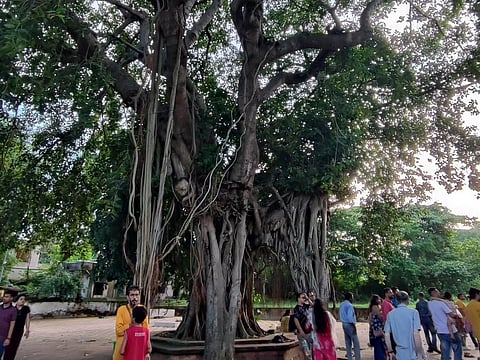
Bishnupur is known for its terracotta temples, Baluchari silk sarees, and the classical music tradition of the Bishnupur Gharana the_musafir_madam/Instagram
A visit to Bishnupur offers more than an encounter with its centuries-old religious traditions. The town is widely known for its terracotta temples, built during the Malla period when the art form reached considerable sophistication. With stone in limited supply in the region, fired clay became an important architectural material, giving rise to temples adorned with intricate depictions of mythology, everyday life, and floral motifs.
Bishnupur is also associated with the Bishnupur Gharana of Indian classical music, which flourished under royal patronage, and its Baluchari silk sarees, distinguished by elaborate woven motifs inspired by mythology and courtly life. Exploring the town’s temples, traditional crafts, and musical heritage offers a broader understanding of the cultural world that sustained the royal Puja.
Advertisement
The Malla kingdom may no longer exist, but its religious and artistic legacies remain woven into Bishnupur’s identity. At the Mrinmoyee Temple, the annual return of the festival keeps that history alive, bringing together an ancient idol, ritual paintings, cannon fire, and customs preserved across generations. For travellers interested in Bengal’s heritage, the Puja offers an opportunity to encounter a living tradition whose story stretches back to the 10th century.
FAQs
1. How old is Bishnupur’s Durga Puja?
Bishnupur’s Durga Puja is traditionally dated to 997 CE. In 2026, it marks approximately 1,030 years of tradition.
2. Where is the 1,030-year-old Durga Puja celebrated?
It is celebrated at the Mrinmoyee Temple in Bishnupur, in West Bengal’s Bankura district.
3. Why are cannons fired during Bishnupur’s Durga Puja?
The tradition dates to the 16th century and is believed to have developed during the Malla kingdom’s period of military influence.
4. What makes Bishnupur’s Durga Puja unique?
The festival features an extended period of worship, three painted forms of the goddess, cannon fire, a restricted midnight Navami ritual, and the permanent presence of the principal idol.
Advertisement
5. What else is Bishnupur famous for?
Bishnupur is renowned for its terracotta temples, Baluchari silk sarees, and Bishnupur Gharana of Indian classical music.

Published At: