Croatia doesn’t really have one kind of road trip. The coastal drives, inland castle routes, wine regions, and national park circuits all feel completely different from each other, even though the distances are short. What changes most is the purpose of the journey—sometimes it’s scenery, sometimes food, sometimes history—rather than the driving itself.
Guide To Road Tripping In Croatia: Six Trips, Six Different Worlds
Croatia offers a mix of road trips, from coastal drives and island links to inland castle routes, wine regions, and national parks. Each journey feels different, shaped more by the region you choose than the distance you cover

Advertisement
The Classic Adriatic Highway (Zadar to Split)
A drive from Zadar to Split along the Adriatic Highway (D8) is one of the main coastal routes in northern Dalmatia. It follows the shoreline for most of the journey and connects several historic towns. The route is short in distance but includes many places worth stopping for, so most travellers take more than just the driving time to complete it.

Old town of Split, Croatia Shutterstock
Route Overview
Start in Zadar, a coastal city with Roman ruins, Venetian walls, and attractions such as the Sea Organ.
The route continues south to Split, covering around 155–170 km along the Adriatic Highway (D8), also known as the Jadranska Magistrala.
Driving time is about 2.5 to 3.5 hours without stops, depending on traffic and road conditions.
Expect winding coastal roads, sharp bends, and limited barriers in places—drive with care, especially in peak summer.
A more direct inland motorway (A1) exists, but the coastal route is far more scenic and atmospheric.
Scenic Stops Along the Way
Šibenik: A striking historic town home to the UNESCO-listed Cathedral of St James and the medieval St Michael’s Fortress.
Krka National Park (short detour): Famous for emerald waterfalls such as Skradinski Buk, ideal for a refreshing nature break.
Primošten: A postcard-perfect peninsula town, great for a relaxed lunch or a swim in the clear Adriatic waters.
Trogir: A UNESCO World Heritage site with beautifully preserved Romanesque and Renaissance architecture, linked by bridges to the mainland.
Morinje Bridge Viewpoint: A peaceful roadside stop near Šibenik offering sweeping sea views and picnic spots.
Advertisement
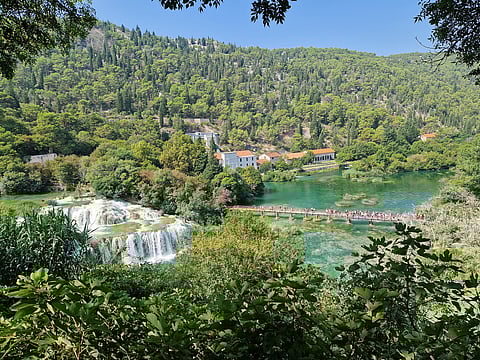
Krka National Park is known for seven cascading waterfalls Rkoster/Wiki Commons
Highlights & Travel Tips
On the way south, there’s a roadside viewpoint near Seget Donji that looks out over Trogir and the surrounding islands.
In Split, Marjan Hill is a simple walk or short drive for a clear view over the harbour and the old town.
Travelling in late spring or early autumn is usually easier, with fewer crowds and more manageable road conditions.
Food options along the route are straightforward coastal and local dishes, including Soparnik and fresh seafood in smaller towns.
The Istrian Triangle (Opatija to Pula)

The famous Maiden with the Seagull statue in Opatija ChrisV/Wiki Commons
A road trip through Istria, often called the “Tuscany of Croatia,” follows a compact, heart-shaped peninsula known for food, wine, and hill towns. The drive links the north-west coast to the southern tip of the region and passes through both coastal roads and inland countryside. While it can be done quickly, most travellers stop frequently to explore towns and food spots along the way.
Route Overview
Start in Opatija, a seaside resort town known for Austro-Hungarian villas and the Lungomare promenade.
The coastal route (DC66) runs along Kvarner Bay with views towards Cres and Lošinj islands.
The journey ends in Pula, a port city known for its Roman amphitheatre and historic centre.
Scenic Stops Along the Way
Motovun: Hilltop town surrounded by truffle-rich forests and vineyards.
Rovinj: Coastal fishing town with a compact old centre and working harbour.
Vodnjan: A small inland town known locally for olive oil and quiet surroundings.
Plomin: A short stop above the bay with open views over the coastline.
Labin: Sits on a hill inland, while Rabac is down by the sea with beaches and a more resort-like feel.
Inland routes through central Istria pass places like Motovun and Grožnjan, where roads link small hill towns known for wine, truffles, and agriculture.
Advertisement

Roman amphitheatre in Pula Olgierd Rudak/Wiki Commons
Highlights & Travel Tips
Istria is often referred to as the “Tuscany of Croatia” because of its hills, food, and small towns.
Olive oil, wine, and truffles are the main local products, especially inland.
The drive itself is short, but most people spend extra time detouring into the interior.
Spring and early autumn are generally easier for driving and sightseeing than peak summer.
Southern Dalmatian Coast (Split to Popovići)

Cliffs in the Konavle Popovici area Bjoertvedt/Wiki Commons
This drive follows the southern Adriatic coast from Split down to Popovići, near the Konavle region in Croatia. It’s about 254 km and stays close to the sea for long stretches, with mountains on one side and the water on the other. You pass a mix of bigger towns and small roadside stops, with a few detours inland or onto peninsulas if you have time.
Route Overview
Start in Split, where most people begin near Diocletian’s Palace or the Riva.
From there the road follows the D8 coastal highway south. It’s slower than the motorway but stays right by the sea for much of the way.
The route ends in Popovići, a quiet village area in Konavle, close to the border with Montenegro.
Scenic Stops Along the Way
Omiš is the first main stop, set between cliffs and the Cetina River.
After that comes the Makarska Riviera, a long stretch of coastal towns and beaches with the Biokovo mountains rising behind them.
The Pelješac Peninsula sits slightly off route but is worth it for oysters, wine, and quieter roads.
Ston is a small fortified town, mainly known for its old walls and shellfish farms.
Dubrovnik is the main stop further south, busy in season but important for most travellers on this route.
Beyond Dubrovnik, the Konavle area becomes much quieter and more rural.
Pasjača Beach near Popovići is a small hidden beach below steep cliffs, reached by a steep path.
Advertisement
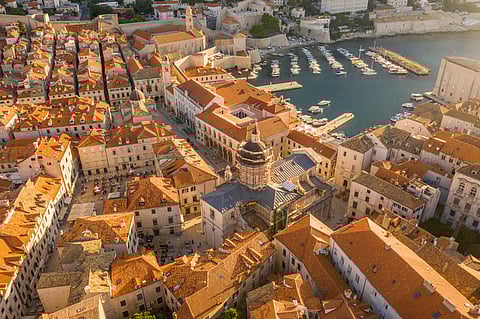
Dubrovnik was chosen as the setting for Kings Landing in Game of Thrones Shutterstock
Highlights & Travel Tips
The coastal D8 road is slower but far more scenic than the inland motorway.
You don’t need to rush it — most people split this drive over a couple of days.
Pelješac works well as a detour if you want food and wine stops.
Summer gets very busy, especially around Dubrovnik. Spring and early autumn are easier for driving and parking.
Journey Through Castle Country (Senj to Čakovec)

Open-air cafés in Čakovec, Croatia Silverije/Wiki Commons
A road trip through northern Croatia from Senj to Čakovec follows inland roads that connect coastal forts, river valleys, and a series of historic castle towns. The route is about 300 km and moves away from the Adriatic into a quieter, more rural part of the country. It is usually done as a multi-stop drive rather than a single through journey.
Route Overview
The route starts in Senj, a small coastal town sitting below the Velebit mountains. Nehaj Castle overlooks the town.
From Senj, the drive moves inland through quieter roads, passing small towns and stretches of river valley.
It ends in Čakovec, close to the Slovenian border, an area connected to the Zrinski family history.
Scenic Stops Along the Way
Nehaj Castle in Senj sits on a hill above the town and looks out towards the coast.
Zagreb: The capital city, usually the main break point, with both historic Upper Town and modern districts.
Ozalj Castle: Set above the Kupa River, surrounded by forested countryside.
Erdődy Castle (Jastrebarsko): A smaller castle in a park setting, often passed en route to Zagreb.
Trakošćan Castle: One of the most visited castles in Croatia, set beside a lake in a wooded area.
Varaždin: A baroque town with a castle in the centre and a well-preserved old town.
Čakovec Castle: Final stop, now a museum, linked to the Zrinski family history.
Highlights & Travel Tips
This is an inland route, so the landscape is mostly hills, rivers, and farmland rather than coastline.
It works better as a slow drive with overnight stops, especially if you want to visit multiple castles.
Trakošćan and Varaždin are the main highlights and usually take the most time.
Some castles have limited opening days, so timings can vary depending on the season.
Roads are generally quiet compared to the coast, with lighter traffic most of the year.
If you have extra time, it’s easy to extend the trip towards the Slovenian border for short detours.
Advertisement
National Parks Adventure (Plitvice to Krka)
A road trip between Plitvice Lakes and Krka National Park links two of Croatia’s best-known natural areas. The route passes through inland forests, mountain roads, and parts of the Dalmatian hinterland before reaching the southern Krka river system. It is usually driven in a few hours, but most travellers turn it into a longer nature-focused trip with stops along the way.
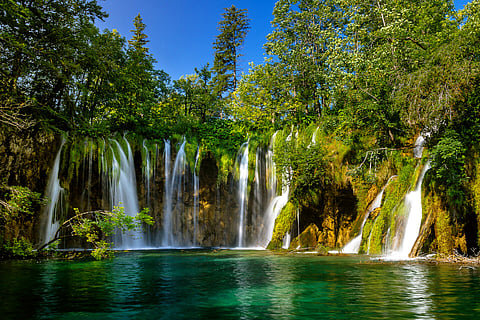
A waterfall in Plitvice Lakes National Park Zysko Sergii/Wiki Commons
Route Overview
The trip usually begins at Plitvice Lakes, a large national park in central Croatia made up of lakes and waterfalls.
From there, the route heads south through inland roads, mainly using the A1 motorway for most of the drive.
It finishes at Krka National Park near Šibenik, where the Krka River forms a series of cascades and pools.
Scenic Stops Along the Way
Northern Velebit is a mountainous stretch with open views and walking trails in parts of the range.
Paklenica National Park is known for its canyons and is popular for hiking and climbing.
Zadar is a coastal city that often works as a stopping point between the two parks.
Šibenik: Historic town close to Krka’s entrance, with old stone streets and a harbour.
Smiljan: Small inland stop with the Nikola Tesla Memorial Centre.
Skradin (Krka access point): Common entry point for boat access into the park.
Kornati Islands (via Murter): Optional detour for boat trips into the archipelago.
Highlights & Travel Tips
Plitvice takes longer to explore, while Krka is generally quicker and easier to visit.
The drive between the two is about 2 to 2.5 hours without stopping.
At Plitvice, it helps to go early in the day because it gets crowded later on.
Krka has a few entry points, and some parts can be reached by boat or short walks.
Both parks get busy in summer, so tickets are better booked in advance.
Most people visit this route as part of a wider trip rather than on its own.
Advertisement
The Slavonian Gastronomy Loop (Požega to Ilok)

Bottles of Graševina and Traminer wine produced in Kutjevo Silverije/Wiki Commons
The drive from Požega to Ilok crosses Slavonia in eastern Croatia, a region made up mostly of farmland, vineyards, and small towns. It is not a fast route, and most of the interest comes from the stops rather than the driving itself. The road eventually reaches the Danube at the far eastern border of the country.
Route Overview
The trip usually starts in Požega, a small town in a valley surrounded by hills and vineyards. Kutjevo nearby is also often used as a starting point because of its wine cellars.
From there, the road heads east through a mix of farmland, small settlements, and open countryside.
It finishes in Ilok, a riverside town overlooking the Danube on the far eastern edge of Croatia.
Scenic Stops Along the Way
Papuk Nature Park: Forested area with walking trails, small waterfalls, and hill views.
Velika: Small town near Papuk, often used as a base for outdoor activities.
Đakovo: Known for its cathedral and horse breeding tradition.
Osijek: The largest city in the region, set along the Drava River with a historic fortress area.
Kopački Rit Nature Park: Wetlands near Osijek with birdlife and flat water channels.
Erdut: A riverside stop on the Danube with vineyards and a hilltop tower.
Ilok: Final stop, a small town with old wine cellars and views over the Danube.
Highlights & Travel Tips
This is a slow inland route with long stretches between towns.
It works better as a 2–4 day trip rather than a single drive.
Wine production is a major part of the region, especially around Kutjevo and Ilok.
Local food is heavier and spicier than coastal Croatia, with dishes like kulen common.
Late spring and autumn are the best times for vineyard visits and outdoor stops.
Advertisement
FAQs
How many days do you need for a road trip in Croatia?
It depends on the route, but most trips work best in 5 to 10 days. Short coastal drives can be done in a couple of days.
Is it easy to drive in Croatia?
Yes. Roads are generally in good condition, and distances are short, though coastal routes can be winding and busy in summer.
What is the best time for a road trip in Croatia?
Late spring and early autumn are ideal, with good weather and fewer crowds compared to peak summer.
Which is better: coastal or inland routes?
Both offer different experiences. Coastal routes focus on sea views and towns, while inland routes include castles, wine regions, and national parks.
Can you combine multiple regions in one trip?
Yes. Many travellers mix coast, islands, and inland areas in a single itinerary because distances are short.
Are Croatia’s national parks easy to visit by car?
Yes. Parks like Plitvice and Krka are accessible by road, but parking and entry tickets should be planned in advance.
Advertisement
Published At: