If time had a smell in Malwa, it would be river water mixed with roses and incense. The kind of scent that walks ahead of you as you wind your way to a ghat or a temple. In this part of Central India, I realised, time isn’t a ticking clock with a schedule, but a rhythm you learn by letting your breath slow and your expectations unclench. And so, consciously leaving my watch behind, I walked into the days guided by stone steps and old walls, by rivers carrying the hours and eons rather than counting them.
Stone, Water And Prayer: A Malwa Journey
A reflective journey through the sacred cities of Ujjain and Maheshwar, where temples, rivers, and living traditions reveal how time, devotion, and craft flow together across the Malwa region

Advertisement
In Ujjain, the rhythm felt inevitable. Gentle but persistent, like a heartbeat you only hear when everything else quiets. The city didn’t make an entrance; it simply unfolded around me through glimpses and chants, and the patient flow of people moving toward something deeper than a destination. At the centre stands Mahakaleshwar Temple, one of India’s twelve sacred Jyotirlingas and a site revered not simply with devotion but as a pulse that has informed how India marks time. Locals speak of Ujjain as the place of origin of the Panchang calendar, an ancient system that still defines festivals, new beginnings, and the horoscope of every newborn baby.
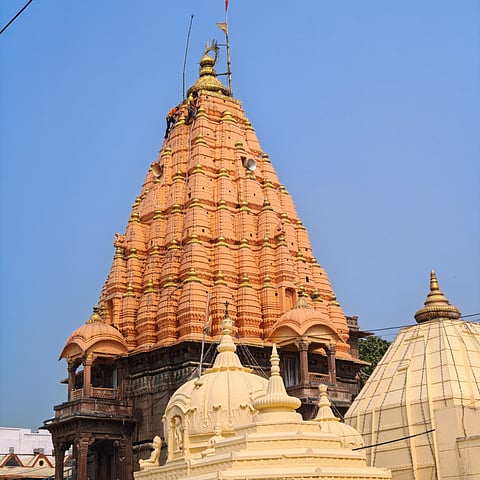
A view of Mahakaleshwar Temple Author
Approaching the temple is nothing like waiting for a landmark to appear. Instead, its presence arrives through the senses; the warmth of stone on bare feet, the subtle shift in how heads are bowed, how conversations drop to a softer pitch. Mahakaleshwar’s swayambhu lingam is believed to have risen on its own from the earth, and faces south, unlike most Shiva shrines, the direction associated with Yama. This orientation isn’t just unusual for Central India; it’s a bold declaration of a shrine that stands beyond time and death, a protector whose gaze blesses endings and transformations.
Advertisement
At the ghats, you see clusters of flowers and diyas set afloat on the Shipra’s current, each offering a wish and a prayer, carried downstream by the river holding the release of intentions. In between, chai stalls keep steaming cups ready for anyone wanting a break, and vendors offer Indori poha-jalebi – fuel for body and soul after a dip in the still-cold February waters. Devotion tempered with practicality and warmth.
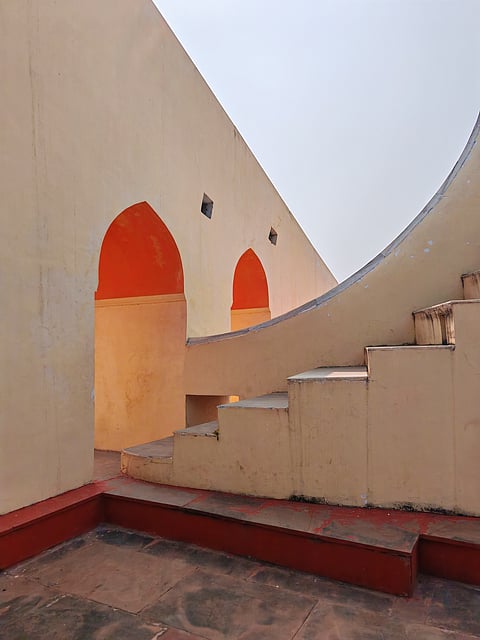
Inside the observatory Author
A short drive away from the temple stands Vedh Shala, Ujjain’s 18th-century astronomical observatory built by Maharaja Jai Singh II. Its stone instruments once measured local time, tracked the movement of stars, and recorded eclipses before mechanical clocks; Vedh Shala marks the birthplace of India’s first timekeeping system. Standing among the sundials and gnomons, it’s easy to imagine scholars calibrating schedules with the sun’s shadow, blending science and the cosmos into a single practice of living. Ujjain showed me that time here isn’t something you stand apart from, but something you step into.
Advertisement
Hitting the road south to Maheshwar the next morning, the journey felt like stepping from one current into another. The river here doesn’t rush. It unfolds. It settles. Maheshwar is not merely a river town. It is a legacy shaped significantly by Ahilyabai Holkar, the 18th-century queen whose touch is still visible in the town’s fort, ghats and daily rhythms. Ahilyabai’s rule was remarkable for its blend of practical governance and spiritual care. She rebuilt and restored shrines across India and breathed life into her own capital, guided by a vision that balanced foresight and community welfare.
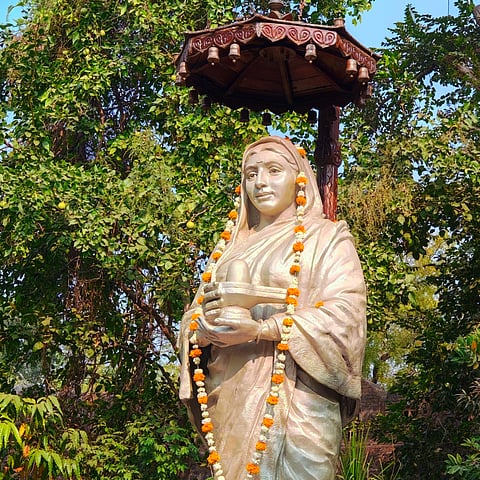
A statue of Ahilyabai Holkar Author
The town has been a centre of thriving handloom for centuries, and under Ahilyabai’s patronage, Maheshwari sarees – light and elegant with distinctive borders and motifs inspired by the river – took shape as garments of grace and heritage. Local tradition holds that she invited weavers from Mandu and Surat to craft these textiles, often designing the inaugural sarees herself. Today, these handlooms still stand as legacies that embody the subtle artistry of generations of women weavers.
Advertisement
While walking up to the fort, I wandered into the weaving quarters where the rhythmic sounds of the looms mark time without urgency. Women work with familiarity and ease, threads passing under their skilled hands as they transform warp and weft into sheer, lightweight sarees.
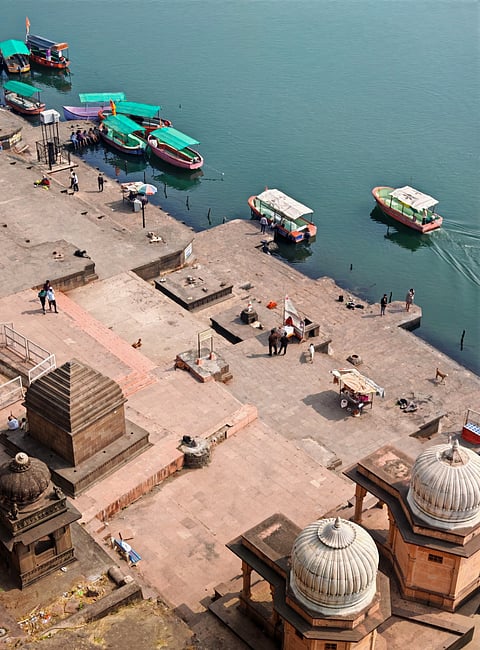
View of ghat and Narmada from the fort Author
Lunch was served in the palace, set alongside an emerald pool, with a glossy green canopy of banana trees overhead. The food came straight from the garden – fresh, seasonal, honest – and every bite tasted brighter for having been picked and prepared just steps away. Around us, fading sounds of drums and chanting from the ghats down below carried across the gardens as shade, good food, and river breeze played at the edges of thought and the drowsiness that warm afternoons bring.
At the Ahileshwar Temple, devotees offered smooth river pebbles from the Narmada at the shrine before taking them back for a loved one or their homes. An elderly woman in a blood-red sari smiled as she said, ‘Narmada ka kankad bhi Shankar’. Intimacy with the divine defines the everyday; not distant or dramatic, but present in the ordinary.
Advertisement
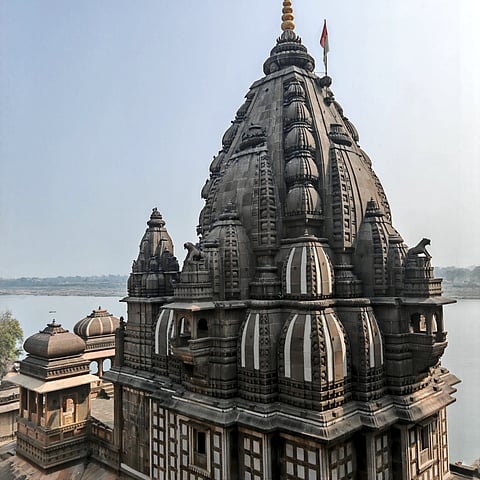
A shot of Ahileshwar Temple Author
Walking through Maheshwar, I realised why Ahilyabai’s legacy endures beyond history books: it is not preserved behind glass or a pedestal, but lived in the daily craft of weavers and the steady rhythms that outlast calendar pages.
Two Rivers, Two Rhythms
If Ujjain showed me how to sense time in brass bells and cosmic reckoning, Maheshwar taught me to feel it in craft and legacy. One city’s communion with the eternal faded into the other’s repose in the gentle current of life. Both were revelations, not because they dazzled, but because they felt true to how people believe, build, pray, and remember. By the time we drove back towards Indore, hours and days seemed less like experiences out of an itinerary and more like memories, distinct yet interconnected. In Malwa, you don’t just visit time. You are invited to understand it as something that flows, returns, and reshapes itself long after you leave its rivers behind.
Advertisement
How To Reach
There are direct flights to Indore from all major cities. Indore to Ujjain is a convenient 56km, best done by private car or taxi. Indore to Maheshwar, on the other hand, is 100km, with good pitstop options along the way
Where To Stay
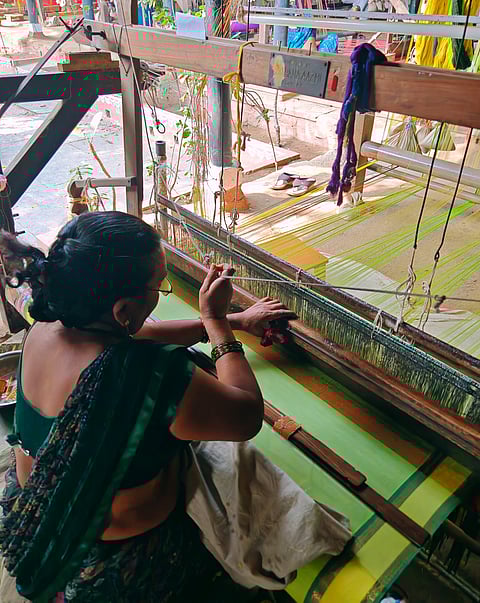
Weaver at Rehwa Center Author
Some of the options to choose to stay here in Indore include Radisson Blu, Wow Crest, Marriott, Sheraton Grand, and The Park. In Ujjain, you can look at MPT Samrat Vikramaditya - The Heritage. In Maheshwar, Ahilya Fort hotel presents a good option.
What To Eat
Explore Chhappan Dukan and Sarafa Bazar if you want to try Indore’s famous street food (don’t miss the poha-jalebi with chai!). Try the shikanji and Indori gundi paan at these markets. In Maheshwar, the Palace lunch at Ahilya Fort is not to miss (pre-book a tour of the palace and gardens).
What To Shop
Check out Maheshwari sarees and textiles fresh off the loom at the Rehwa Society Store in Maheshwar. In Indore, MT Cloth Market and Sitlamata Bazar have multiple shops selling Maheshwari and Chanderi sarees and textiles. Look for pure silk-cotton. Religious souvenirs and trinkets outside the Mahakaleshwar Temple, Ujjain, are good to take back with you; make sure to carry cash.
Advertisement

Published At: