It was fifteen minutes to midnight when I found myself walking past the iconic Clock Tower at the junction of Gandhi Road and Ladenla Road. The 1920-built neo-Gothic and neo-classical style 100-foot stone sentinel glowed an improbable blue, standing tall against the winter sky, while fog drifted in like an uninvited but strangely comforting guest. It wrapped the last day of the year in a cold, almost tender embrace, muffling sounds and slowing time: Darjeeling was holding its breath, waiting for the year to end before exhaling.
How I Spent My New Year In Darjeeling: Spots Beyond Chowrasta, Tiger Hill And The Usual Tourist Trail
From midnight at Chowrasta to sunrise on Kanchenjunga, and from pine forests of Lepchajagat to quiet borders, tea estates and Mirik Lake, a New Year’s Day journey through Darjeeling’s lesser-known corners

Advertisement
I walked on, past shuttered shops and darkened cafés, their colourful signs now reduced to faint silhouettes. Glenary’s, however, bore the burden of the jostling crowd in front of it. Unhurried, my breath was visible in the air, my mood somewhere between nostalgia and anticipation. My destination was fixed. The Darjeeling Mall. Or, as some here prefer to call it, the Chowrasta. With every step uphill, the town grew quieter.
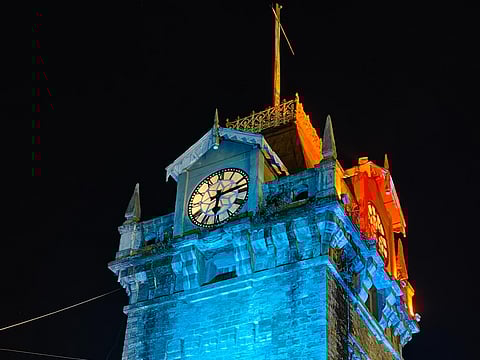
Darjeeling Clock Tower Anwesha Santra
By the time I reached the Mall, it was wrapped in an unusual stillness. The shops were closed. I took a seat on a quiet bench. Around me, people had begun to gather in slow, unhurried clusters. Locals stood chatting in low voices, tourists huddled together. Someone laughed. Someone poured tea from a flask. The air was thick with anticipation, stretched thin by the seconds ticking toward midnight. Everyone was waiting to welcome 2025, the year we bid farewell to just recently.
Advertisement
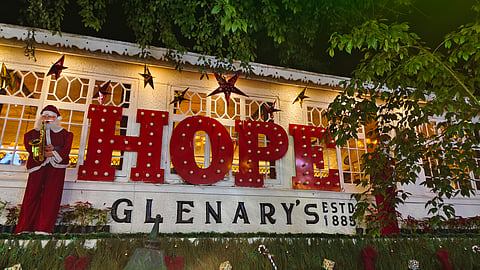
Tourists flock in front of Glenary's in Darjeeling for photographs Anwesha Santra
The fog drifted lazily through the Mall, occasionally swallowing a lamppost whole before letting it reappear. Time felt suspended. Ten seconds. Five. Three.
And then midnight arrived.
Fireworks erupted into the sky, tearing through the quiet. Cheers broke out across the Mall, voices echoing into the night as strangers smiled at one another, bound briefly by the moment. Darjeeling welcomed 2025 with warmth, wonder and the soft promise of beginnings.
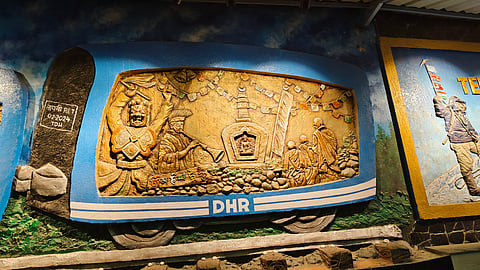
Murals alongside the path that leads to Mall Road, Darjeeling Anwesha Santra
The First Rays On The Kanchenjunga
After a cup of coffee and the long walk back from the Mall, sleep felt optional. This was the moment people have been coming to Darjeeling for, decade after decade. The Kanchenjunga. I left the hotel at around half past two in the morning, stepping into a town that was once again quiet.
The drive to Tiger Hill was slow. I had been warned about the traffic, about the chaos that usually accompanies this pilgrimage to the sunrise. Even at that hour, headlights snaked up the narrow roads, cars inching forward in patient determination. Everyone was chasing the same promise. Tiger Hill, perched at nearly 8,500 feet above sea level, is the most famous viewpoint near Darjeeling, offering panoramic views of the eastern Himalayas. On clear mornings, Kanchenjunga rises in full glory, and if luck is generous, even Mount Everest reveals itself in the distance. But luck, here, is never guaranteed.
Advertisement
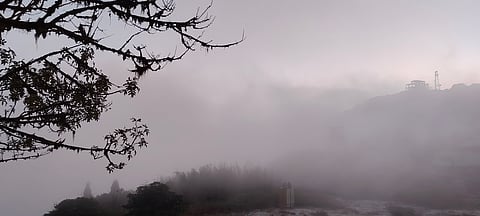
Fog engulfed the Tiger Hill in Darjeeling before sunrise Anwesha Santra
It was still dark when I finally reached the summit. Vendors were already in place, locals wrapped in layers of wool, pouring steaming coffee into paper cups, selling gloves, caps and shawls to the unprepared. The icy cold of the first morning of January seemed to find every inch of exposed skin, slipping through jackets and scarves with ease. We stood there, stamping our feet, rubbing our hands, staring at the horizon with stubborn hope.
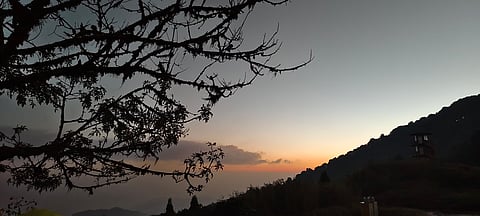
Watching sunrise from Tiger Hill, Darjeeling Anwesha Santra
As dawn edged closer, the mountains remained hidden. Fog rolled in thick and unyielding, swallowing the entire range before us. All that remained was an orange glow bleeding slowly into the sky, a teasing hint of what lay beyond. Nothing was visible to the naked eye, and yet no one moved.
Then, without warning, the fog began to lift.
The clouds parted, and Mount Kanchenjunga revealed itself. Snow-capped peaks emerged, bathed in the soft orange light of the rising sun. A collective gasp rippled through the crowd. Cameras clicked, phones were raised, but for a second, I forgot to reach for mine. I simply stood there, taking it in.
Advertisement
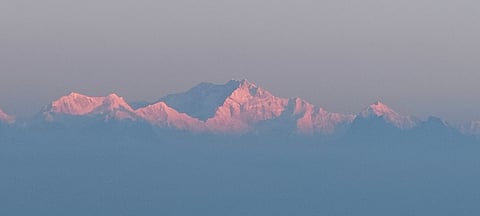
Mount Kanchenjunga as seen from Tiger Hill, Darjeeling, at sunrise Anwesha Santra
The last time I had seen Kanchenjunga was from Gangtok, years ago. But this was different. Seeing it here, at dawn, on the first morning of a new year, felt intimate and overwhelming all at once. It’s true what they say: the first time you truly see Kanchenjunga, it isn’t just a view; it’s a moment. And it stays with you long after the sun has fully risen.
Lingering Amidst Pine Trees In Lepchajagat
The trees here were as tall as they could get. Towering pines, oaks, and rhododendrons rose straight into the sky, forming a dense canopy overhead. Even though the day outside was bright and sunny, very little sunlight made its way in. What did filter through arrived in soft, scattered patches, leaving the forest floor cool and dim. After having watched the Kanchenjunga reveal itself at dawn, I set out to explore a few quieter, lesser-known corners around Darjeeling. The first stop was Lepchajagat.
Advertisement
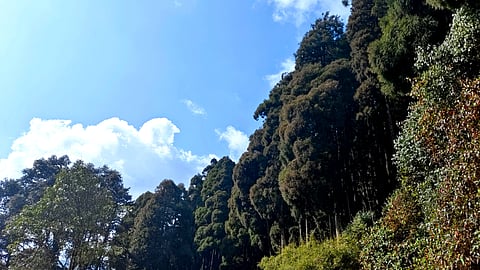
Pine trees line the forest in Lepchajagat Anwesha Santra
Lepchajagat is a small forest village located about 19 kilometres from Darjeeling at Sukhipokhri on the Ghoom-Mirik road, sitting at an altitude of nearly 6,950 feet. Once a settlement of the Lepcha community, it is now part of a protected forest area managed by the forest department. The absence of crowds gives the place an almost untouched quality. The air feels cleaner, the pace slower, and the surroundings deeply immersive. Thick woods stretch in every direction, home to a rich mix of Himalayan flora and fauna. Birdlife thrives here, with sunbirds, flycatchers and other forest species darting through the trees, while moss, ferns and wild shrubs blanket the ground in layers of green.
Standing At The India-Nepal Border
Moving further from the pine forest of Lepchajagat, the landscape begins to change almost imperceptibly. The trees thin out, the road curves gently, and light starts to spill freely across the hills. Before you realise it, Lepchajagat gives way to Simana.
Advertisement
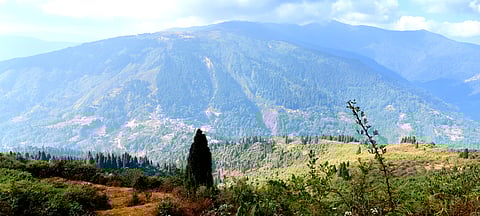
Simana, Indo-Nepal border Anwesha Santra
Close to the India-Nepal border, Simana sits at an altitude of roughly 7,200 feet. It is a place where geography itself becomes the attraction. On one side lies India, on the other Nepal, separated not by fences or walls but by an invisible line marked by a modest border pillar. Tea gardens unfurl across the slopes, and small stalls dot the roadside, selling tea, momo, snacks, while travellers linger not for activities, but for the view.
From Simana, the hills seem softer, more expansive. Villages appear scattered across the ridges, smoke rising lazily from chimneys, life carrying on at its own steady rhythm. Standing there on New Year’s Day, the moment felt fitting. A gentle crossing of landscapes, from forest to frontier, mirroring the subtle transition from one year into another.
Smelling Fresh Tea Leaves At Gopaldhara Tea Estate
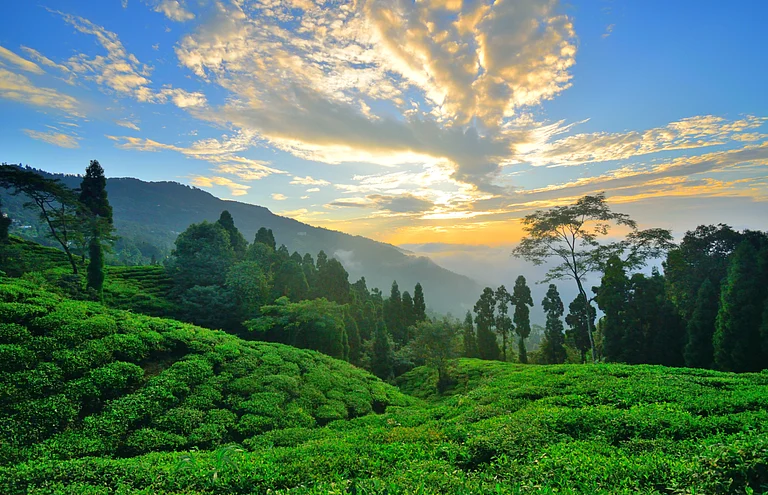
A little away from Simana, the road dips gently and opens into a small stretch of tea plantation. This is the Gopaldhara Tea Estate, one of Darjeeling’s lesser-known but highly regarded tea gardens. Established in the late nineteenth century, the estate sits at elevations ranging from about 5,500 to over 7,000 feet, making it one of the highest tea plantations in the region. The cool climate and frequent mist lend its teas a distinct character, especially the spring and autumn flushes that are prized for their floral aroma and light, layered flavours.
Advertisement
Walking along the edges of the estate, the neat rows of tea bushes flowed with the curves of the land. Pluckers moved through the fields with efficiency, their baskets filling slowly as the morning unfolded.
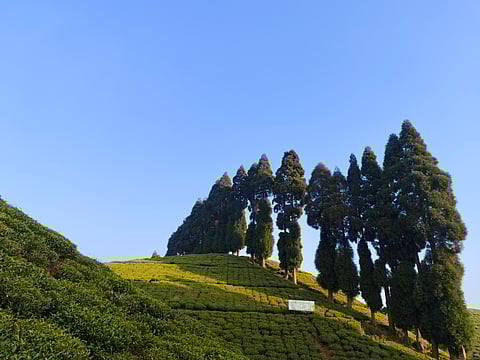
Gopaldhara Tea Estate Anwesha Santra
On the roadside near the estate, I stopped at a small shop that sold odds and ends, souvenirs and tea accessories. It was there that I found two tea cups that felt impossible to leave behind. Both were adorned with dragon motifs, one in deep red, the other in muted gold; I bought them without much thought, knowing they would carry this morning back home with me.
Walking Around The Mirik Lake
By the time we left the rolling slopes of the Gopaldhara Tea Estate, the day had begun to wind down. The sun softened into a mellow glow, stretching long shadows across the road. My driver, Aryan, told me this would be my final stop before we headed back to Darjeeling.
Advertisement
Mirik sits at around 4,900 feet and feels gentler, calmer than the higher hills. At its centre lies Sumendu Lake, better known as Mirik Lake, developed in the 1960s as part of efforts to shape Mirik into a hill resort. The lake is encircled by a paved walkway and crossed by a narrow footbridge, inviting visitors to slow down and linger.
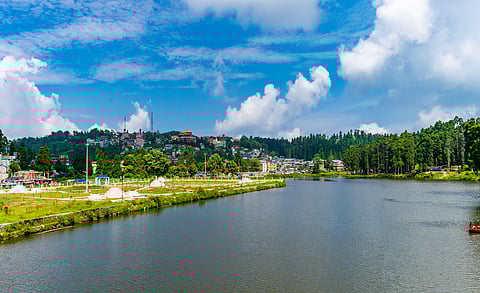
Panoramic view of Mirik Lake Wikimedia Commons
I walked around the water as evening settled in. Horses stood along the path, their handlers offering rides, while families and couples occupied benches, letting the day slip by. Pine trees framed the lake, flowering plants lined its edges, and birds skimmed the surface or disappeared into the branches above. The air here felt softer, the cold less insistent.
Soon, we would begin the drive back to Darjeeling in complete darkness, passing once again through the pine forests that would look far more eerie by night. But for a little while longer, I remained by the lake, allowing the first day of the year to fade away gently, without haste, wrapped in quiet calm.
Advertisement
Walking Around Mall Road In Darjeeling
It had been a tiring day, no doubt. But not every day gets to be the first day of the year. As evening settled in and the cold returned to Darjeeling, I found myself walking along Mall Road, past murals painted along the walls that lead up to it. Splashes of colour surfaced under glowing streetlights, turning ordinary stretches of stone into stories. It was here that I ran into Yuraj Pradhan.
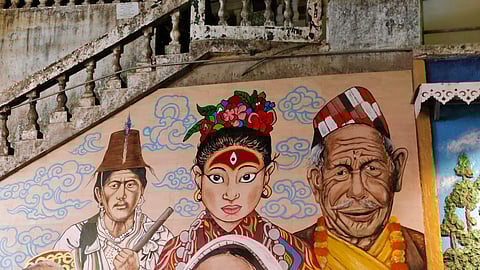
Graffiti on the walls that lead to Mall Road, Darjeeling Anwesha Santra
Yuraj is a young homestay owner I had met earlier at the Himalayan Orange Festival in Kolkata. This time, we walked together along Mall Road, his home ground, talking as the town slowly filled with nighttime energy. He runs the Vantage Point Homestay in Darjeeling, and as we strolled, he spoke about what New Year’s really means here.
“New Year in Darjeeling is quite special,” he said. “People come from all over the country and even from other parts of the world. Everyone is creating memories with their loved ones.” He gestured towards the road ahead. “The vibe while walking from the Clock Tower to Chowrasta is something else. People are clicking photos, eating momo and chowmein, and shopping for loved ones. Everyone is making their own memories.”
Advertisement
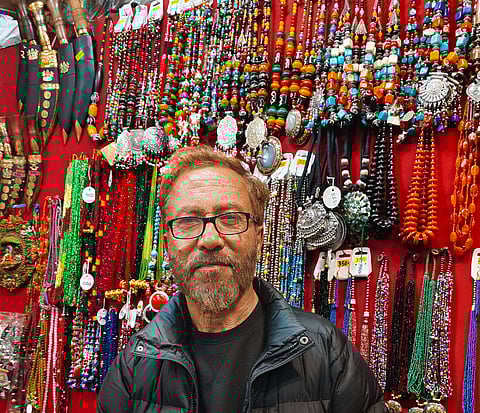
A curio shop owner in Darjeeling Anwesha Santra
Near Glenary’s, music played, and lights glowed warmly. “People line up here just to take photographs,” Yuraj said. “There’s always an expectation that something will happen at Chowrasta.” He spoke about how celebrations change once you leave town behind. “In rural areas, most homestays arrange bonfires. Guests and host families sit together, play guitar, sing and enjoy music till New Year.”
Urban homestays, he explained, follow a quieter rhythm. “We usually don’t have bonfires here. We sit together, drink tea or coffee, exchange cultures and stories. Karaoke is more common.” Laughing, he added, “Earlier, people waited for new movies on TV and shouted Happy New Year in the neighbourhood. Now, even I don’t feel that energetic.” Fireworks, he said, still happen, but far less than before.
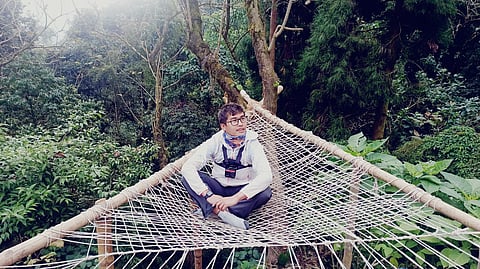
Homestay owner Yuraj Pradhan Supplied
When I asked him how he thought one should welcome the year, he didn’t hesitate. “Staying warm with positive people or old friends is the best idea,” he said. “For young people, I always suggest going for hikes and creating good memories.” Darjeeling, he reminded me, has always held a special place for travellers. “It was once called the Queen of Hills,” he said, before adding, “We all need to be responsible and keep it clean so future generations can enjoy it as we do.”
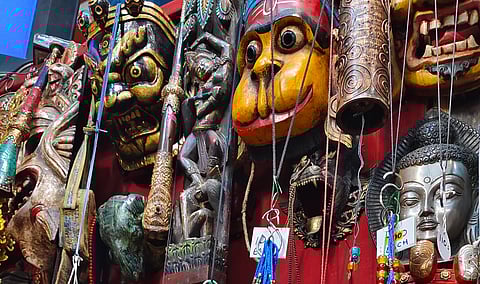
Shop for Tibetan masks and decor along the Mall Road in Darjeeling Anwesha Santra
After we parted, I stepped into a small curio shop nearby and bought Tibetan jewellery and a few keepsakes. As Mall Road hummed softly around me, it felt like the right way to end the first day of the year. Not loudly or in a rush, but through shared stories, warm conversations and the familiar, comforting rhythm of Darjeeling.
FAQs
1. What is New Year’s Eve like in Darjeeling?
New Year’s Eve in Darjeeling is centred around Chowrasta and Mall Road, where locals and tourists gather quietly for fireworks, walks, tea and shared celebrations rather than loud parties.
2. Is Tiger Hill worth visiting on New Year’s Day?
Yes. Despite crowds and unpredictable weather, watching the first sunrise of the year over Mount Kanchenjunga from Tiger Hill is considered a once-in-a-lifetime experience.
3. What are some lesser-known places to visit near Darjeeling?
Lepchajagat, Simana near the India-Nepal border, Gopaldhara Tea Estate and Mirik Lake offer quieter, crowd-free experiences beyond the usual tourist trail.
4. How cold does Darjeeling get during New Year?
Temperatures in late December and early January can drop close to freezing, especially at dawn and night, making warm clothing essential for travel and sightseeing.
5. Is Darjeeling suitable for slow and reflective travel?
Absolutely. Darjeeling lends itself well to slow travel, with forest walks, tea gardens, quiet viewpoints and unhurried interactions that go beyond checklist tourism.
Published At: