In recent months, power banks have come under renewed scrutiny after several incidents of smoke and fire were reported inside aircraft cabins. In India, the aviation regulator, the Directorate General of Civil Aviation (DGCA), is working on updated guidelines for carrying power banks on flights. This follows multiple lithium-ion battery malfunctions, including a fire on an IndiGo aircraft while taxiing at Delhi airport and another case of smoke from a power bank on a Dimapur-bound flight. These incidents have prompted authorities to reassess how such devices are handled during air travel.
Power Bank Rules For Flights Explained: Capacity Limits, Packing And Airline Policies
Power banks are travel essentials, but aviation rules around capacity, packing and in-flight use are tightening. Here’s a clear guide to what flyers must know before carrying one onboard

Advertisement
Globally, several airlines, especially in the Middle East and Southeast Asia, have tightened power bank rules. Dubai-based carriers Emirates and Flydubai, for example, now limit passengers to one power bank with a capacity of under 100 watt-hours (Wh) and ban in-flight use. By contrast, many US and European airlines still allow power banks if they meet capacity limits and are stored safely. As guidelines change, understanding why power banks are considered a safety risk is critical.
Why Power Banks Are Considered A Flight Safety Risk
Power banks utilise lithium batteries, which store a significant amount of energy in a compact form. Malfunctions can result from overcharging, poor quality, damage, or heat. The primary technical risk is thermal runaway, where a rising temperature triggers a chain reaction, potentially causing a fire or the release of toxic fumes.
Inside an aircraft cabin, such incidents are especially hazardous due to limited space, high passenger density, and restricted movement. Unlike smartphones or laptops with built-in safety circuits, cheaper or uncertified power banks may lack adequate protection. Given these risks, understanding where to safely pack your power bank is key to compliance with aviation rules.
Advertisement
Where To Pack Your Power Bank When Flying
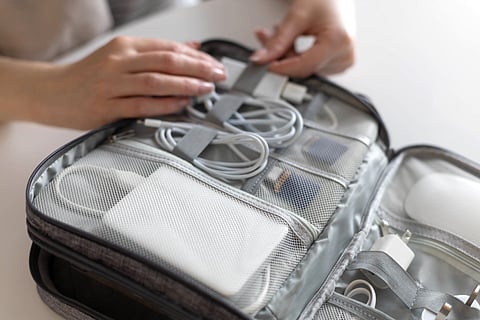
A traveller organises and packs cables and travel tech in a pouch Shutterstock
One rule is universal across almost all airlines: power banks are prohibited in checked baggage. They must be carried in hand or cabin baggage.
India’s security norms and global standards require lithium-powered electronic devices to remain in the cabin, allowing for a quick response in case of a malfunction. Fires in checked luggage are more difficult to control, so power banks are never permitted in them.
Passengers are advised to:
Keep power banks in a protective case or pouch
Prevent contact with metal objects that could cause short circuits
Ensure the device is easily accessible during security checks
Several airlines also now recommend storing power banks under the seat or in seat pockets instead of overhead bins for faster crew access in case of overheating. With the right packing method established, attention turns to the allowable power bank capacity when bringing them on flights.
Power Bank Capacity Limits On Flights (Watt-Hour Rules)
Advertisement
Capacity is regulated using watt-hour (Wh) ratings, not the mAh value sometimes shown.
Up to 100 Wh: Allowed on board without airline approval. Most common smartphone power banks fall in this category.
Between 100 Wh and 160 Wh: May be permitted with airline approval, usually for larger laptop-capacity power banks.
Above 160 Wh: Completely prohibited on passenger aircraft.
The capacity rating must be clearly printed on the device. Without a visible label, security may confiscate the power bank as non-compliant. After capacity questions, passengers are often left wondering whether they can use their power banks during the flight.
Can You Use Your Power Bank During the Flight?
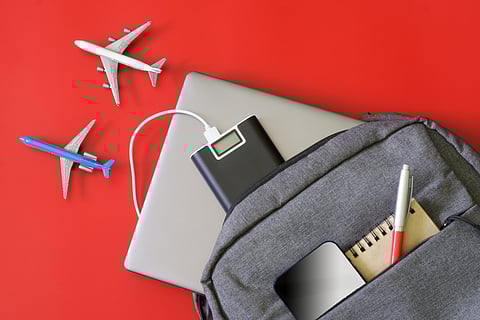
A backpack and travel gadgets set beside toy aircrafts Shutterstock
This is where rules now differ sharply by airline and region.
On several Middle Eastern and Southeast Asian carriers, including Emirates and Flydubai, power banks are not permitted for use during the flight, either to charge devices or to be charged using the aircraft's power outlets. These rules were introduced after a rise in battery-related cabin incidents.
However, many airlines in the US and Europe still allow the use of power banks onboard, as long as they:
Advertisement
Are within the approved capacity limit
Remain in hand baggage
Do not show signs of overheating or damage
Regardless of the airline's policy, avoid continuous charging, monitor for unusual heat, and notify the crew if a power bank shows signs of overheating or emits an odour. If an issue is flagged at security, it's important to know what happens next.
What Happens If Your Power Bank Is Confiscated?
If a power bank is flagged during security screening, it is usually because:
The capacity exceeds permitted limits
The rating label is missing
It was packed in checked luggage
The device appears damaged
What happens next varies by airport and jurisdiction. In many cases, the device is surrendered permanently. At some airports, passengers may have the option to:
Mail the power bank to their home address at their own cost
Leave it with lost-and-found services for limited-time retrieval
Receive a receipt for record purposes
In practice, retrieval is often difficult and not guaranteed, so travellers are advised to verify airline rules before arriving at the airport.
Advertisement
Final Word
Power banks are now under increased scrutiny by aviation authorities. Rules vary globally, especially regarding in-flight use. While India permits power banks within cabin baggage and sets limits, DGCA is currently reviewing its guidelines in response to recent incidents.
For travellers, the bottom line is simple: check your airline’s power bank policy before flying, verify the capacity rating on your device, keep it in your hand baggage, and follow the crew's instructions strictly. A few minutes of preparation can prevent last-minute confiscation or, worse, an onboard safety emergency.
FAQs
1. Are power banks allowed in checked baggage?
No, power banks are strictly prohibited in checked luggage and must always be carried in cabin baggage.
2. What is the maximum allowed power bank capacity on flights?
Power banks up to 100Wh are allowed without airline approval, 100–160Wh may need approval, and above 160Wh are completely banned.
3. Can power banks be used during the flight?
This depends on the airline. Some Middle Eastern and Southeast Asian airlines ban in-flight usage, while many US and European carriers still allow it.
Advertisement
4. What happens if my power bank is confiscated at the airport?
It is usually surrendered permanently, though some airports may allow mailing it back at the passenger’s cost.
5. Why are power banks considered a flight safety risk?
They contain lithium batteries that can overheat, enter thermal runaway, and cause fires in the confined aircraft cabin.
Published At: