Rajasthan is many things, but its towering, imposing forts remain the stories that linger long after the desert sun dips below the horizon. And there I was at Amer, looking up at the fabled fort of victories, the Jaigarh Fort, an expanse of red sandstone rising out of the Aravallis with the kind of credence only centuries can shape. Built in the early 18th century by Maharaja Sawai Jai Singh II, the fort was the Kachwaha dynasty’s muscle, a war-ready command centre where strategies were drafted, armour was hammered into shape, and soldiers learnt to anticipate the shifting moods of a kingdom that prized preparedness.
Jaigarh Heritage Festival Lights Up Jaipur With Music, Art, And Cultural Showcases
At the Jaigarh Heritage Festival, centuries-old architecture met modern ideas as musicians, artisans, scholars and visitors filled the fort with rhythm, colour, and conversation—redefining how Rajasthan’s stories are told and experienced today

Advertisement
This year, the second edition of the Jaigarh Heritage Festival unfolded within these formidable walls. The setting itself added a charge no indoor venue could imitate. Held on December 6 and 7, 2025, the festival was presented by The Vedanta Group in collaboration with Maharaja Sawai Padmanabh Singh and produced by Teamwork Arts—the same team behind the Jaipur Literature Festival. The result was a two-day cultural gathering that looked back at Jaipur’s legacy even as it nudged it forward.
A Cultural Celebration Of Jaipur
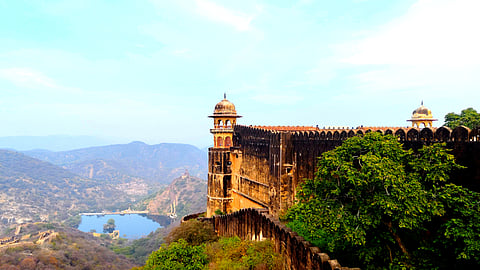
Aerial view from the Jaigarh Fort Anwesha Santra
Jaigarh’s imposing presence is more than aesthetic. Much of its original architecture remains intact—underground passages, minutely designed water-harvesting systems, and the monumental Jaivana cannon, once considered the world’s largest wheeled cannon. Standing before it, it is easy to picture the urgent, disciplined world that once operated here. Climb higher still, and Amer Fort glitters below, Maota Lake mirrors the sky, and the hills roll outward like pages of an unfinished story. The two forts, one ornamental, one defensive, still seem to be in quiet conversation.
Advertisement
I arrived in Jaipur on December 5, greeted by bright winter sunshine that gave way to a sharp chill by nightfall. Dinner at Baradari Restaurant inside the City Palace was a comforting affair— laal maas and butter naan enjoyed in the shadow of the Chandra Mahal, the official residence of the Jaipur Royal Family. Above me, unusually clear stars scattered across the sky, a stark contrast to Delhi’s smog-choked December nights.
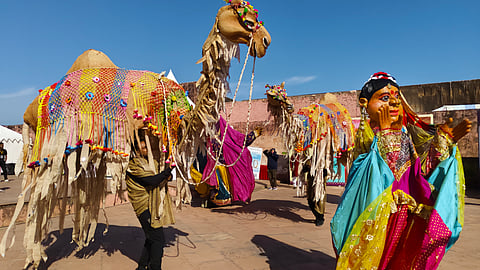
Puppetry performance at the Jaigarh Heritage Festival 2025 Anwesha Santra
The festival’s opening morning eased gently into Jaigarh’s courtyards with a soulful performance by Hullas Purohit, supported by the Dagar Archives Museum. The fort’s stone walls seemed to absorb and return every note. Soon after, Nathoo Lal Solanki, whose family has played the nagara for 13 generations, delivered a thunderous act that shook the courtyard awake. Huge camels, men and women puppets came to life, moving in rhythm with the traditional music that filled the space. At the inaugural ceremony, Sawai Padmanabh Singh, Ritu Jhingon of the Anil Agarwal Foundation, and Sanjoy K Roy of Teamwork Arts set the tone for the festival’s ambition: to treat heritage not as a preserved relic but as a living conversation between generations.
Advertisement

Nagara player Nathoo Lal Solanki at the Jaigarh Heritage Festival 2025 Is'Haq Bhat
In an exclusive conversation with Outlook Traveller, HH Padmanabh Singh said, “We’ve tried to bring together as many Rajasthani elements as possible in one place, at one time, under one roof. I often tell people that if they don’t have the time to travel across the state, they should come to the Jaigarh Festival to immerse themselves in Rajasthani culture over these two days. Personally, I’m a huge fan of the musical traditions from the border regions of Barmer and Jaisalmer. Some incredible Manganiyars have been performing here all day, and more will perform in the Charbagh [a venue at the festival] later this evening. I think Manganiyar music is one of the most powerful art forms anywhere in the world, so that’s been a standout element for me, and I’m happy to share it with everyone.”
Widely known as Pacho, Singh remains a polo player alongside being a cultural steward.
Advertisement

(Left to right) Sanjay Kothari, Ritu Jhingon, Sanjoy K Roy and HH Maharaja Sawai Padmanabh Singh, Shabana Dagar, Shikha Durlabhji, Manju Kothari Puneeta Roy and Sammohan Mathodia Supplied
“Sustainability is the most important element when it comes to heritage or luxury. Without it, nothing else can be preserved. Jaigarh is the best example of sustainable architecture you’ll find anywhere in Rajasthan, if not the world. Nearly a thousand years ago, its builders anticipated water scarcity in this naturally dry region. The water systems here are remarkable—channels built across the fort and surrounding hills guided every drop into different takas or reservoirs. I’m told not a single drop was wasted. If you haven’t seen the large tanka, I’d urge you to. It’s among the most incredible architectural contributions of Dhundhar. Amid all the celebrations, we hope visitors also observe the sustainable practices embedded in these forts and palaces,” the Maharaja remarked.
Craftsmanship At The Festival

Close-up of a puppet at the Jaigarh Heritage Festival 2025 Is'Haq Bhat
On the ground, the festival’s cultural ecosystem came alive through small but meaningful interventions. Self-help groups, including women-led collectives, transformed the fort’s open spaces into living showcases of Rajasthan’s artisanal traditions.
Advertisement
Visitors moved between stalls where AR/VR installations explained how Rajasthan’s mineral resources fuel modern India—from renewable energy and healthcare to aviation and defence. Meanwhile, artisans under the Princess Diya Kumari Foundation worked under colourful shades, reviving traditional crafts while securing independent livelihoods.
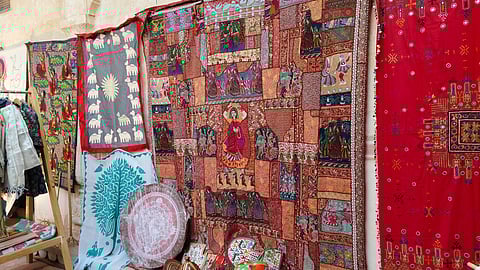
Traditional Rajasthani motifs on fabric on display at the Jaigarh Heritage Festival 2025 Anwesha Santra
I paused at the stall of an elderly artisan named Rukhsana, who was shaping molten lac into bangles over a small chulha. If you venture into the walled city of Jaipur, Mahiharo ka Rasta awaits—a lively street dedicated entirely to lac bangles. Artisans work at their benches as you watch, and you can have your own set made to order, a true piece of Jaipur to treasure.
Rukhsana told me she could craft a hundred bangles over two days, her hands moving with the kind of ease that comes only from years of repetition. She made me a pair on the spot; still warm from the flame, they slipped onto my wrist as if carrying a bit of Jaipur’s warmth with them. Around her, other women embroidered fabrics, stamped block prints, and laid out vibrant textiles, while a bustling craft bazaar nearby sold traditional Rajasthani attire, pickles, jewellery, and home decor.
Advertisement
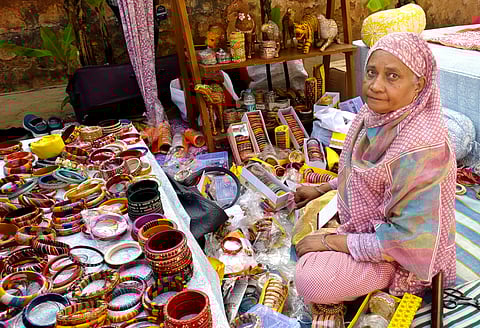
Rukhsana selling lac bangles Anwesha Santra
Discussions On Heritage
The second day began on a contemplative note with a performance by Pandit Mohan Shyam Sharma, his rhythms echoing across the fort’s broad terraces. This was followed by a rich conversation between Giles Tillotson and Mrinalini Venkateswaran on the royal courts’ visual history in ‘Painting & Photography in the Jaipur Court’. Later, scholars Rima Hooja, Jigyasa Meena and Pankaj Jha, in discussion with Abhimanyu Singh Arha, examined Rajasthan’s political and military legacy in ‘Rajasthan and the Subcontinent: Politics, Polity and the Art of War’.

Giles Tillotson in conversation with Mrinalini Venkateswaran at Jaigarh Heritage Festival 2025 Supplied
Workshops brought a more hands-on energy to the afternoon, particularly Chugge Khan’s Khartal session, which drew everyone from curious visitors to seasoned rhythm enthusiasts. Performances by Shahzad and Sakil Khan, alongside contemporary collaborations like “Divyam x Khwaab” and Soumik Datta’s “One Size Fits All,” infused the heritage venue with an unexpectedly modern pulse. As dusk settled, Sanjoy Roy and Arundhati Nath’s “Otherworldly Chronicles” delved into spectral tales in a setting that felt tailor-made for the theme.
Advertisement

Manganiyar Seduction Supplied
The finale arrived with theatrical force. The previous night, Papon had electrified the audience with his soulful vocals. The next evening, Roysten Abel’s Manganiyar Seduction, a hypnotic fusion of light, music and movement, flowed into Nathoo Lal Solanki’s pulsating Nagadas and the Princely States Dub Orchestra featuring Rajasthan Josh, transforming the fort into a booming arena of sound and revelry.

Glimpses from the Jaigarh Heritage Festival 2025 Is'Haq Bhat
Reflecting on the event’s close, Sanjoy Roy said that the second edition builds on last year’s year-zero learnings, with a redesigned craft and retail layout, new artisans, and refined programming across talks, music and heritage walks. “We now offer deeper ways to explore Jaigarh’s history and discover new voices and forms. The focus remains on craft, art and food, and on highlighting traditional practices like water conservation, which are incredibly relevant for a desert region like Rajasthan. Women artisans are central to the festival, as you can see all around us. I’ve always believed this platform will grow, and in the next few years it can become as significant as any major cultural festival, because this fort offers a unique environment that draws people to Jaipur, Rajasthan and India,” Roy told Outlook Traveller.
Advertisement
As the festival wound down, the fort returned to its familiar stillness. Walking once again through its red-sandstone gates, the intent behind Jaigarh becomes instantly clear. Unlike the ornate Amer Fort, it was built to protect, not impress. Its courtyards, granaries, sentry points and thick walls still carry the weight of a time when danger was not metaphorical but imminent.
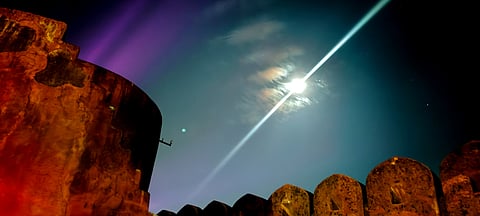
Night sky from Jaigarh Fort Anwesha Santra
And perhaps that is what makes hosting a contemporary festival here so compelling: at Jaigarh, the past is not a distant chapter. It remains present, layered, and listening—ready for the next story to unfold.
FAQs
1. What is the Jaigarh Heritage Festival?
A two-day cultural festival held at Jaipur’s Jaigarh Fort featuring music, crafts, talks, heritage walks and performances celebrating Rajasthan’s traditions.
2. When was the 2025 edition held?
The second edition took place on December 6 and 7, 2025, inside the historic walls of Jaigarh Fort.
3. Who curated and supported the festival?
The festival was presented by The Vedanta Group with Maharaja Sawai Padmanabh Singh and produced by Teamwork Arts.
Advertisement
4. What experiences can visitors expect at the festival?
Live folk music, craft stalls, workshops, cultural discussions, heritage walks and performances by acclaimed Rajasthani and contemporary artists.
5. Why is Jaigarh Fort significant for hosting the festival?
Its intact architecture, water-harvesting systems and history as a defensive stronghold make it a living monument that perfectly blends heritage with modern cultural programming.
Published At: