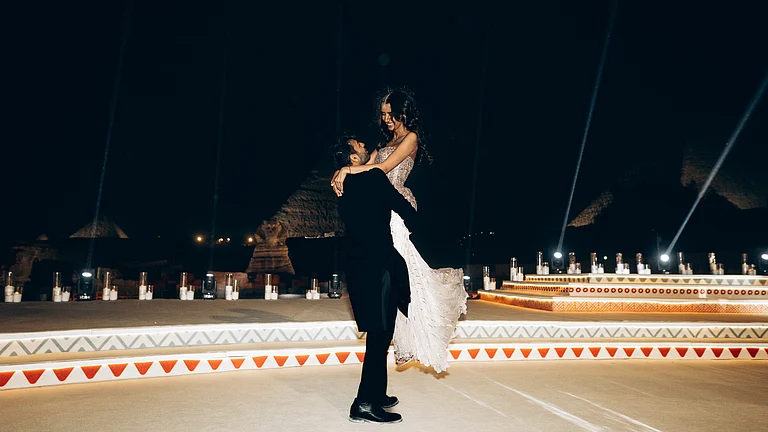


Set amidst the vast sands of the Giza Plateau, with the Great Pyramids rising against the desert horizon, Egypt's most recognisable archaeological landscape has opened its doors to a different kind of spectacle. The ancient monuments, which have fascinated travellers for more than 4,500 years, now share the landscape with contemporary sculptures, colourful architectural forms and large-scale installations.
The sixth edition of Forever Is Now, the international contemporary art exhibition organised by Art D’Égypte, is now underway at the Pyramids of Giza. Running from November 8 to 28, 2026, the exhibition brings together eight artists from different parts of the world, each responding to the architecture, symbolism and enduring mysteries of ancient Egypt. The result is an open-air gallery in which contemporary artistic expression meets one of humanity's most extraordinary architectural achievements.
Eight Artists, Eight Interpretations Of Ancient Egypt
This year's exhibition brings together eight artists from Egypt, France, the United States, China, Britain, Jamaica, and Turkey. Led primarily by women artists, the sixth edition explores the relationship between humanity, architecture and the natural world. Its central themes include continuity, spatial order, cultural memory and the passage of time.
Rather than treating the pyramids as a backdrop, the artists have drawn inspiration from their construction, geometric precision, celestial alignment and place in ancient Egyptian belief systems. Stone, metal, wood, palm fronds and other materials have been used to create installations that respond to the surrounding landscape.
Here are eight works to look out for during the exhibition:
Hortus Pictus by Geoffroy Pithon
French artist Geoffroy Pithon's "Hortus Pictus" introduces a striking burst of colour to the otherwise sandy landscape. Inspired by the idea of the Tree of Life, the installation takes the form of a colourful, architectural garden with rectangular structures, cut-out windows and doorways.
Visitors can walk through the installation, with its openings framing different views of the pyramids. The contrast between the vibrant painted surfaces and the desert's muted tones is central to the work. Pithon has described the installation as a passage that invites people to cross through it, rather than a wall that separates them from the landscape.
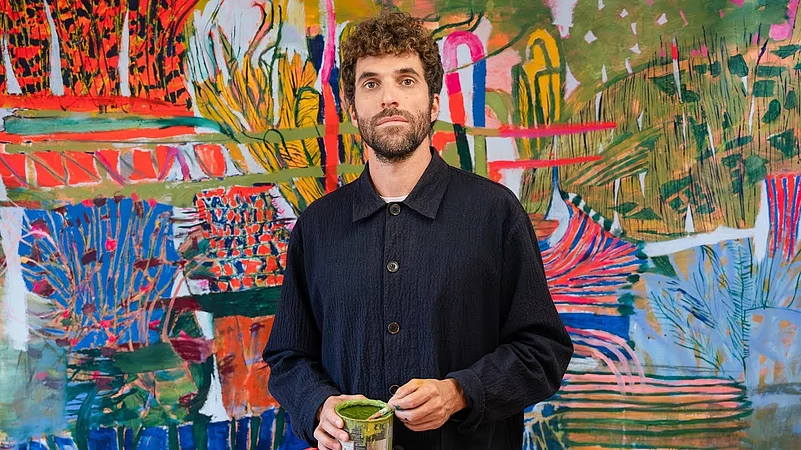

Passage by Raphaele Shirley
American multimedia artist Raphaele Shirley presents "Passage," an installation comprising a sequence of ascending and descending arches. Made using copper, steel, wood, hand-woven Egyptian cotton and palm fronds, the work draws on geometric motifs and references to Egyptian heritage.
Its design also takes inspiration from Nut, the ancient Egyptian goddess of the sky. The arches represent different stages of existence, from birth and life to death, while their patterns cast changing shadows across the desert floor.
Visitors can walk through the installation and experience the pyramids framed by its repeating structures. The interplay of sunlight, shadow and geometric patterns makes this one of the works worth experiencing at different times of the day.
Celestial Vessels by Rochelle Webster-Nembhard
British-Jamaican interdisciplinary artist Rochelle Webster-Nembhard takes inspiration from the ancient Egyptian creation myth of the Ogdoad for "Celestial Vessels." The installation consists of eight monumental, egg-shaped limestone forms, created in collaboration with Egyptian stone producer Marmonil.
The sculptures reference the eight primordial deities associated with the ancient Hermopolitan creation myth. The artist uses the circle as a symbol of nurturing, care and collective existence, in contrast to the triangular geometry that defines the pyramids.
An interesting detail is the material itself. The sculptures use Egyptian limestone of the kind associated with the construction of the pyramids. Visitors can walk through the installation and even sit inside one of the forms, making it an interactive experience rather than a work meant only for observation.
Possible Landscapes by Charlotte Colbert
British-French artist and filmmaker Charlotte Colbert explores imagination, perception and the relationship between reality and fantasy through "Possible Landscapes." One of its most striking features is a polished steel arch topped with a sculptural eye, positioned to frame the pyramids.
The eye is a recurring symbol in Colbert's artistic practice and represents collective imagination, curiosity and the possibility of seeing the world differently. The installation also incorporates other reflective, dreamlike elements, including a mirrored tree and a wishing well.
With the pyramids appearing within its sculptural frame, the work encourages visitors to consider how belief, mythology, and imagination have shaped human understanding across different periods of history.
It Is Time to Plant Love by Jiang Qiong Er
Chinese artist and designer Jiang Qiong Er presents "It Is Time to Plant Love," a work that also marks 70 years of diplomatic relations between Egypt and China.
The installation features 12 mythical guardian figures positioned along a reflective pathway leading towards the pyramids. Drawing on ancient Egyptian, Chinese, Mayan, Indian, and other cultural traditions, the figures represent universal human values such as wisdom, peace, freedom, bravery, authenticity and inclusion.
Another interesting element is a newly imagined hieroglyph representing love. The artist combines visual and written elements from Egyptian hieroglyphics, Chinese, Arabic, Latin, and Hebrew traditions to create a contemporary symbol of shared cultural expression.
The Gathering by Abdul Rahman Taha
Saudi artist and photographer Abdul Rahman Taha looks at human connection through "The Gathering." Inspired by Tawula, the traditional Egyptian board game also known as backgammon, the installation uses large stone structures resembling the game's playing pieces.
The sculptural forms are stacked and arranged to create a geometric composition. Their circular shapes provide an interesting contrast to the sharp triangular silhouettes of the pyramids behind them.
The work draws attention to the role of games and shared spaces in bringing people together, making it a contemporary interpretation of a familiar cultural practice.
Talisman of Salvation by Emad Abu Grain
Representing Egypt, visual artist Emad Abu Grain draws on the "Book of the Dead," the collection of ancient Egyptian funerary texts associated with the deceased person's journey into the afterlife.
His installation, Talisman of Salvation, uses carved natural stone and rope to create an interconnected canopy. The structure evokes a gateway of light and explores the relationship between awareness, spiritual understanding and the journey towards eternity.
The work brings the exhibition back to one of the most enduring aspects of ancient Egyptian civilisation: its elaborate beliefs surrounding death, rebirth and the afterlife.
The King's Road by Seçkin Pirim
Turkish sculptor Seçkin Pirim looks at the history of movement and construction on the Giza Plateau through "The King's Road." The installation uses Egyptian marble columns arranged in a series of repeating formations that frame the pyramids.
Its inspiration comes from the ancient routes that connected quarries and temples across the plateau, facilitating the movement of people and building materials.
The columns have deliberately weathered-looking surfaces, suggesting the passage of time. Visitors can walk between them, observing how repetition, light and shadow alter the appearance of the installation against the surrounding archaeological landscape.
Visiting The Exhibition: What Else To Explore Around The Pyramids Of Giza
The setting of Forever Is Now is as significant as the artworks themselves. Located on the western edge of Greater Cairo, the Giza Plateau is home to the three principal pyramids of Khufu, Khafre and Menkaure, alongside the Great Sphinx and several smaller monuments.
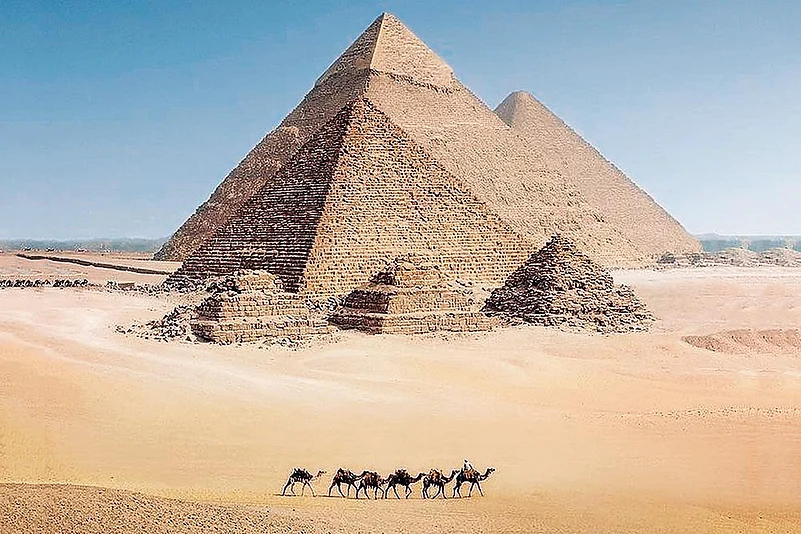
Built during Egypt's Fourth Dynasty, around 4,500 years ago, the pyramids served as royal tombs. The Great Pyramid was constructed for Pharaoh Khufu, while the other two were built for his son Khafre and grandson Menkaure. The Great Pyramid was the tallest man-made structure in the world for approximately 3,800 years.
The plateau is part of the Memphis and its Necropolis UNESCO World Heritage Site, which encompasses some of Egypt's most important ancient burial grounds and pyramid complexes. Beyond the three main monuments, visitors can explore subsidiary pyramids, mastaba tombs, temples and the remains of the ancient funerary landscape.
A visit to the exhibition can also be combined with a trip to the Great Sphinx of Giza, the monumental limestone sculpture depicting a lion's body and a human head. The nearby Grand Egyptian Museum, which opened in November 2025, is another worthwhile addition. Its galleries explore ancient Egyptian civilisation through an extensive collection of artefacts, including the treasures of Tutankhamun and the reconstructed Khufu solar boat.
For travellers with more time, the Step Pyramid of Djoser at Saqqara makes for an interesting excursion. Considered the earliest large-scale stone pyramid complex in Egypt, it provides an insight into the architectural developments that preceded the pyramids at Giza. Dahshur, known for the Bent Pyramid and Red Pyramid, is another archaeological destination worth considering.
The Information
Founded by Nadine Abdel Ghaffar, Art D’Égypte has used Forever Is Now to bring international contemporary artists into direct conversation with Egypt's archaeological heritage. The sixth edition also comes as the organisation marks its tenth year, adding another milestone to its cultural programme.
For visitors, the exhibition provides an opportunity to experience the Giza Plateau through two very different perspectives: the extraordinary engineering and beliefs of an ancient civilisation, and the artistic questions being explored by creators today. With the pyramids remaining a constant presence across the landscape, Forever Is Now 2026 makes a compelling case for experiencing Giza beyond its familiar historical narratives.
Dates: November 8–28, 2026.
Location: Giza Plateau, Al Haram, Giza, Egypt.
Organiser: Art D’Égypte, founded by Nadine Abdel Ghaffar.
Exhibition format: Open-air contemporary art exhibition featuring eight international artists.
Access: Visitors need entry to the Giza archaeological site. The exhibition's official listing provides tour-booking information through the Pyramids Visitor Centre. Check the exhibition's official website for current access and tour arrangements.
Official website: artdegypte.org/ar/event/forever-is-now-06
For international visitors, the Egyptian Ministry of Tourism and Antiquities currently lists the Giza Plateau entry ticket at EGP 700 for foreign adults and EGP 350 for foreign students. Entry inside individual pyramids and certain tombs requires separate tickets. Visitors should check the latest ticketing information before travelling.
FAQs
1. What is Forever Is Now 2026?
Forever Is Now is an international contemporary art exhibition organised by Art D’Égypte at Egypt's Pyramids of Giza. Its sixth edition features eight artists presenting large-scale installations inspired by ancient Egyptian civilisation, architecture and cultural heritage.
2. When is Forever Is Now 2026 taking place?
The exhibition is open from November 8 to November 28, 2026, at the Giza Plateau in Egypt.
3. How many artists are participating in Forever Is Now 2026?
Eight international artists are participating, including Jiang Qiong Er, Charlotte Colbert, Raphaele Shirley, Rochelle Webster-Nembhard, Geoffroy Pithon, Emad Abu Grain, Abdul Rahman Taha and Seçkin Pirim.
4. What can visitors see at Forever Is Now 2026?
Visitors can explore eight large-scale installations, including Hortus Pictus, Passage, Celestial Vessels, Possible Landscapes, It Is Time to Plant Love, The Gathering, Talisman of Salvation and The King's Road.
5. Where is Forever Is Now 2026 being held?
The exhibition is taking place at the Giza Plateau, near Cairo, Egypt. Visitors can also explore the Great Sphinx, the three pyramids and the nearby Grand Egyptian Museum during their trip.