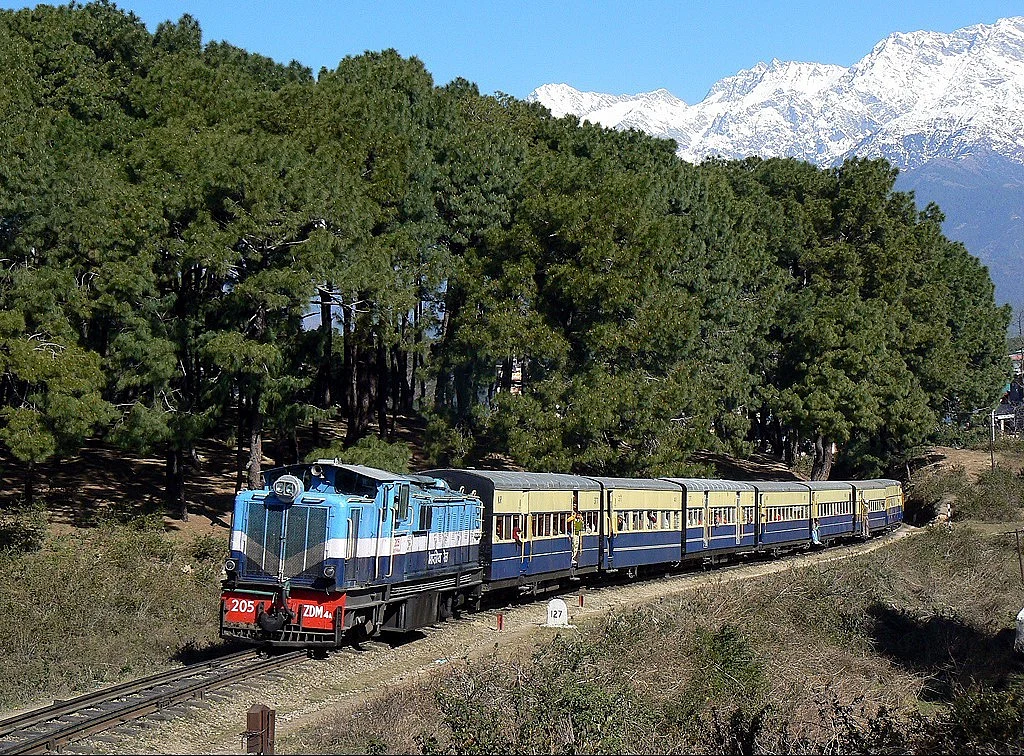
If you have ever longed for a Himalayan train journey away from the crowds, the Pathankot–Jogindernagar Railway may be worth a second look. The colonial-era narrow-gauge line, which winds through Himachal Pradesh’s Kangra Valley, has returned to service after repair works, bringing travellers back to one of northern India’s most overlooked rail journeys. Often eclipsed by the better-known Kalka–Shimla Railway, the route meanders through the lower Himalayas, with sweeping views of the snow-covered Dhauladhar range and a sense of tranquillity that is increasingly difficult to find on the region’s more popular tourist circuits.
Nearly four years after floodwaters brought traffic to a halt, trains are once again running between Pathankot and Jogindernagar. The line had been cut off since August 2022, when the Chakki railway bridge was badly damaged during heavy flooding, breaking a key rail connection between Punjab and Himachal Pradesh. Following a rebuilding effort worth about INR 70 crore, the route reopened to passengers on June 2. Its return has prompted fresh interest in a railway that has long remained in the shadow of the country’s better-known hill train journeys.
A Slower Way Through The Himalayas


The Pathankot–Jogindernagar line has never enjoyed the fame of the Kalka–Shimla Railway, and that is part of its appeal. The narrow-gauge route runs from Pathankot in Punjab to Jogindernagar in Himachal Pradesh, crossing the Kangra Valley through tea-growing country, scattered villages and the foothills of the Dhauladhars.
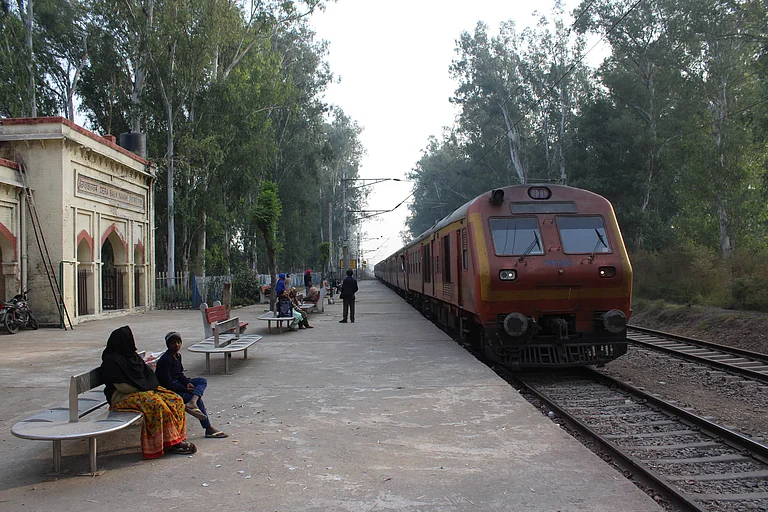
A journey on the line feels refreshingly removed from the bustle associated with many of India’s better-known hill railways. Small coaches, hauled by a ZDM-3D locomotive, trundle through landscapes where the mountains often seem closer than the nearest town. There are no grand tourist crowds here; instead, the route offers long views, quiet stations, and an unhurried glimpse of life in the lower Himalayas.
Key Features of the Line
Route details: The railway begins at Pathankot in Punjab and ends at Jogindernagar in Himachal Pradesh’s Mandi district.
Distinction: It is regarded as the longest narrow-gauge railway line in India. The track rises gradually through the Kangra Valley, reaching its highest point at Ahju station at 1,290 metres (4,230 ft).
Engineering background: Completed in 1929, the line was designed to avoid steep gradients, taking a long, winding alignment through the foothills. It has no major tunnels, but crosses close to 1,000 bridges and includes 484 curves along its length.
Stations, Stops, And The Journey
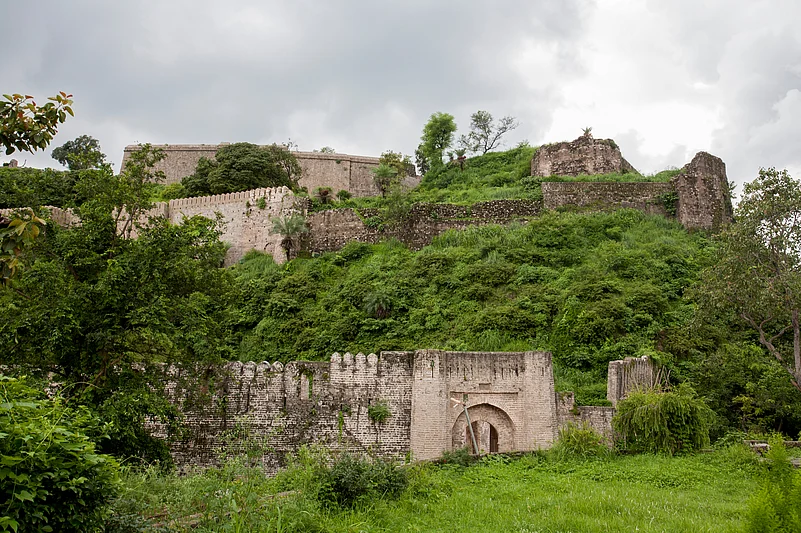
The Pathankot–Jogindernagar line links a series of important towns, pilgrimage sites and valley settlements across the Kangra region. For many passengers, it is less a single point-to-point trip and more a slow passage through everyday life in the lower Himalayas.
Kangra: Access point for the historic town and Kangra Fort.
Jwalamukhi Road: The nearest stop for the Jwala Ji Temple, a major pilgrimage site in the region.
Palampur Himachal: Gateway to Palampur’s tea estates, and onward access towards Bir Billing, known for paragliding.
Baijnath Paprola: Serves the Baijnath Temple, an ancient Shiva shrine.
The line is often used by local commuters, helped by its modest fares and dependable timings. Trains move at an even, unhurried pace, tracing river valleys, skirting hillside villages and opening up long stretches of quiet sub-Himalayan scenery. Updated schedules and ticketing information for the restored services are available through official Indian Railways and IRCTC channels.
Good To Know
This is very much a working railway rather than a polished tourist product, and that shows in how it is used day to day. Most coaches are filled with local passengers, and travel remains inexpensive, with tickets still issued over the counter at stations rather than through online booking.
Fare range: Around INR 40 to INR 330 depending on distance and class, with many short unreserved journeys costing roughly INR 15 to INR 40.
Ticketing: No online booking for regular services; tickets are bought directly at station counters such as Pathankot Junction, Kangra, Palampur, and Baijnath Paprola before departure.
Route length and time: The full 158 km line, with 33 stations, takes around 8.5 to 10 hours to complete.
Journey style: Trains move at a slow pace through river valleys, pine forests and scattered hillside settlements across the lower Himalayas.
FAQs
Is the Pathankot–Jogindernagar train running again?
Yes. Services resumed on 2 June 2026 after major restoration work following flood damage in 2022.
How long does the full journey take?
The complete run of around 158 km typically takes between 8.5 and 10 hours, depending on the service.
What is the main attraction of this route?
The journey passes through the Kangra Valley with views of rivers, pine-covered hills and the Dhauladhar range, alongside stops linked to temples, towns and tea-growing regions.
Which major places does the train connect?
The route links towns and pilgrimage centres such as Kangra, Jwalamukhi Road, Palampur and Baijnath Paprola, before terminating at Jogindernagar.
Is this route mainly used by tourists or locals?
It is still used largely by local passengers for daily travel, with tourism gradually returning after the restoration of services.