


There is an obvious, bordering-on-salacious pleasure in reading an artist&rsquos journal writing that is intensely personal, made visible to an audience already invested in the public persona of the writer.
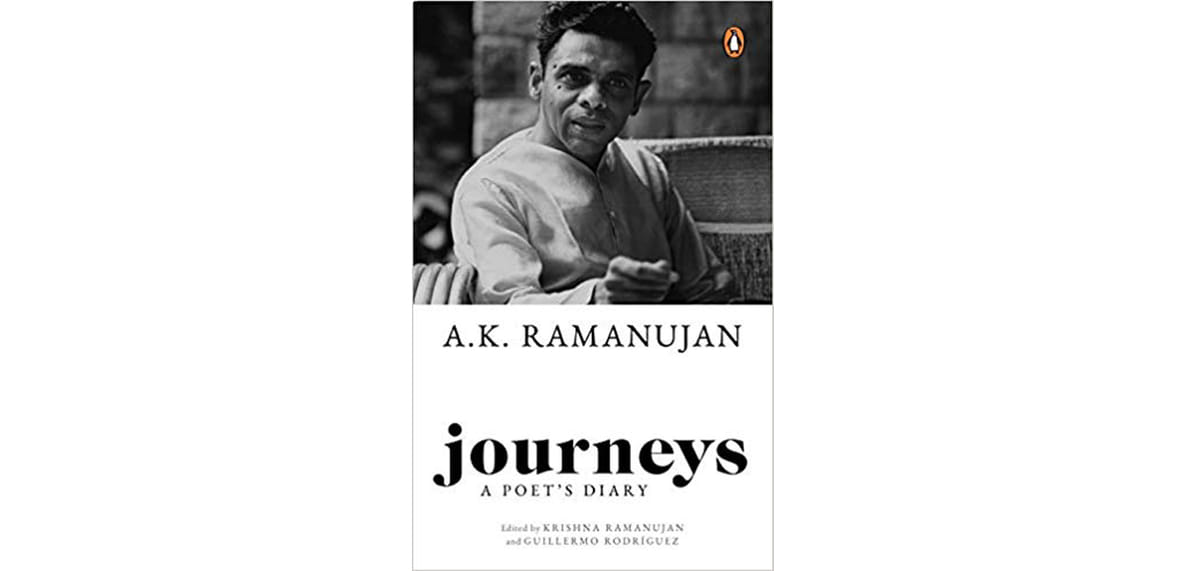
The promise of a peek inside their mind, insight into their creative process, is that much more tantalising when said persona is a prolific poet, translator, and folklorist like A.K. Ramanujan. Journeys A Poet&rsquos Diary, published in commemoration of Ramanujan&rsquos 90th birthday in March 2019, is an attempt by his son, Krishna Ramanujan, and Ramanujan scholar, Guillermo Rodríguez, to introduce to the reader, a writer in &ldquocontinuous dialogue with the past and himself&rdquo. In a diary entry from 1976, Ramanujan writes about the politics of upturning public and the personal &ldquo&hellipso that the private may find a place in a larger discussion, just as the larger discussions entered my private journal.&rdquo This blurring of lines is what the purpose of the current volume seems to be.
In his foreword to the text, the late Girish Karnad makes an astute observation about Ramanujan&rsquos capacity to &ldquosee connections and patterns between unrelated phenomena&rdquo. This innate ability is what gives immediacy and relevance to Ramanujan&rsquos poetry. Readers familiar with his oeuvre will know of his translations from Kannada, as well as his poetry in Kannada and English. Others might well only know (of) his controversial Three Hundred Ramayanas, a radical yet scholarly essay on comparative tellings of the great Indian and Southeast Asian epic. Ramanujan is a difficult writer to have missed altogether. This volume, structured into five chronological sections of diary entries, and thematically sorted (published as well as unpublished) poetry pieces, chronicles the writer&rsquos early experiences as a teacher in various Indian universities, his journey to America and subsequent years spent in academia at the University of Chicago, among others. It intends, perhaps, to present to the reader not just the accomplished poet and linguist/translator, but also an anguished writer, often unsure of his own ability.
The diary entries speak repeatedly of anxieties, fear of social situations, of having to read his work out aloud to an audience, the problematics of the roles of husband and father &ldquoWave after wave of discontent with myself&rdquo, as he puts it. Frustrated with middle class insularity, he declares, in August 1951, &ldquoLiving, however comfortable, is wearisome because it is meaningless.&rdquo The exploration of this tragedy of existence and its alleviation through art seems to be an ongoing motif in his writing. The book contains a mammoth 27-page account of a mescaline experiment a conscious narrativisation of the effects of a hallucinogen over a period of two days. These &ldquoMescalin Notes&rdquo, exploding with sensory surfeit, become an account of his personal anxieties as well as goals&mdashof writing better, terser, sharper.
A dominant theme that emerges in the book is Ramanujan&rsquos concern with the genesis of poetry. He states over and over again, how the poem chooses the poet, implying a certain submission to an abstract process of creativity, along with the consistent honing of skill. It is interesting that the linguist who insists on demystifying English as a language and sees Indian English as not a monolith but a composite, organic creature of accents and regional usages, who speaks of translation as a post-colonial practice of transactions between languages and cultures, has this rather romantic vision of the origin of poetic ideas and intent.
The poet is also a traveller. Hence, the title of the volume. Journeying begins with the act of growing up and out of the privilege of home and the father&rsquos reflection, and soon transforms into literal travelogues, with all the enthusiasm as well as insecurities of the unseasoned traveller. The cityscapes, the museums, the sketches of people he observes minutely, the land he explores from a bird&rsquos eye view, sitting in an airplane, the nostalgia he feels for the home he never explored enough, all form ley lines of the artist&rsquos complex identity shaped over five decades.
A question that finally begs asking is this&mdashdoes the publishing of a writer&rsquos journal posthumously, turn into a violation of their private mindspace The answer might lie in Ramanujan&rsquos own words from 1980
&ldquo Should one write a diary to suit a possible snooper, a reader over your shoulder (&hellip.) I am going to contrive to write what I think and feel. For the first honesty is with oneself.&rdquo
All the reader doesthen, is parse the truthand, like a young Ramanujan at the Louvre, &ldquosee different things&rdquo.