

I belong to a generation of Tibetans whose roots are built through memories of rituals. Having never set foot in a homeland my grandparents escaped, I learnt of the stories that they carried across borders. I am the surviving link of a family that was a prime witness to our displacement. Losar, the Tibetan New Year, is one of our most-awaited festivities that stands as a testament to the homeland.
Losar has a distinct way of announcing itself in my home in Dehradun. Long before the first greetings of Losar, "Tashi Delek," are exchanged or the chuba, a traditional Tibetan dress, is donned, the kitchen breathes life into the house. Around 4 am, while the rest of the house is fast asleep, my Apa (father) is already awake, moving through the kitchen with a sense of certainty. He pauses, listens, and stirs as though each dish carries its own weight of expectation. Nothing is left to chance. He checks the pots, adjusts the flames, tastes and retastes, guided not by written recipes but purely by memory, habit, and instinct.
Days Before Losar
Losar is not a single-day celebration. Preparations begin well before the new year arrives and last for over 15 days. Apa would start planning months in advance. Houses are painted anew; cupboards are scrubbed clean. Visits are made to tailors for new chubas. Preparing food is the ultimate heartbeat of this build-up.
Khapsey and bhungu amchok, both deep-fried pastries, are made in massive batches. Both are served as festive snacks and as derga, the elaborate, tiered offerings placed on the altar for the gods. Khapse-making appears deceptively simple: knead the dough, braid it, and fry it golden brown. But it required immense time, teamwork, and patience when I tried it myself. As far as I remember, it was chaotic and exhausting, but at the same time, it was what brought the family together.
The crescendo of this preparation reaches its peak on nyi-shu-gu, the 29th day of the last lunar month. This is when we gather for guthuk, a nine-ingredient noodle soup, eaten only once a year. The most interesting part is the ritual that accompanies the gathering. Each bowl contains a dough ball, which is broken open at the table to reveal an object, or, in some homes, a small note naming the object inside. Chosen at random, these carry symbolic meanings, much like a fortune cookie.
If one finds a “wool” ball, it means one is kind. A “thread rolled inward” is a call for luck and prosperity, whereas “salt” signifies laziness. A person who gets “coal” will bear the brunt of mockery from the family, because it means you have a black heart.
Losar Tashi Delek!
By dawn, the house begins to fill with the tangible weight of the feast. There is the sweet, starchy scent of dresi—rice warming in the pot, glistening with butter and sugar. The salty, rich aroma of butter tea, bhoeja, rises as the tea leaves release their flavours into the pot. Meanwhile, khapsey are laid out in generous heaps, ready for the arrival of guests.
While my atheist Apa anchors the kitchen, he also tends to the divine, a quiet irony that defines our life in exile. For him, these rituals are more about cultural duty than personal faith. He is the one who decorates the altar and prepares the derga, stacked like monuments.
The morning begins with him making water offerings in seven small bowls to the deities. The water bowls are paired with the chemar bo, a two-tiered wooden box filled with roasted barley flour, butter, and sugar, signifying good fortune for the year ahead. We also visit our close families and friends to wish them Losar Tashi Delek.

Flavours That Travelled, Adapted, And Survived
Resilience is not something we actively ruminate over when we celebrate Losar or prepare our meals. It is not a conscious mission. Looking back over six decades, one sees how our culture, language, and food have survived without a physical country to anchor them, and this realisation begins to reveal the silent responsibility we carry.
It would be wrong to say we have not adapted. In a changing world, survival means pivoting. Flavours brought from Tibet to India endured not by staying static, but by evolving as landscapes changed.
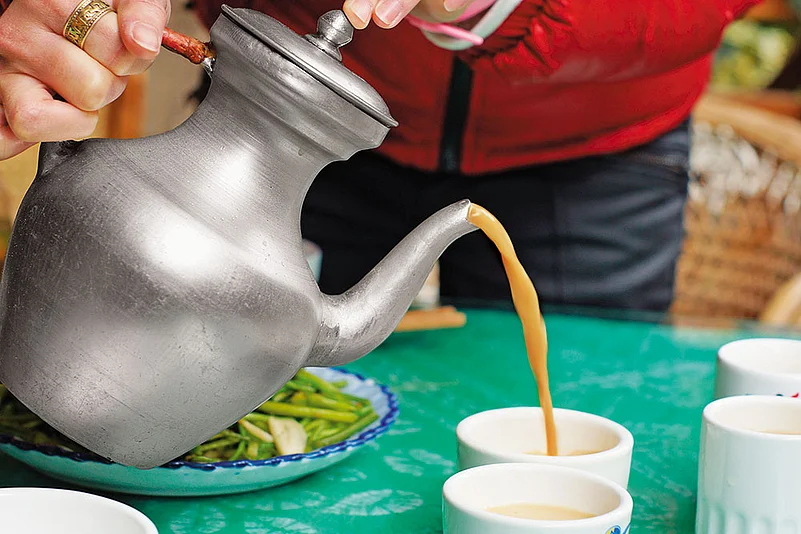
Take our butter tea. To anyone else, it’s a bit of a surprise. It is a salty, rich brew that feels more like a light soup than a morning tea. In the past, it was made in the mdong mo, a tall wooden churner. Today, we have swapped the thump of the wood for the practical whir of an electric blender. The method has been modernised, but that first salty sip still brings the same grounding comfort it did generations ago.
The dresi is another example of “making do.” In Tibet, along with rice, the dish used yak butter and droma, a tiny root foraged from the frozen earth. Since we did not have these ingredients, yak butter was replaced by the yellow tint of Amul butter. Droma became a rare treasure. We filled that gap with the bounty of the plains: cashews, almonds, and raisins.
Now, the dish tastes like both the land we left behind and the land that welcomed us. It is a culinary bridge built from whatever was available at the local market.
What Remains, What Is Carried Forward
Now I watch my father in the kitchen as Losar dawns. I realise this thread of continuity is now in my hands. We are further from Tibet than our grandparents, yet we are more conscious of what it means to keep a tradition breathing.
Losar is no longer just a celebration that happens around me. It is a legacy I must choose to carry forward. One day, it will be my turn to rise before dawn. I will stir pots, taste broth, and show someone how khapsey should look and how guthuk should feel. Through these simple, everyday acts, I will keep a living history alive. Having watched my grandfather perform these rituals, and now, my father, I stand as the observer of a tradition that refuses to fade.
Looking for more such exciting and meaningful stories? Grab our latest issue on Amazon.