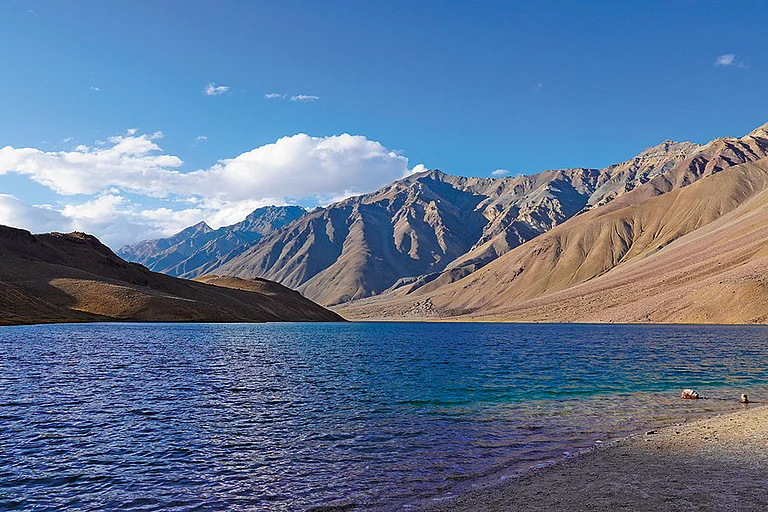


Each summer, she beats her wings and leaves Africa, crossing continents to return to the wild moorlands of the Peak District. Locals call her the “Mountain Blackbird.” Scientists call her the ring ouzel. I simply see a companion—another migrant who found herself in this windswept corner of England.
I came from India to London, and then on to the quiet spa town of Buxton, my new home at the gateway to the Peak District. With its graceful Georgian crescents, steaming thermal water, and hills rolling in every direction, Buxton feels like a place suspended between history and wilderness. It is also the perfect base to explore a national park that changed the story of British access to nature.
Where Freedom First Took Root
The Peak District may look serene today, but its past is shaped by resistance. Long before it became the UK’s first national park, much of the moorland belonged to wealthy landlords. Fences, signs, and strict boundaries kept ordinary people out.
Yet these same moors—open, rugged, raw—were exactly the escape the working class needed during the gloom of the Great Depression in the 1930s. When people were barred from walking the hills, they protested. They trespassed. They demanded the right to roam. Their fight paved the way for a landmark moment in 1951, when the Peak District became Britain’s first national park—a symbol of public freedom carved out of private land.
Learning this history made me realise how extraordinary it is that I, a quiet newcomer from another continent, could simply walk into landscapes once fiercely protected from outsiders. Still, the feeling of being a foreigner lingered—in the accent I carried, in the way I searched for belonging, in the unspoken loneliness of starting again in an unfamiliar place.
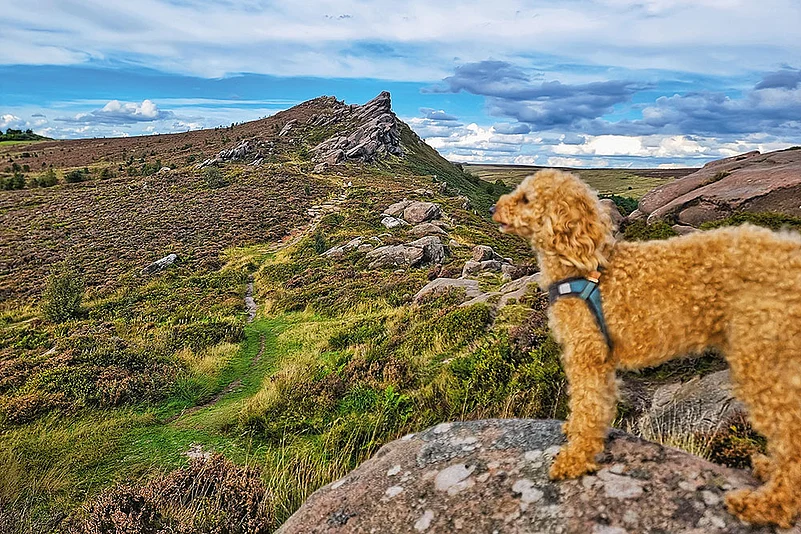
But slowly, the moors themselves invited me in. With time, I explored the park’s wild edges with my poodle, Walle, letting each trail peel back a new layer of connection. Two moorlands in particular—Stanage Edge and Ramshaw Rocks—became my personal gateways into this rugged world.

Stanage Edge
Driving from Buxton toward Stanage, a small sign outside Cat and Fiddle Distillery announced: Forest Gin and Whisky—made with spring water from the surrounding moors. It felt like a quiet promise that what awaited us was not just scenery but life shaped intimately by the land.
Stanage sits high above the Derwent Valley, a sweeping gritstone escarpment older than the dinosaurs. The trail began gently—1.5 km of dry path where reed grasses shimmered like golden blades under the summer sun and sheep dotted distant hillsides like moving pearls.
But the moors are moody creatures. Soon the solid path dissolved into boggy ground, and my boots began to sink into thick sphagnum moss. Each step made a soft, wet sigh. Sphagnum can hold 20 times its weight in water, feeding the reservoirs that supply to towns across the region. It’s a tiny ecosystem quietly holding up an entire community.
The slower the ground asked me to walk, the quieter my mind became. That’s the strange magic of moorlands—their pace becomes your pace. Deadlines loosen. Technology fades. Even Walle’s steps softened.
A final steep climb—half a kilometre of scrambling, panting, slipping—lifted us onto the ridge. From the top, Stanage Edge stretched six km, thin as a blade, against the sky. Below lay Hope Valley, winding in greens and golds. Across the horizon stood Bamford Edge, once reserved for grouse hunting and now part of ongoing conservation work to restore the endangered black grouse.
Just as I admired the view, something moved in a narrow crack in the rock. A brown bird—slender, alert, delicate—popped her head out. A ring ouzel, raising her brood inside the safety of her tiny cave. Watching her, I felt an unexpected kinship. She too had travelled far to make a home here. She too had found refuge on this ancient ridge.
A little farther along, Walle and I stumbled upon our own sanctuary: a vaulted cave etched into the cliff face. Known as Robbers Cave, it was once a hideout for thieves and wanderers. We sat inside, letting the wind sweep past the opening like a soft exhale. For the first time since moving continents, I felt still; unhurried and untethered.

Ramshaw Rocks
“The winking man guards Ramshaw,” locals say. And indeed, the first thing I saw on the road toward the southwestern moorlands was a giant stone face—one eye closed as though mid-blink, watching over travellers.
Ramshaw is stranger, softer, wilder than Stanage. Its 2.5-kilometre ridge resembles a giant bony spine, sculpted over millennia by wind, frost, and rain. Some rocks are smooth as river pebbles; others jut out like broken teeth. Walking through them, I felt a quiet empathy. Just as the elements shape these rocks, every new challenge in a new country was shaping me, rounding some edges and sharpening others.
The ridge rose to 460 m, blanketed in ling heather and willowherb. In late summer, the moors turn into a violet tide that rolls toward Hen Cloud and the rugged heights of The Roaches. Walle padded ahead, nose twitching as bees hummed in the heather. The London noise that once followed me like a shadow was replaced by birdsong and the rustle of winged insects.
Halfway along the ridge, we paused. A climber was inching his way up a rock face, fingertips gripping cracks, body balanced like a whisper. It felt like witnessing history—a quiet echo of the early 20th-century climbers who met on these very moors, forming the Ramblers Association and fighting for access to nature. Today, Ramshaw’s solitude still carries that spirit of defiance and freedom.
In the beginning, I thought moving to Buxton would make me an outsider—another migrant tucked into a quiet English town. But somewhere between Stanage’s ancient gritstone and Ramshaw’s violet heather, I found small markers of connection. I came here as a visitor. I walk here now as someone who belongs.
The Information
Peak District, England: The UK’s first national park is a landscape of remarkable natural beauty, shaped over millennia by the enduring interaction between people, wildlife, and nature.
Getting There: From Manchester Airport, rent a car or take a train from Manchester Piccadilly to Buxton (just over one hour). From London, National Express coaches run to Derby, with further bus connections into Buxton, Bakewell, and Matlock.
Stay: For budget-friendly options, choose Buxton, Leek, or Sheffield.
Tips: If you don’t have a car, explore Peak District via its four train lines: Buxton, Glossop, Hope Valley, and Derwent Valley, which connect to villages and trailhead, or hop on the Peak Sightseer open-top bus.
Best Time to Visit: May to September for the most pleasant weather.
Author Bio
Eva Badola is a UK-based Indian writer and freelance journalist. She has several articles and a book themed around nature, culture, and sustainability to her name.
Looking for more such exciting and meaningful stories? Grab our latest issue on Amazon