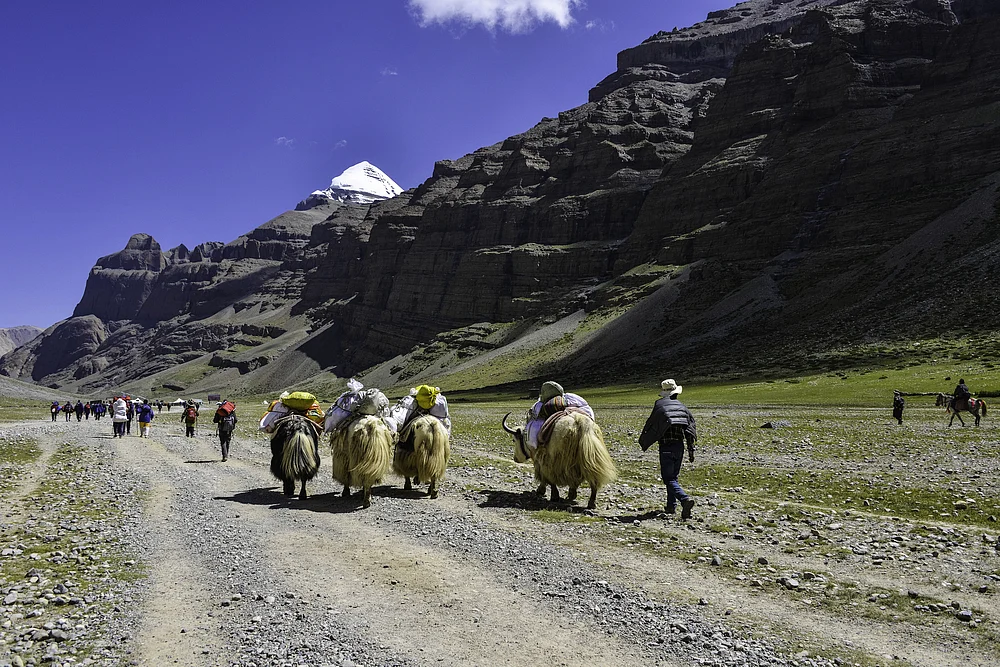
At first glance, Mount Kailash appears like any other Himalayan giant—snow-capped, remote, and commanding. Yet unlike the world's other great peaks, this mountain is not a destination to be conquered. Revered as sacred for millennia, Mount Kailash remains unclimbed, drawing thousands of pilgrims each year who come not to reach its summit but to walk in its shadow. Their pilgrimage is the Kailash Parikrama, a journey where faith, rather than altitude, defines every step.
Also known as the Kailash Kora, the Parikrama is a 52-kilometre circuit around the mountain, completed over three days across the high-altitude Tibetan plateau. Winding through glacial valleys, ancient monasteries and the formidable Dolma La Pass, the route ranks among the world's most extraordinary pilgrimages. While the terrain and thin mountain air demand resilience, the experience is far more than a physical challenge. For pilgrims, it is an act of devotion, a ritual of introspection and a symbolic journey of spiritual renewal.
Mount Kailash holds an exceptional place in the beliefs of four major religions. Hindus worship it as the celestial abode of Lord Shiva and Goddess Parvati. Buddhists regard it as the home of Demchok (Chakrasamvara), embodying ultimate bliss and enlightenment. Jains believe their first Tirthankara, Rishabhadeva, attained liberation here, while followers of the ancient Bon tradition honour it as the spiritual axis of the universe. Though their beliefs differ, they all share a common conviction: that circumambulating this sacred mountain is a deeply transformative act capable of purifying the soul and bringing one closer to the divine.
More Than A Trek


The word parikrama literally means circumambulation, while Tibetans refer to the ritual as kora. Instead of ascending the mountain, pilgrims circle its base in a clockwise direction, except Bon practitioners, who traditionally walk counterclockwise. It is believed that completing a single circuit cleanses accumulated karma, while multiple circuits deepen spiritual merit.
Unlike many Himalayan treks where scenery takes centre stage, the Kailash Parikrama is inseparable from faith. The dramatic landscapes—glacial rivers, broad valleys, barren cliffs and snow-covered ridges—certainly leave a lasting impression, but it is the symbolism attached to every landmark that gives the journey its extraordinary character. The route passes monasteries that have watched over pilgrims for centuries, sacred lakes tied to mythology and one of the highest mountain passes regularly crossed by devotees.
The journey begins and ends at Darchen, a small settlement sitting at approximately 4,670 metres above sea level. Before starting the trek, pilgrims usually spend time acclimatising, often after visiting the nearby Lake Mansarovar. The effects of altitude are impossible to ignore here, making preparation every bit as important as devotion.
Walking Through Sacred Geography
Every section of the Parikrama carries religious meaning. Soon after leaving Darchen, pilgrims arrive at Yam Dwar, also known as Tarboche, regarded as the symbolic gateway to the sacred realm of Kailash. Passing through it signifies leaving behind worldly attachments before entering a spiritual landscape.
The route then unfolds through the Lha Chu valley, where Mount Kailash slowly reveals its different faces. Many pilgrims consider the north face, viewed near Dirapuk Monastery, to be the mountain's most majestic perspective. On the second day, the trail reaches Dolma La Pass, the highest point of the journey at around 5,630 metres. In Hindu belief, this crossing represents the symbolic passage through death before spiritual rebirth. Just below the pass lies Gauri Kund, a turquoise glacial lake associated with Goddess Parvati, adding another deeply revered stop along the route.
By the final day, the terrain softens into broad valleys dotted with grazing yaks, streams and prayer flags. The trail passes Zutulpuk Monastery, traditionally associated with the great Tibetan yogi Milarepa, whose meditation cave remains an important pilgrimage site.
The Three-Day Kailash Parikrama

Day 1: Darchen To Dirapuk
The first day is often described as the gentlest introduction to the Parikrama. Beginning either directly from Darchen or after a short drive to Yam Dwar, the route follows the Lha Chu valley through gradually ascending terrain. The walk takes around six to seven hours and allows pilgrims to settle into the rhythm of high-altitude trekking. As the valley narrows, spectacular views of Mount Kailash's north face emerge, culminating at Dirapuk Monastery, where simple guesthouses provide overnight accommodation. Many pilgrims consider this the finest viewpoint of the sacred mountain.
Day 2: Dirapuk To Zutulpuk Via Dolma La Pass
The second day is unquestionably the most demanding. Covering roughly 22 kilometres over nine to twelve hours, it includes the steep ascent to Dolma La Pass, where oxygen levels are significantly lower than at sea level. The climb tests even experienced trekkers, while the descent requires equal caution over rocky terrain.
Soon after crossing the pass, pilgrims encounter Gauri Kund, whose emerald waters are closely associated with Hindu mythology. Horses, which can be hired for much of the Parikrama, cannot negotiate this steep descent, meaning everyone must complete this stretch on foot. The trail eventually levels out before reaching Zutulpuk Monastery, where another basic overnight stay awaits.
Day 3: Zutulpuk To Darchen
Compared to the previous day's exertion, the final stretch feels almost meditative. The route follows a relatively flat valley through open landscapes, taking around three hours before vehicles return pilgrims to Darchen. Along the way, travellers encounter nomadic settlements, grazing livestock and flowing streams, offering time to absorb the experience before completing one of the world's most extraordinary pilgrimage circuits.
Preparing For The Journey
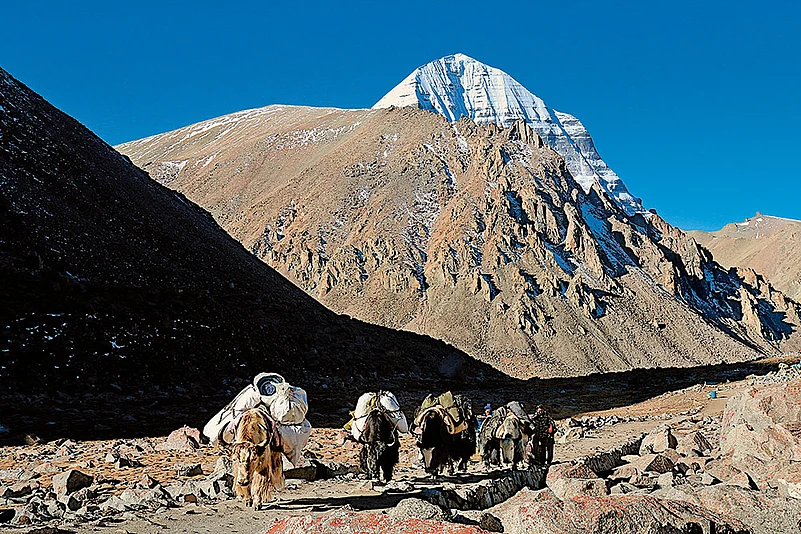
The greatest challenge of the Kailash Parikrama is not its distance but its altitude. The trek remains above 4,600 metres throughout and climbs beyond 5,600 metres at Dolma La Pass, where oxygen levels are dramatically reduced. Even individuals in excellent physical condition can experience symptoms of acute mountain sickness, making acclimatisation an essential part of the itinerary.
Most organised yatras recommend spending at least a couple of days adapting to the altitude before beginning the trek. Medical fitness certificates are often mandatory, and those with heart disease, severe hypertension or chronic respiratory illnesses are generally advised to seek medical clearance before attempting the Parikrama. Many senior pilgrims choose to limit their journey to Kailash Darshan from Darchen or Yam Dwar rather than undertaking the full circuit.
Accommodation along the route is intentionally simple. Pilgrims stay in shared dormitories or basic guesthouses at Dirapuk and Zutulpuk, where facilities are limited, and bathing is often impractical because of the cold. Meals typically consist of uncomplicated Tibetan fare such as noodles, rice, soups and vegetables, with tea houses offering hot drinks, snacks and bottled water. Carrying energy bars, dry fruits, electrolytes, and adequate hydration remains essential throughout the trek.
Outer Kora, Inner Kora And The Deeper Pilgrimage
Most visitors undertake the Outer Kora, the standard three-day route completed by thousands of pilgrims every year. There is also the far more demanding Inner Kora, a shorter but considerably tougher circuit that approaches Mount Kailash more closely, passing sacred locations such as Nandi Parvat, Charan Sparsh and other spiritually significant sites. Access is restricted and generally reserved for experienced pilgrims who have already completed the Outer Kora.
Whether one completes the full Parikrama or simply catches a glimpse of Mount Kailash from afar, the mountain's significance extends well beyond geography. It remains one of the few places on Earth where multiple faiths intersect without competing narratives, united instead by reverence for a landscape that has inspired devotion for centuries.
For those who undertake the three-day walk, the Kailash Parikrama becomes far more than a trek through high-altitude terrain. It is a journey through myth, faith, endurance and self-reflection—one that leaves its mark long after the final steps back into Darchen.
FAQs
Q1. What is the Kailash Parikrama?
The Kailash Parikrama, also known as the Kailash Kora, is a sacred 52-kilometre pilgrimage around Mount Kailash in Tibet, usually completed over three days.
Q2. How long does the Kailash Parikrama take?
The Outer Kailash Parikrama is typically completed in three days, covering approximately 52 kilometres.
Q3. What is the highest point on the Parikrama route?
The highest point is Dolma La Pass, which stands at around 5,630 metres (18,471 feet) above sea level.
Q4. Can you visit Mount Kailash without doing the Parikrama?
Yes. Many pilgrims choose to have Kailash Darshan from Darchen or Yam Dwar without undertaking the full trek.
Q5. When is the best time to undertake the Kailash Parikrama?
The pilgrimage season generally runs from May to September, with many travellers planning their visit during the Saga Dawa Festival.