The Indian sustainable tourism market was valued at USD 44.3 million in 2025, a rapidly growing segment with an expected cumulative annual growth rate of 19.3 per cent. (according to a report titled India Sustainable Tourism Market Size and Share Forecast Outlook 2025 to 2035 published by Future Market Insights Inc). Eco-tourism holds the lion’s market share at 35 per cent. Identifying this potential, India’s Finance Minister, Smt. Nirmala Sitharaman, delivering the Union Budget speech of 2026, stated that the government would shift its focus to developing ecologically sustainable mountain trekking trails, especially in the Himalayan regions of Uttarakhand, Himachal Pradesh, and Jammu & Kashmir. She added that this would be an effort to boost employment and regional development. However, it is crucial to ask how sustainable the current scenario truly is.
Budgeting Peak Ambitions: A Green Himalayan Future Or A Polluted Pipe Dream?
Balancing the rapid growth of tourism with the need to protect the fragile ecology of India’s Himalayan trails

Peak Pressure
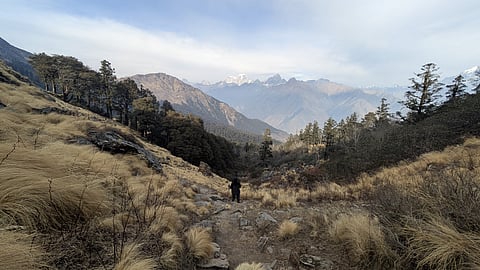
Mountain trekking has surged in popularity across India in recent years. Over ten prominent organisations now run treks year-round in the Himalayas, with Uttarakhand boasting nearly 20 trails, Himachal Pradesh over 40, and Jammu & Kashmir more than 10. Many are easy-to-moderate routes for beginners. Trails like Kedarkantha in Uttarakhand are now severely overcrowded, with multiple groups scheduling trips simultaneously. A single group averages 35–40 trekkers plus staff, so peak campsites host over 150 people at once, overwhelming fragile high-altitude zones. Without regulation, this leads to rampant open waste dumping, turning pristine areas into polluted bottlenecks.
A Snow Drought
This year, the Uttarakhand Himalayas stayed snowless during the peak snow season of December and January. Data published in various publications quoting meteorological stations at peaks like Tungnath reveal that this snow drought was an unusual event not seen since recording started in 1985. Snow deficits in Jammu & Kashmir exceeded 25 per cent in December 2025. Two major factors contributing to this snow drought are the natural variability of western disturbances and global warming. Weak storms are carrying less moisture, triggering dry winters, but anthropogenic pressure adds to the malaise. Rising greenhouse gas emissions at higher altitudes, especially in such sensitive zones, spike the ambient temperature. Due to this, even if storms bring in moisture, most of it falls as rain rather than snow. This directly impacts our glaciers and exacerbates India’s water security crisis.
Foul Waters
While speaking with a local trek guide from Himachal at the Kuari Pass trek, he emphasised how the Himalayas are being exploited as treks proceed without regulations or governance. Overcrowding does more than generate waste; it fouls streams. The campsites of these organisations lie at very high altitudes where amenities are scarce. Consequently, the water consumed by them for operations such as cooking and washing dishes is taken from the natural river streams found along the trails. This is the same water used by villages downstream; therefore, an increased number of treks pollutes this water in the absence of a defined process framework.
Regulating Trails
A holistic approach must underpin planning sustainable tourism. "Limits of Acceptable Change" (LAC) is a framework used globally to balance the economic benefits of tourism with environmental conservation and the interests of indigenous communities. This model helps define clear limits and standards that curb over-tourism and mitigate its negative consequences. Implementing such a model would ensure a continuous evaluation, monitoring, and reporting system, which should then be controlled by a central authority.
Lessons from Thimphu
India’s neighbour has been able to manage its sustainable tourism effectively with its "High Value, Low Impact" policy. The Bhutan trekking industry charges a Sustainable Development Fee (SDF) from all international visitors except those from India, Bangladesh, and the Maldives. The SDF funds environmental conservation efforts, development of eco-friendly infrastructure, healthcare, and cultural preservation in sensitive zones. Though it acts as a barrier to budget tourism in Bhutan, the SDF has been successful in striking a balance – providing a good experience to visitors, whilst protecting cultural heritage and reducing environmental impact. Similar interventions are needed in India, even at the state level, where high entry fees should be charged to access the ecologically sensitive zones of the Himalayas. The revenue could then be reinvested in the preservation and maintenance of the range.
Smart Governance, Not Bans
People are right to urge, "Leave the mountains alone, don’t overcrowd them," as they witness successful trails like Kedarkantha drawing global crowds, overwhelming fragile high-altitude campsites with more than 150 trekkers per group, and leading to rampant waste dumping. Yet, the crisis stems from poor regulation, not trekking itself, which fosters public apathy towards India’s Himalayan gems. This defies proven global models in Nepal’s Annapurna or Peru’s Inca Trail that cap visitors and enforce pack-out systems. Rather than restrictive bans that deny access to our natural beauty, the government must prioritise smart governance: permits, waste management, and capacity limits to sustain trails. With such systems in place, India can emerge as a world-class adventure tourism hub, validating optimists while silencing sceptics and turning hiking into a pristine national sport.
Shagun Mamgain is a Research Consultant at Chintan Research Foundation. The views expressed are personal.