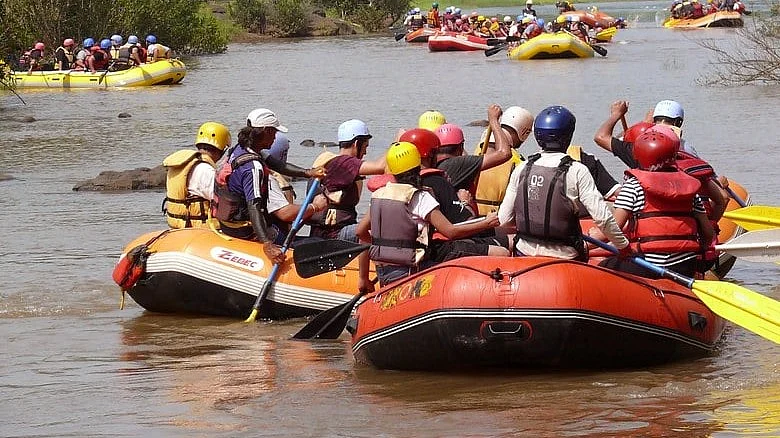
For years, the banks of the Tawi River, venerated as the "Surya Putri" or Daughter of the Sun, were marked by concrete embankments and the steady hum of city traffic. This week, the narrative shifted from transit to leisure. On January 29, 2026, the first-ever Tawi Boating Festival concluded, transforming the new artificial lake into a vibrant hub and signalling a long-awaited revival of Jammu’s urban landscape.
The two-day event, organised by Jammu Smart City Limited (JSCL), saw nearly 5,000 visitors flock to the riverfront. For many locals, seeing boats glide across the water was the realisation of a project nearly two decades in the making. What was once a vision trapped in administrative delays has now become a cornerstone of the city’s tourism strategy.
"The overwhelming public response shows the vision behind rejuvenating the Tawi riverfront. This project aims at creating vibrant, safe and accessible public spaces for citizens," Jammu Municipal Corporation Commissioner and CEO JSCL, Devansh Yadav, said.
A 16-Year Journey To The Shore
The journey to this week's festivities began in 2009, when the foundation stone for the Tawi artificial lake was laid. Marred by technical hurdles, funding gaps, and shifting political landscapes, the project missed nearly a dozen deadlines over sixteen years.
The revival gained momentum under the Smart Cities Mission, with the project modelled after the Sabarmati Riverfront in Gujarat. Executed at an estimated cost of INR 180 crore, the development integrates flood protection with recreational infrastructure. The Irrigation and Flood Control department achieved the necessary water pondage, about 3-4 metres, through a new barrage, creating a 1.5-km-long water body that now reflects the city’s skyline.


Beyond Boating: A Cultural Showcase
The festival was also a celebration of Dogra identity. As the sun set, the embankments were lit with decorative lighting, providing a backdrop for performances by local music bands. Temporary stalls offered authentic Dogra cuisine, inviting visitors to rediscover traditional flavours while enjoying the breeze off the water.
"Suryaputri Tawi has always been the centre of Jammu’s devotion," noted Dr Yadav. "With this project, it is poised to become the centre of our tourism as well."
The festival served as a successful test for safety and operations. With the State Disaster Response Force (SDRF) overseeing the trial, JSCL plans to float tenders by March 2026 to engage private entrepreneurs for permanent boating, jet skiing, and possible evening cruises.
Protecting The Lifeline: Swachhtantara 2.0
The celebrations also carried a strong message of environmental stewardship. In a striking display, hundreds of students, citizens, and sanitation workers formed a massive human chain across the Tawi Bridge and the riverfront.
This initiative, held under the banner of Swachhtantara 2.0, aimed to link the spirit of Republic Day with the goals of the Swachh Bharat Mission Urban (SBM-U) 2.0. By creating a "human wall," participants pledged to protect the river from pollution and encroachment, acknowledging that the sustainability of the new lake depends entirely on the health of the Tawi itself.
A New Stop For The Pilgrim Circuit
For travellers, the development adds a new dimension to the "City of Temples." Traditionally a transit point for pilgrims heading to the Mata Vaishno Devi shrine or the Raghunath Mandir, Jammu now offers a reason to stay an extra day.
With Phase I, a 2.7-km stretch from Bhagwati Nagar to Bikram Chowk, now operational, focus shifts to Phase II, which will extend the riverfront to Gujjar Nagar. For the people of Jammu, the Tawi is no longer just a river to cross; it is finally a destination to experience.
FAQs
1. What is the Tawi Boating Festival in Jammu?
The Tawi Boating Festival is Jammu’s first boating event, launched to promote riverfront leisure and urban tourism.
2. Where is the Tawi River located?
The Tawi River flows through Jammu and is considered the city’s lifeline and cultural landmark.
3. Who organised the Tawi Boating Festival?
The Tawi Boating Festival was organised by Jammu Smart City Limited.
4. Why is the Tawi Riverfront project important for Jammu?
It transforms the riverfront into a public leisure space while integrating flood control and tourism infrastructure.
5. Will boating on the Tawi River be permanent?
Authorities plan to introduce permanent boating and water-based activities through private operators in 2026.