“I’m extremely worried about the water, the air, the soil. I don’t even know where all this is going.”
Blue Ocean And The Crime Against The Himalayas
Filmmaker Shankar Borua’s latest thriller “Blue Ocean” uses the story of a financial fraudster to explore a larger deception: the environmental cost of unchecked development, overtourism, and ecological decline in the Himalayas

Advertisement
This is what filmmaker Shankar Borua told me when I called him one afternoon to talk about his latest film, “Blue Ocean”.
Borua, who grew up near Assam’s biodiverse Dehing Patkai rainforest and has spent years working and travelling across mountain regions, is not a climate activist in the conventional sense. Yet environmental concerns sit at the heart of his latest project. Set in Dehradun and the foothills of the Himalayas, “Blue Ocean” is a fictional crime thriller that follows undercover cop Prakash Negi as he tracks down a con artist accused of duping investors with promises of quick profits. But beneath the cat-and-mouse chase lies a larger metaphor. The fraudster at the centre of the plot is merely a stand-in for what Borua sees as a far greater deception: the belief that unchecked development, relentless construction, and ever-expanding tourism can continue in the Himalayas without consequences.
The film describes the climate crisis in the Himalayas as a criminal act or a “con job” being committed against future generations. Through its narrative of deception and pursuit, “Blue Ocean” draws parallels between financial fraud and environmental exploitation, arguing that pristine mountain ecosystems are being sacrificed in the name of progress. While the story unfolds through fictional characters, its concerns are rooted in reality—melting glaciers, disappearing forests, climate-linked disasters, and the mounting pressures of tourism and infrastructure development across one of the world’s most ecologically sensitive regions.
Advertisement

The character of Prakash Negi on Blue Ocean Shankar Borua
The timing of the film is significant. The Himalayas are becoming increasingly fragile under the combined pressures of climate change and human intervention. Scientists describe the wider Hindu Kush Himalayan region as the planet’s “Third Pole” because it contains the largest concentration of ice outside the Arctic and Antarctic. Nearly two billion people across South Asia depend directly or indirectly on water originating from these mountains.
Recent research paints a troubling picture. According to the International Centre for Integrated Mountain Development (ICIMOD), glaciers across the Hindu Kush Himalaya are now losing ice at twice the rate recorded at the beginning of this century, with some glaciers having lost up to 27 metres of ice thickness since 1975. A 2026 scientific review found that the region is warming at roughly twice the global average rate, while parts of the Central and Eastern Himalayas have already lost around 30 per cent of their snow cover since 1990. Earlier this year, ICIMOD also reported that Himalayan snow persistence had dropped to its lowest level in more than two decades, marking the fourth consecutive year of below-normal snow cover.
Advertisement
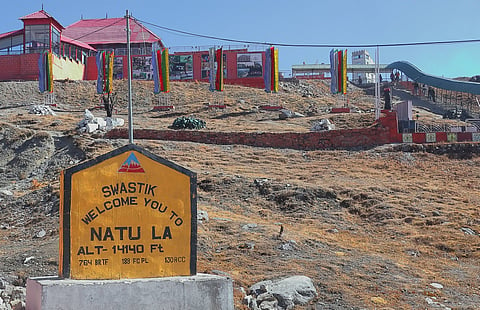
Nathu La Pass, the iconic India–China border crossing high in the Himalayas Shutterstock
The vulnerability is compounded by geology. Much of the Himalayan belt lies within one of the world’s most active seismic zones, where the Indian tectonic plate continues to collide with the Eurasian plate. The mountains remain young, unstable and naturally prone to landslides and earthquakes. Against this backdrop, expanding road networks, tunnels, hydropower projects, and tourism infrastructure have intensified concerns among scientists and environmentalists about the long-term resilience of mountain ecosystems.
For Borua, these developments form the backdrop to “Blue Ocean”. The film may be framed as a thriller, but its central question is environmental: what happens when the pursuit of growth begins to outweigh the limits of the landscape itself?
The Himalayan Climate Crisis
Rather than making a conventional documentary, Borua chose fiction deliberately. Climate narratives, he argues, are slowly entering mainstream cinema globally, but remain relatively rare in India.
“People remember stories and characters,” he says. “A documentary can come and go. But if you can engage audiences through a film format, through drama and popular culture, the message has a better chance of staying with them.”
Advertisement

A still from Blue Ocean Shankar Borua
Borua repeatedly returns to one central argument: that economic development is often discussed without a serious assessment of its long-term ecological costs.
He frames the issue as a question of cost-benefit analysis. Roads, tunnels, expressways, and tourism infrastructure may generate immediate economic gains, he argues, but their environmental consequences are frequently ignored.
“Every project has a cost-benefit analysis,” he says. “The question is: what are the long-term costs?”
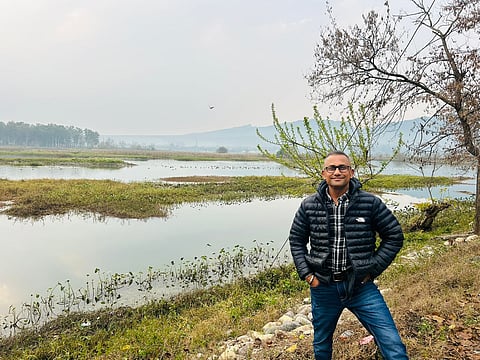
Shankar Borua at the wetlands on the way to Paonta Sahib in Himachal Pradesh, that attract a bunch of migratory birds in the winter, primarily wild ducks Shankar Borua
For Borua, recent events across the Himalayan region offer evidence that those costs are already becoming visible. Rising temperatures, erratic weather patterns, glacial retreat, cloudbursts, landslides, and land subsidence have increasingly become part of public discourse in mountain states.
He points to large-scale forest clearance and expanding infrastructure networks as signs of a development model that may be pushing ecological systems beyond their limits.
The metaphor of the financial scam running through “Blue Ocean” emerges directly from this concern. In Borua’s view, the promise that continuous development can proceed without significant environmental consequences resembles a Ponzi scheme: immediate benefits are highlighted, while future liabilities are passed on to generations yet to come.
Advertisement
“If we know the consequences and continue anyway, then future generations will pay the price,” he says.
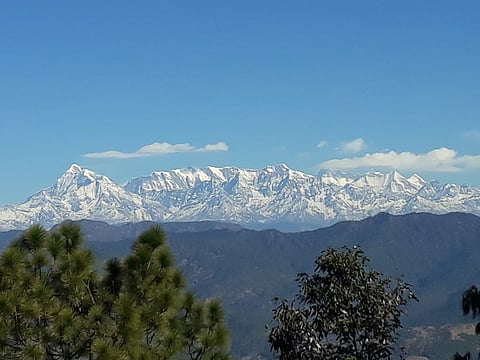
The Himalayas Shankar Borua
Tourism, Overtourism, And The Himalayan Question
While tourism often becomes a focal point in debates about mountain sustainability, Borua is careful not to frame tourism itself as the villain.
“The argument of the film is not that tourism is bad,” he says. “The bigger question is how much we are willing to sacrifice in the name of development.”
Yet he acknowledges that overtourism has become increasingly visible across Himalayan destinations. Places once marketed as “offbeat” are now experiencing pressures similar to those seen in established tourist hubs.
From Chakrata and Tirthan Valley to Mussoorie and Nainital, visitor numbers have surged in recent years. Borua believes carrying capacities need greater attention and that mountain destinations cannot absorb unlimited growth.
He cites Bhutan’s tightly regulated tourism model as one possible example of balancing economic activity with environmental protection.
Advertisement
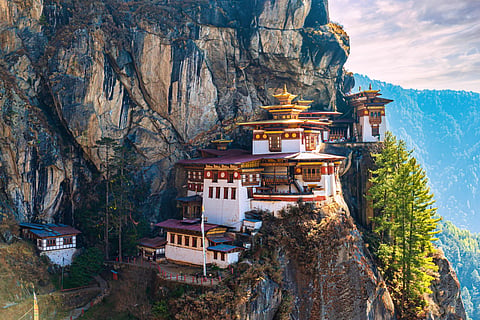
Taktshang Goemba (Tiger’s Nest) Monastery, Bhutan Shutterstock
For Borua, the issue extends beyond visitor numbers. He questions whether tourism should remain the primary development pathway for mountain communities.
“Why is tourism the only answer?” he asks. “Why can’t there be other forms of economic activity that allow people to remain connected to their land without depending entirely on visitors?”
He also raises concerns about social changes accompanying rapid tourism growth, including pressures on local culture, rising alcohol consumption, and shifts in traditional livelihoods.

A matriarch from Kumaon Shankar Borua
The Crisis Beyond Landslides And Glaciers
When discussions about the Himalayas emerge in public discourse, they often focus on dramatic events such as landslides, floods and melting glaciers. Borua believes other consequences receive far less attention.
Among them is migration from mountain villages. Across parts of Uttarakhand and other Himalayan regions, many settlements have witnessed population decline as younger residents move to cities in search of work.
Borua argues that a different development model—one built around local entrepreneurship, regenerative agriculture and environmentally compatible industries—could help reduce such migration pressures.
Advertisement
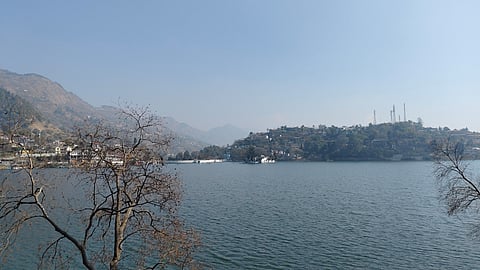
The Bhimtal Lake, Uttarakhand Anwesha Santra
He also points to less visible consequences of environmental degradation, including climate anxiety and mental health concerns. For him, climate change is not merely a scientific or policy issue; it is increasingly affecting people’s daily lives, health, and sense of security.
The filmmaker draws on personal experience as well. Originally from Assam’s Dibrugarh district and raised near the biodiverse forests of Dehing Patkai, he says witnessing ecological change over decades has shaped his worldview.
A Message For Travellers
If there is one message Borua hopes audiences take away from “Blue Ocean”, it is remarkably simple.
“Do not litter the mountains. Leave no trace behind.”
The principle appears repeatedly in the film through scenes inspired by real-life incidents. Borua recounts the story of a woman from the hills who confronted a group of tourists and refused to leave until they cleaned up the waste they had left behind.
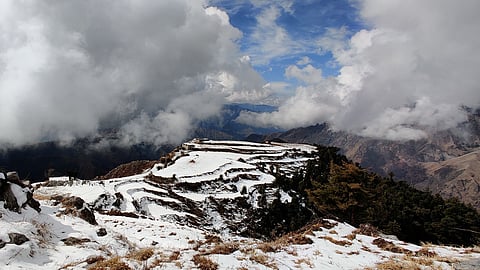
Snowcapped mountains in Chakrata Shutterstock
For him, environmental responsibility cannot be outsourced entirely to governments or conservation agencies. Individual behaviour matters, particularly in ecologically sensitive regions.
Advertisement
The larger lesson, however, is philosophical. Borua argues that rivers, forests, and mountains are not assets that belong to any single generation.
“We don’t own these places,” he says. “We are only custodians.”
That idea lies at the heart of “Blue Ocean”. The film’s con artist may be fictional, but Borua suggests the deception he is really interested in exposing is one that extends far beyond the screen: the belief that nature can be endlessly exploited without consequence.
Whether audiences agree with that argument or not, “Blue Ocean” seeks to place a question before viewers that is becoming increasingly difficult to ignore: who ultimately bears the cost of development when the ecological bill comes due?
FAQs
1. What is Blue Ocean about?
Blue Ocean is a crime thriller by filmmaker Shankar Borua that uses the story of a financial fraudster to explore climate change, overtourism and environmental degradation in the Himalayas.
Advertisement
2. Who is Shankar Borua?
Shankar Borua is an Indian filmmaker whose work often engages with environmental themes. His film Blue Ocean focuses on the ecological challenges facing the Himalayan region.
3. Why are the Himalayas considered environmentally fragile?
The Himalayas are geologically young mountains located in an active seismic zone. Climate change, glacier retreat, landslides, infrastructure projects and overtourism have increased ecological pressures across the region.
4. How is tourism affecting the Himalayas?
Rapid tourism growth has led to increased waste generation, pressure on local resources, infrastructure expansion and concerns about carrying capacity in several Himalayan destinations.
5. What is the central message of Blue Ocean?
The film argues that unchecked development and environmental exploitation come with long-term costs, urging policymakers, communities and travellers to adopt more sustainable approaches to growth and tourism.
Published At: