Maharashtra Tourism Policy: Santosh Jadhav On Investment, MICE Expansion And Youth Skill Development
From attracting ₹1,00,000 crore in private investment to expanding MICE capacity and empowering youth, Santosh Jadhav, Joint Director, DoT, details Maharashtra’s strategy for sustainable tourism growth

How do Maharashtra’s tourism policies support private investment in the sector?
The Tourism Policy 2024 serves as our blueprint to position Maharashtra among the world’s leading tourism investment destinations. It sets ambitious targets to attract ₹1,00,000 crore in private investment over the next decade, spanning hospitality, cultural tourism, and infrastructure, while generating approximately 18 lakh direct and indirect jobs across hospitality, transport, and local services.
To catalyse private investment, the policy offers a comprehensive suite of incentives. Investors can avail a capital subsidy of up to 15% (maximum ₹15 crore), a 5% interest subsidy on loans (maximum ₹50 lakh), electricity duty exemptions, stamp duty and registration fee waivers, and SGST reimbursement on tourism-related services. Certified eco-friendly or low-carbon tourism projects are eligible for enhanced capital subsidies and priority clearances under the Green Incentives framework, encouraging sustainable infrastructure development.
The policy also emphasises balanced regional growth by offering higher incentives for projects in rural and underdeveloped areas, ensuring that tourism benefits reach all parts of the state. Additionally, it promotes inclusive development by supporting women entrepreneurs and marginalised communities. Together, these measures aim not only to boost tourism investment but also to create sustainable livelihood opportunities across Maharashtra.
The Maharashtra Convention Bureau (MCB) was launched internationally at IMEX Frankfurt. What international outreach and partnerships have been secured so far? What steps are being taken to decentralise MICE capacity beyond Mumbai?
Since its launch at IMEX Frankfurt, the Maharashtra Convention Bureau has prioritised international outreach by building partnerships with global associations, participating in international trade shows, and securing memberships in leading MICE networks. The Bureau’s structure includes allied memberships for international organisations and association bodies, enabling direct collaborations and joint bidding initiatives.
Bidding for major international conventions has already commenced, supported by subvention schemes to attract global organisers. The Bureau is authorised to negotiate with international associations, governments, and industry bodies to bring high-profile events to Maharashtra.
Decentralisation is a key priority. The Bureau’s Governing Board includes municipal commissioners from Pune, Nagpur, Nashik, and Chhatrapati Sambhajinagar, thereby expanding MICE infrastructure beyond Mumbai. The Bureau has the authority to develop and manage convention facilities in Tier-II and Tier-III cities, with dedicated budgets allocated for pipeline venues in these emerging centres.
By 2030, Maharashtra aims to host at least 10 major international conventions annually across both metro and emerging cities, strengthening its position as a diversified and future-ready MICE destination.
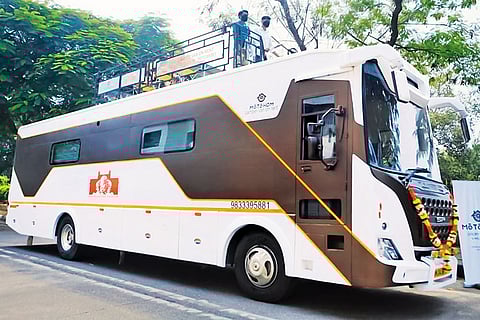
What strategies will bring Caravan Tourism into the spotlight as an alternative to traditional accommodation?
The Maharashtra Caravan Tourism Policy reimagines travel by focusing on flexibility, accessibility, and immersive experiences beyond conventional hotels.
The strategy highlights the freedom caravans offer by designating sites in remote and scenic locations, such as fort foothills, dam premises, and forest buffer zones. This opens access to destinations that traditional hotels may not reach, allowing travellers to experience Maharashtra’s landscapes more intimately.
To ensure quality and safety, the policy mandates certified Caravan Parks equipped with essential utilities, waste management systems, security, and tourist assistance. Fiscal incentives, including GST and duty waivers, encourage private investment in well-managed facilities.
Operator training in hygiene, hospitality, and service standards ensures professionalism, while streamlined, time-bound forest and environmental clearances facilitate ease of operation. With eco-safeguards such as regulated waste disposal and controlled visitor limits, caravan tourism offers a sustainable and adventurous alternative within Maharashtra’s tourism portfolio.
How will the Youth Tourism Club initiative help shape a culture of responsible tourism and youth participation?
As part of the Government of India’s initiative during the 75th year of Independence, accredited schools and colleges have been encouraged to establish Youth Tourism Clubs for students in grades 7 and above. Each school club receives a grant of ₹10,000, while college clubs are eligible for ₹25,000, with a total allocation of ₹25 crore for the programme.
Proposals submitted to the Directorate of Tourism are considered on a first-come, first-served basis. Beyond financial support, the initiative promotes activities such as heritage site adoption, guided walks, conservation drives, and cleanliness and eco-awareness campaigns in tourist zones.
These hands-on engagements aim to nurture youth leadership and foster civic responsibility toward tourism. The programme ensures that young citizens do not merely experience tourism but actively contribute to shaping its future.
How does the NaMo Tourism Skill Training Programme align youth development with Maharashtra’s vision of becoming a globally recognised tourism hub?
The NaMo Tourism Skill Training Programme bridges Maharashtra’s youth with the state’s expanding tourism economy. Under this initiative, 7,500 local men and women will receive professional training in hospitality and tourist guiding at sites across the state, including UNESCO-recognised heritage forts.
The programme is implemented through reputed national institutions such as the Indian Institute of Tourism and Travel Management in Gwalior and the Maharashtra Institute of Hotel Management and Catering Technology in Solapur, under the Directorate of Tourism. Training has already commenced at key heritage locations with strong participation from local youth.
By building skilled manpower, the programme strengthens the local economy and reinforces Maharashtra’s ambition to be recognised globally as a culturally rich, service-oriented, and professionally managed tourism hub.