If you have an active social media profile, you’ve probably already seen it by now: a GRWM (Get Ready With Me) reel from Prime Minister Narendra Modi, urging Gen Z to film themselves getting dressed in handloom and post it online, ahead of today’s National Handloom Day. It’s spread quickly across Instagram and X over the past day. Whatever one makes of the format, it’s a reminder that this day exists, and worth asking why.
National Handloom Day 2026: The Threads India Is Losing
As India marks National Handloom Day, six textile traditions—from Toda embroidery to Patan’s double-ikat Patola—survive on the hands of a dwindling few

Advertisement
National Handloom Day was launched in Chennai in 2015; this year marks its 12th edition. The Ministry of Textiles is holding the main event at the Rashtrapati Bhavan Cultural Centre in Delhi, with President Droupadi Murmu as the chief guest, 22 weaver awards, live demonstrations of Kani weaving, and the release of four commemorative postage stamps.
Why August 7 Is National Handloom Day
The date isn’t arbitrary. On August 7, 1905, in Kolkata’s Town Hall, Indians launched the Swadeshi Movement—a boycott of British goods, textiles chief among them, and a call to revive domestic industry as an act of political resistance. It was one of the first mass economic protests in the freedom struggle, and homespun cloth became its most potent symbol: a rejection of the mills of Manchester. That thread runs through the rest of the century—Gandhi’s charkha, the Khadi movement, and the post-Independence push to protect weaver livelihoods through cooperatives and, later, Geographical Indication tags.
Advertisement

Gandhi as captured by Margaret Bourke-White ollections.artsmia.org
The stakes are still substantial. Per the Ministry of Textiles, India’s handloom sector supports the livelihoods of more than 35 lakh people, with women accounting for over 70 per cent of that workforce—one of the largest cottage industries left anywhere in the world, still worked almost entirely by hand.
The Silk Weavers
Last year, when I travelled to Murshidabad for its Heritage Festival, I ended up wandering into Tantipara, the old weavers’ quarter that once supplied silk to Mughal royalty and European trading companies. Inside a modest house, a weaver sat bent over a pit loom sunk into the floor, feet working the treadles, hands guiding the shuttle back and forth between rows of starched Garad silk thread—the kind traditionally worn for religious rituals because of its purity of white and red. He told me a single saree takes him four to five days, that a broken thread can undo a full day’s work, and that he still earns less than 500 rupees a day for it.
Advertisement
Murshidabad’s silk trade is nearly 300 years old and once made the region a global commodity centre; today, the number of active looms in some of its villages has fallen from 400 to under 70, and its Garad and Korial silks were granted GI status only as recently as January 2024, alongside its far more famous Baluchari, which has carried GI protection since 2011.

A weaver from Tantipara in Murshidabad, working on a garad saree Anwesha Santra
I have been to Banaras and found a very different, but equally precarious, version of the above story. In the narrow lanes of Madanpura and Alaipura, weavers work Banarasi brocade on looms strung with silk and real zari, building up motifs—paisleys, floral jaal, Mughal-era meenakari colourwork—thread by thread, sometimes over weeks for a single saree. Banarasi weaving has carried a GI tag since 2009, meant to separate genuine handloom from the power-loom “Banarasi-style” sarees flooding the market from Surat. It hasn’t been enough to stop the exodus: rising power tariffs, cheap machine-made imitations, and the pandemic have pushed entire weaving families out of the trade in the past decade, and the average age of a master weaver in the city's clusters keeps climbing as fewer sons pick up the loom their fathers sat at.
Advertisement
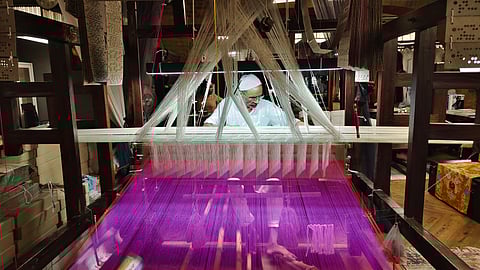
A weaver working at his loom in Banaras Anwesha Santra
Both crafts are still, technically, alive—GI tags, awards, government schemes, and enough of a luxury market to keep the biggest names afloat. But sitting beside those looms, what struck me was how much of it depended on one person’s hands, that day, choosing to keep going.
That’s a smaller version of a much larger pattern playing out across India’s craft map. Behind the aggregate numbers of the handloom sector is a thinner story: dozens of hyper-local, centuries-old weaving and embroidery traditions, each tied to a specific river, forest, tribe, or royal court, several of which are now down to single-digit numbers of people who still know how to make them. Here are six.
Toda Embroidery, The Nilgiris
Practised exclusively by Toda women in the hill hamlets of the Nilgiris, this red-and-black embroidery (locally called pukhoor) is worked entirely by counting threads by hand, without a hoop, frame, or printed guide. The work is done using a darning stitch from the reverse side of the fabric by counting the warp and weft. Linguist Murray Emeneau, who studied the Toda language, recorded nine distinct embroidery designs as far back as 1937; today, artisans and researchers count more than 15 named motifs in active use, with new ones still occasionally added to the repertoire. Among the oldest and most recognised are twehhdr pukhoor (pattern in pairs), meettoofykonn pukhoor (a peacock motif), pat pukhoor (vulture), kopaan pukhoor (butterfly), kadg pukhoor (drawn from the Nilgiri wild rose), and pob pukhoor (snake).
Advertisement

The Toda community of the Nilgiris Shutterstock
The Toda population itself is tiny. The 2011 Census recorded 2,002 people across roughly 69 settlements, and estimates of how many still practise the embroidery vary widely depending on who’s counting: Ooty-based social enterprise Shalom puts active embroiderers at 250 to 300 women, other craft researchers cite closer to 200 working across 10-12 villages, and an earlier survey had put the number engaged in embroidery work nearer 400. The GI tag it received in 2013, backed by the Toda Nalavaazhvu Sangam, the Keystone Foundation, and Poompuhar, means only Toda-made, hand-counted embroidery can legally carry the name—a real legal safeguard, but one that hasn’t on its own guaranteed a next generation of artisans to carry the craft forward.
Kotpad weaving, Odisha
In the Koraput district of southern Odisha, the Mirgan weaving community has for generations produced Adivasi Pata—cotton saris, dupattas, and gamchas dyed a distinctive earthy maroon using the root and bark of the Aal tree (Indian madder, Morinda citrifolia), fixed with cow dung, wood ash, and castor oil in a process that involves no synthetic chemicals at any stage. The weaving itself is done on antique throw-shuttle pit looms, and the motifs, drawn from local flora, fauna, animistic beliefs, and everyday life, traditionally served as a visual code, with individual patterns marking the identity, gender, or rites of passage of the neighbouring tribal communities (the Dhurva, Muria, Kondh, and others) for whom the Mirgans wove. It became Odisha’s first GI-tagged textile in 2005, a recognition of nearly 2,000 years of documented sericulture and weaving history in the region.
Advertisement

Kotpad handloom from Koraput Deposit Photos
The numbers tell a starker story than the history does. Documentation by the World Crafts Council-Asia Pacific found that only 18 weaving households remain active in Kotpad today, even after some families entered new markets and product lines specifically to slow the decline. The threats compound each other: cheaper synthetic clothing has eroded the tribal patronage that once reliably bought Kotpad fabric for ceremonial use; deforestation and forest-use regulations increasingly threaten access to the wild Aal trees the dye depends on, with no guarantee of the raw material’s future availability; and the craft remains largely unknown outside Odisha despite holding the state’s very first GI tag.
Pattamadai mats, Tamil Nadu
In the village of Pattamadai on the banks of the Thamirabarani river in Tirunelveli district, the Muslim Lebbai community has for centuries harvested korai grass (Cyperus corymbosus) and split it by hand into strands as fine as a hundredth of an inch, weaving it into silk mats (pattu pai) so smooth and pliable they can be folded like a handkerchief. The tradition dates back to ancient references to ceremonial mat-weaving in the Atharva Veda and reached global attention in 1953, when Pattamadai artisans wove a coronation mat for Queen Elizabeth II, which today hangs in Buckingham Palace. The finest mats are graded by count—100, 120, and up to 140—with the highest grade so labour-intensive that an artisan can weave no more than about six inches of it in a full day, and a single mat can take up to four months from harvest to finish.
Advertisement

Men making Pattamadai mats Wikipedia
The craft, GI-tagged in 2012–13, has undergone a quiet demographic shift: once a male-dominated trade, it is today carried almost entirely by women of the Lebbai and Rowther communities. Demand has fallen sharply since the mid-20th century as cheap plastic and synthetic mats have replaced the traditional pai in most Tamil households, leaving the weave largely dependent on ceremonial and wedding-gift markets rather than everyday use. There is a note of possible revival, though: recent research by engineering academics has found that Pattamadai mats have genuine acoustic soundproofing properties, opening a potential non-traditional market, from recording studios to noise-guarded classrooms, that the ageing weaving households have only just begun to explore.
Mishing textiles, Assam
The Mishing, the second-largest plains tribe of Assam and part of the wider Tani cultural family that stretches into Arunachal Pradesh and Tibet, weave on backstrap looms set up largely by women, producing garments like the ege gasor and gero for daily wear and for the community’s two major festivals: Ali-Aye-Ligang, the spring sowing celebration, and Po:rag, the post-harvest thanksgiving.
Advertisement

Mishing women in traditional attire Wikimedia Commons
The textiles are known for nature-inspired motifs—floral, animal, and geometric patterns that, according to community elders, were originally designed to resemble tiger stripes so that people could camouflage themselves in the forest for safety. Mishing weavers are noted for a technical skill rare even among India’s handloom traditions: the ability to weave in seven colours simultaneously, using an indigenous design vocabulary called ghai-yamik.

Traditional dress of the Mishing tribe Wikimedia Commons
Unlike several other crafts on this list, Mishing weaving is not dying from neglect so much as being reshaped by geography. The tribe lives largely in flood-prone areas of the Brahmaputra plains, and recurring floods and shrinking cultivable land have pushed many Mishing men to migrate for wage labour, leaving weaving—traditionally a domestic, non-commercial skill passed from mother to daughter—to become a primary economic anchor for entire households. In response, weaving cooperatives, often run under bodies like the Mising Autonomous Council, have begun connecting artisans to wider markets, including online sales. The tradition received formal GI certification only in March 2024, a relatively recent recognition for a craft with a documented history stretching back generations, and one that community organisations hope will help convert a subsistence skill into a more secure livelihood.
Advertisement
Patan Patola, Gujarat
Patan Patola is widely regarded as the most technically demanding handloom tradition in India: a double-ikat silk weave in which both the warp and weft threads are separately tie-dyed (a technique called bandhani) with such mathematical precision that the pattern only fully resolves once the two are woven together, with no room for correction. Legend and inscription trace the craft to the 12th century, when King Kumarpal of the Solanki dynasty is said to have invited 700 Salvi weaving families from Jalna in southern Maharashtra to settle in Patan; a completed sari can take anywhere from six months to three years, involves roughly eight skilled workers at different stages, and is worked from patterns first calculated on graph paper before a single thread is dyed.
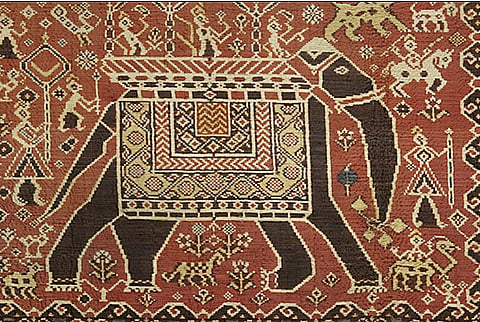
A patola ikat from Gujarat, Patan, woven in the early 19th century Wikimedia Commons
Of those original 700 families, the number still practising authentic double-ikat weaving has collapsed to a handful—by 1965, only four Salvi families remained in the trade, and current counts put the figure at somewhere between three and five families, with the Salvi lineage the most prominent among them. The knowledge has historically been held within family lines and passed from father to son and mother to daughter-in-law, with no tradition of teaching outside the bloodline, meaning the craft’s survival now depends on individual family decisions rather than any institutional pipeline. Patan Patola received GI protection in the early 2000s (registration number 232, among the earliest in India), and the Salvi weavers’ association now issues its own certificate of authenticity with every genuine piece—a legal and commercial safeguard for a craft where a finished sari can sell for well over a lakh of rupees, but one that does nothing to widen the pool of people who actually know how to make it.
Advertisement
Chamba Rumal, Himachal Pradesh
Chamba Rumal is often described as “paintings in embroidery”, a double-sided needlework tradition from the former princely state of Chamba in Himachal Pradesh, in which Pahari miniature artists first sketch scenes from the Ramayana, the Mahabharata, or Radha-Krishna legends onto fine muslin, which women then embroider using an untwisted silk-thread technique called dorukha, so precise that the image appears identical and flawless on both faces of the cloth. Its origins are dated to the 17th century, under the patronage of Raja Prithvi Singh, who brought embroiderers from the Mughal court to Chamba; the earliest surviving example is attributed to Bebe Nanaki, sister of Guru Nanak, in the 16th century, and a 19th-century rumal depicting the Kurukshetra war was gifted to the British in 1883 and now sits in London’s Victoria & Albert Museum.

Chamba Rumal of Himachal Pradesh Wikipedia
The craft nearly disappeared after Independence, when the royal patronage that had sustained it for over two centuries dried up almost overnight, and it was flooded with cheap imitations that further eroded its market. Revival efforts beginning in the late 1970s, led first by Usha Bhagat and later by Padma Shri and Nari Shakti Puraskar awardee Lalita Vakil, brought original designs back from museum archives and retrained local women in the traditional technique, pulling the craft back from what multiple accounts describe as the brink of extinction. It has held a GI tag since 2007, but reliable numbers on how many artisans can still execute the finest court-style dorukha stitch are scarce—practitioners and craft historians generally describe the pool as small and ageing, concentrated in and around Chamba town, with the tradition’s survival now resting heavily on a handful of trained revivalists and the students they’ve been able to teach.
What’s Actually At Stake
Each of these crafts is protected on paper. Most carry a GI tag; several have dedicated NGOs, cooperatives, or state schemes working alongside the artisans. None of that has solved the underlying economics: these are skills that take years, sometimes a lifetime, to master properly, pay poorly relative to the hours and precision they demand, and compete for the next generation's time with jobs in cities that offer steadier income and far less physical strain. A GI tag prevents others from copying the name and selling a counterfeit. It does nothing to ensure handloom work pays enough for a young weaver to choose it over migrating to wage labour.

A weaver from Assam on her loom Arpan Uzir
That’s the quieter argument behind today’s push to get people buying handloom directly. A reel won’t teach anyone to weave a Patola or count out a Toda motif. But it can put money directly into the hands of the artisans who still know how—the 18 households left in Kotpad, the few hundred women left in the Nilgiris, the three or four families left in Patan—and buy these traditions the one thing every account of their decline keeps circling back to: a livelihood worth staying in.
FAQs
1. Why is National Handloom Day celebrated on August 7?
National Handloom Day commemorates the launch of the Swadeshi Movement on August 7, 1905, when Indians boycotted British-made textiles and promoted indigenous handwoven fabrics.
2. Which are some endangered handloom traditions in India?
Toda embroidery, Kotpad weaving, Pattamadai mats, Mishing textiles, Patan Patola, and Chamba Rumal are among India's rare traditional crafts facing declining numbers of artisans.
3. What is a GI tag in handloom?
A Geographical Indication (GI) tag legally protects textiles that originate from a specific region and are made using traditional methods, helping distinguish authentic products from imitations.
4. Why are India's traditional weaving communities declining?
Low incomes, competition from machine-made products, rising production costs, migration, and fewer young people entering the profession have contributed to the decline of many traditional weaving communities.
5. How can travellers support India's handloom artisans?
Buy authentic handloom products directly from artisan cooperatives, certified GI producers, local weaving clusters, museums, and government-run emporiums to ensure more of the income reaches the craftspeople.

Published At: