Every few minutes on the road to Ladakh, I found myself checking on my father. Was he hydrated? Was his gear fine? Which line was he taking through the water?
From The Latest Issue: A Father-Son Motorcycle Journey Through Ladakh And Beyond
Adventure changes with age, from chasing activities to noticing people, places and moments that refuse to be planned

Advertisement
“We’ll just go through it,” he would say.
He was 62 and had just retired after almost 40 years in the Indian Army. Yet, suddenly, I was the one telling him how to take a motorcycle through a water crossing. At night, everybody would sit around asking Dad questions and listening to his stories. By day, he was learning from me. Once, after his bike had a puncture, he rode pillion with me for a few hours. It was a complete role reversal, and one of the best journeys of my life.

At Barnawa, Baghpat, linked to the Mahabharata’s Lakshagriha
Travel has always been tied to my family. Before MTV, I travelled for competitive sport, and before that, my father’s Army postings kept moving us around India. Maybe, that is why I’ve always felt there is a difference between arriving somewhere and actually travelling through it.
When you cross into a state on a motorcycle, you feel it change. In India, every 100 km, something shifts: the clothes, food, language, colours, trees, architecture, even the games children are playing. You begin to notice what people grow, how towns and villages are built and what everyday life looks like beyond the main cities.
Advertisement
Had everything gone as per plan, we might have visited a tea estate, taken photographs and left. Instead, experiencing it through someone who lived there stayed with me
Cycling slows it down even further. You can watch somebody working in a field or take in a landscape for minutes rather than seconds. The journey itself starts telling you where you are. Sometimes it does that by completely ruining your plans.
Years ago, during a motorcycle ride through Assam, floods had left stretches of road full of slush, mud and water. Ten kilometres that should have taken minutes took us nearly three hours. Our gear was soaked, we were exhausted, and darkness was approaching in an area where we had been advised not to travel at night.

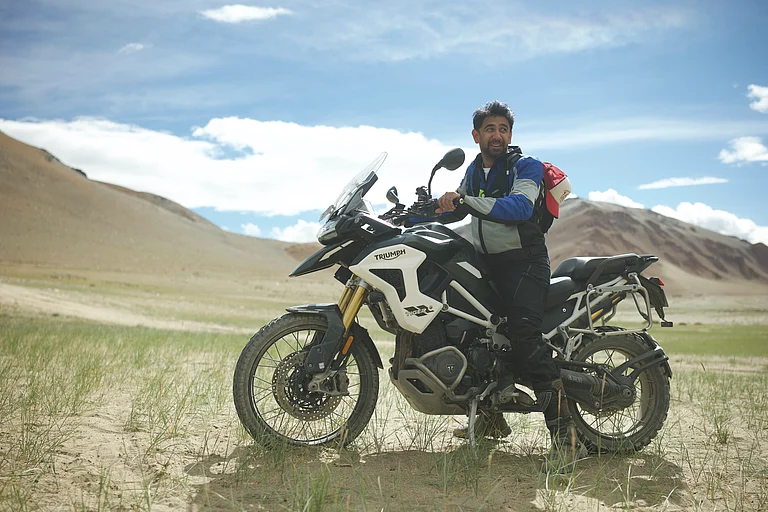
With his father on a motorcycle journey through Ladakh
Someone helped us find space at a tea estate. There were 11 of us and one room, but we got hot showers, dry clothes and food. The general manager sat with us, told us stories about the area and later took a few of us to a nearby village to pick up dinner. Had everything gone according to plan, we might have visited a tea estate, learnt how tea was processed, taken photographs and left. Instead, we experienced it through somebody who lived there. I remember that far more clearly.
Advertisement
Over time, I’ve realised that some of the journeys that stay with me most are the ones that introduce me to the people behind a place. I felt that again while filming “Safari India,” a wildlife series I hosted across India’s national parks and sanctuaries. You might enter a forest thinking mainly about wildlife. Spend enough time there, and you begin to see everything around it: water, villages, forest officers, scientists and the people who have dedicated their lives to protecting these places. I remember young women forest officers riding through the forest on motorcycles, communicating over walkie-talkies, completely at home there.

Kaali hugs Singha’s leg at Pakke Tiger Reserve in Arunachal Pradesh
Then there was Kaali, an orphaned bear being prepared for rewilding, who unexpectedly came over and hugged my leg. I had been missing my children during that trip, so the moment hit me differently. You cannot plan something like that.
Looking back, this way of travelling probably began much earlier. Sundays in an Army family could mean cycling to an orchard, hiking somewhere or figuring out how to cross a stream. We stayed in officers’ messes, campsites and people’s homes. Without knowing it, we were building a kind of muscle memory for travel and adventure.
Advertisement
Adventure felt normal to us. What I wanted from it, though, changed as I grew older. When my friends and I were younger, economics decided everything. We might have to choose between eating out and spending that money on river rafting. We were greedy about activities. Now I still want some adventure, but I also want the history, the food and the life of the place.
Since becoming a parent, I keep reaching places and thinking, I wish my kids were here. I want to take them across India slowly.
Rajasthan should be Rajasthan, not one stop squeezed into a larger holiday. The Northeast will need several journeys because you cannot do it in one. I want them to have the time to take a place in.
And one day, I want to return to that road to Ladakh with my children on motorcycles, riding beside me. Maybe by then the role will reverse again. I’ll be the older man they are checking on, and they’ll be telling me which line to take through the water.
Advertisement
I hope I still say, “We’ll just go through it.”
—As told to Kartikeya Shankar
Looking for more such exciting and meaningful stories? Grab our latest issue on Amazon.
Published At: